Configuration spaces
summer school
University of Michigan
25–29 May 2026

General information
This workshop is on configuration spaces and braid groups in algebraic topology. It is aimed at graduate students and early-career researchers in geometry, topology, and related fields. The schedule will include research talks, in addition to talks delivered by participants in the style of the Talbot Workshops.
| Dates: | 25–29 May 2026 |
| Location: | University of Michigan in Ann Arbor, USA |
| Organizers: | Jeremy Miller and Jenny Wilson |
This conference is supported by the National Science Foundation (CAREER DMS-2142709) and the University of Michigan.
Faculty speakers
Nir Gadish
Zachary Himes
Rita Jiménez Roland
Jeremy Miller
Peter Patzt
Andreas Stavrou
Phil Tosteson
Nicholas Wawrykow
Participants
Tatiana Abdelnaim
Evgeniya Akhmedova
Sarah Anderson
Emmanuel Asante
Gregory Borissov
Fabio Capovilla-Searle
Ayako Carter
Ari Davidovsky
Ethan Dlugie
George Domat
Sam Freedman
Akash Ganguly
Atharva Gawde
Ryan C. Gelnett
Skyler Hudson
Faye Jackson
Trevor Karn
Aaron Kim
Sergio Lenis
Vivian De León Ramos
Amy Li
Trent Lucas
Sydney Mayer
Dan Minihan
Andres Moran Lamas
Maria Morariu
Aru Mukherjea
Urshita Pal
Anuvertika Pandey
Devayani Pradhan
Lauren Pusey-Nazzaro
Sidhanth Raman
Samuel Restoy Berganza
Pratik Roy
Gahl Shemy
Aislinn Smith
Reena Somani
Summer Sun
Lucas Williams
Zhong Zhang
Zhi Zhou
Jacob Zweifler
Topics for expository talks
Participant speakers will be asked to submit notes on their talk for feedback, and give a practice talk to another participant, several weeks before the summer school.
Participant non-speakers may be asked to watch a participant's practice talk and provide feedback, and to tex up notes one of the talks from the workshop.
Schedule
The conference will be held at the University of Michigan's central campus in Ann Arbor.All talks will take place in East Hall, in the Basement Floor Room B844.
Refreshment breaks will be in the East Hall Upper Atrium (Room 2061).
Note from the organizers: We tried to record the conference talks, but, unfortunately, the video quality is poor. We nevertheless decided to post some of these recordings in case they are useful as a supplement to the notes. See the "video" links in the schedule below.
| Monday May 25 |
Tuesday May 26 |
Wednesday May 27 |
Thursday May 28 |
Friday May 29 |
|
|---|---|---|---|---|---|
Abstracts
A brief introduction to representation stability (Slides)Rita Jiménez Rolland
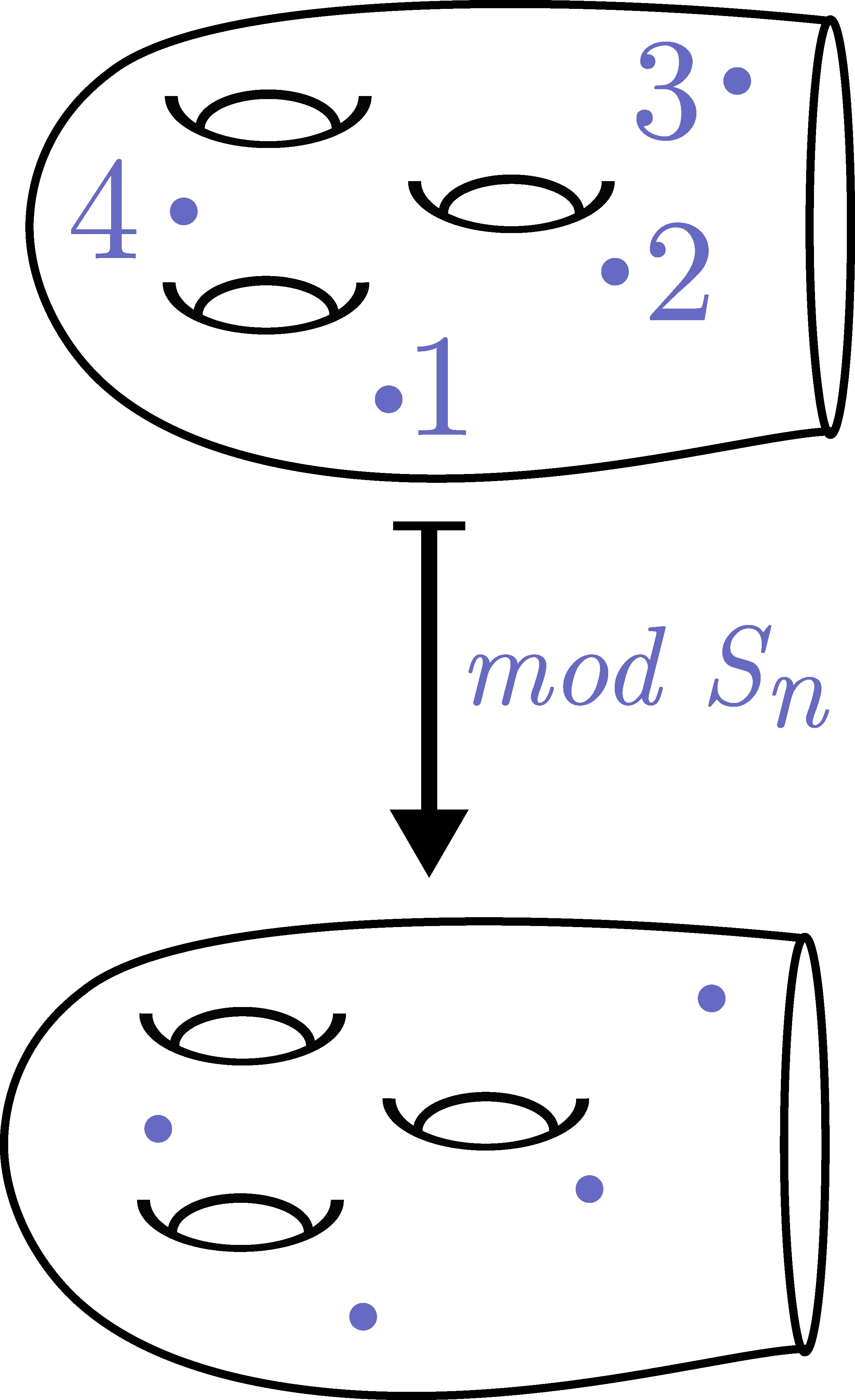
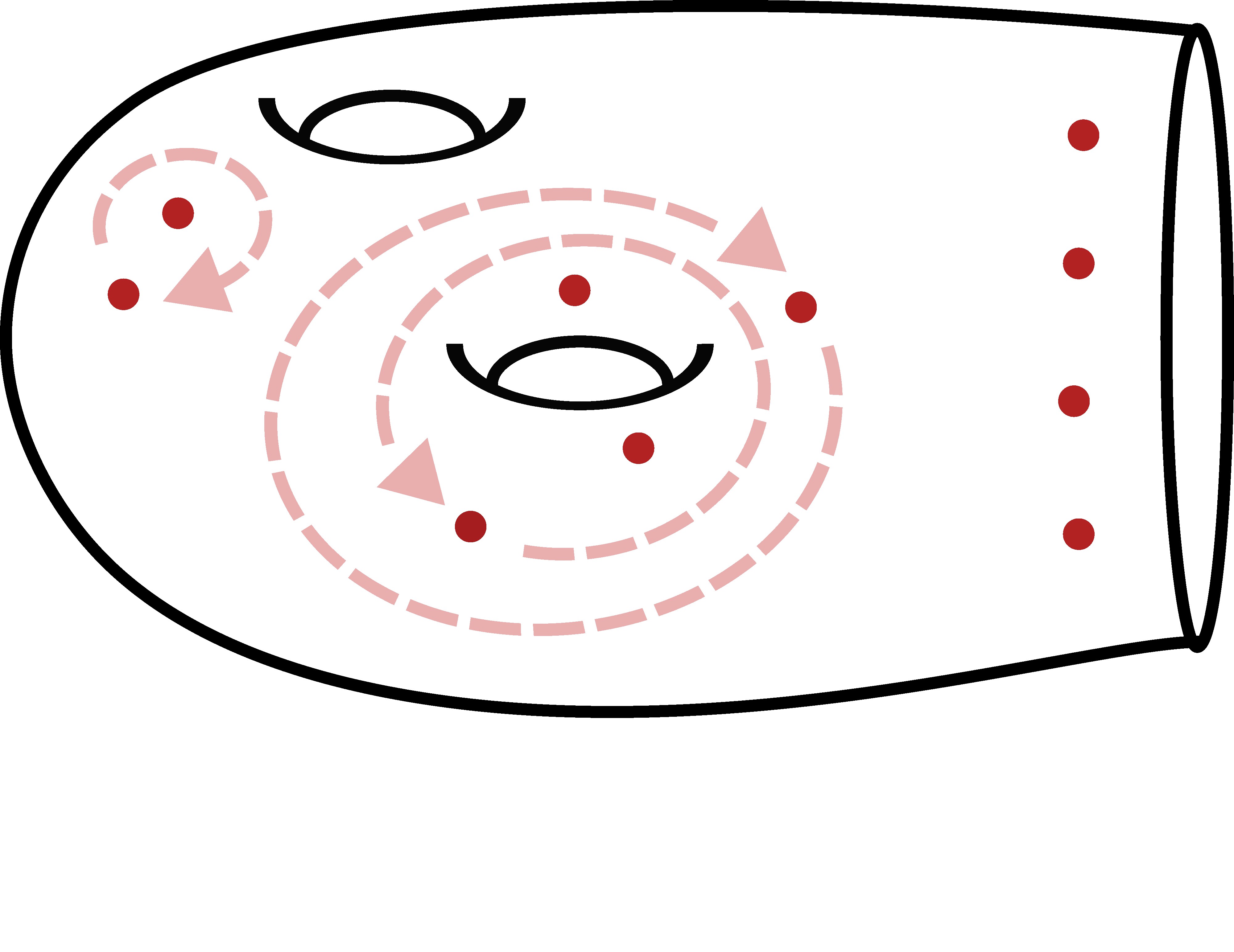
In this talk we will consider some natural families of groups and topological spaces Xn where the presence of symmetries rule out classical homological stability. Our discussion will include the case of configuration spaces of ordered n-tuples of distinct points in a manifold, pure braid groups on n strands and pure mapping class group of surfaces with n marked points. In each case, X_n carries a natural action of the symmetric group S_n on n letters, and has Betti numbers that grow with n. By focusing on these examples, I will give a brief introduction to representation stability, a framework that formalizes a representation-theoretic sense in which the (co)homology groups of these X_n stabilize.
Periodic homological stability for configuration spaces (Notes) (Video)
Zach Himes
McDuff and Segal showed that the homology of unordered configuration spaces of non-compact manifolds stabilizes as the number of points increases. Unlike for non-compact manifolds, the homology of unordered configuration spaces of compact manifolds does not stabilize in general. But, if you take homology with certain coefficients, then there still are homological stability patterns for configuration spaces of compact manifolds. I will talk about one such pattern for homology with F_p coefficients discovered independently by Nagpal and Cantero–Palmer called periodic homological stability. I will present a proof of this pattern due to Kupers–Miller.
The 15 Puzzle and homological stability in the space direction (Slides)
Nicholas Wawrykow
The 15 puzzle is a game that tasks the player with sliding 15 numbered squares around a 4 by 4 rectangle to reach a target configuration. Because there is only one unoccupied square in the rectangle, this puzzle can be incredibly challenging if not impossible, though it becomes significantly easier if we make the rectangle a little bit bigger. One can interpret this fact as a homological stability result. In this talk, we generalize this idea by considering the ordered configuration space of n open unit squares in the w by h rectangle. We exhibit conditions on w, h, k, and n that ensure that the k-th homology of this space is isomorphic to the k-th homology of the ordered configuration of n points in the plane. This talk is based on joint work with Jesus Gonzalez and Matthew Kahle.
Scanning and Poincaré duality (Notes) (Video)
Jeremy Miller
In this expository talk, I will explain how the map inducing Poincare duality can be viewed as a scanning map. The free abelian group on a space X has homotopy groups isomorphic to the homology of X. The space of maps from X to an Eilenberg–MacLane space has homotopy groups given by the cohomology of X. The scanning map relates these two constructions when X is a manifold. When X is a 1-manifold, one can use these models to define homology with non-abelian coefficients and formulate non-abelian Poincare duality. I will describe how to make sense of these definitions in higher dimensions using the notion of E_k-algebras. These results build on work of Dold, Thom, Kan, Thurston, Lurie, Kallel, and Salvatore.
Configuration spaces of surfaces and the mapping class group (Video)
Andreas Stavrou
It has been a long-standing question whether mapping class groups of surfaces are linear, i.e. whether they admit finite dimensional faithful representations. This property was proven to hold for braid groups, independently by Bigelow and Krammer, who exhibit the faithful representation using configuration spaces of a punctured disc. Similar approaches have been tried for mapping class group of surfaces, but so far the representations have always had kernel related to the Johnson filtration. In this talk, I will recall what the notions of the mapping class group, the Torelli group and the Johnson filtration, and give an overview of recent results from the literature about their actions on the homology of configuration spaces of the given surface.
Totaro's spectral sequence for configuration spaces in manifolds (Notes) (Video)
Nir Gadish
We will discuss the construction and computational implications of a spectral sequence that converges to the cohomology ring of ordered configuration spaces of distinct points in manifolds, often attributed to Totaro and Kriz. For configurations in smooth projective varieties the E2-page gives a Sullivan model, describing the rational homotopy type of the configuration space completely. After visiting the construction of the spectral sequence we will describe its E2 page as a differential graded algebra, see that it implies representation stability, and think about its action by the mapping class group of the manifold.
Homological stability for spaces of rational functions and Manin's conjecture (Video)
Phil Tosteson
We will discuss a classic result of Segal, that compares the homology of the space of rational functions to the double loop space of the 2-sphere. Segal's theorem has since been generalized in many directions, and recently been applied to an arithmetic conjecture about rational points due to Manin. We will talk about these generalizations, and the connection with number theory.
Uniform twisted homological stability and asymptotics of moments of L-functions (Notes) (Video)
Peter Patzt
The statistical notion of moment values of L-functions gives important information to number theorist. One can translate the question about their asymptotics to a homological stability question of braid groups with twisted coefficients related to the Burau representation. I will sketch a theorem that allows to get a uniform stability range for a family of twisted coefficients and apply it to this problem.