Chapter 3: Rate Laws


Activation Energies


Consider the following elementary reactions

\(1) \, A \xrightarrow{k_1} B\)

\(2) \, A \xrightarrow{k_2} D\)

\(3) \, A \xrightarrow{k_3} Y\)

\(4) \, A \xrightarrow{k_4} U\)
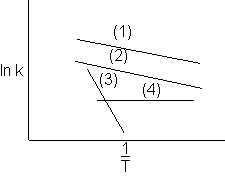
 

Graph of ln(k) versus 1/T showing four lines labeled (1), (2), (3), and (4). Lines (1) and (2) have similar negative slopes and are positioned higher on the graph. Line (3) has a steeper negative slope and intersects line (4), which is flat and horizontal.

1) Which reaction has the higher activation energy?


Solution


2) Which reactions have the same activation energy?


Solution


3) Which reaction is virtually temperature insensitive?


Solution


4) Which reaction will dominate (i.e. take place the fastest) at high temperatures if all reactions were to take place in the same reactor?
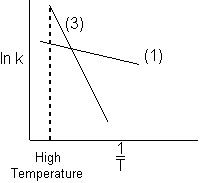
Graph of ln(k) versus 1/T showing two lines labeled (1) and (3). Line (1) has a gentle negative slope, while line (3) has a steeper negative slope. A dashed vertical line represents high temperature on the 1/T axis. \(k_3 > k_1\)


Solution


5) Which reaction will dominate (take place the fastest) at moderate temperatures?
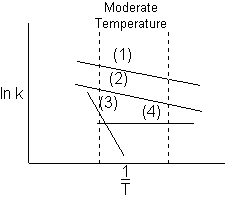
Graph of ln(k) versus 1/T with lines labeled (1), (2), (3), and (4). Lines (1) and (2) have gentle negative slopes, while line (3) has a steep negative slope and line (4) is nearly horizontal. Two dashed vertical lines indicate the range of moderate temperature on the 1/T axis.


Solution


6) Which reaction will take place the fastest at low temperatures?
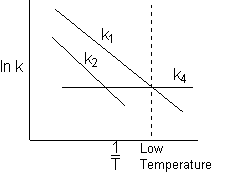
Graph of ln(k) versus 1/T with lines labeled k1, k2, and k4. Lines k1 and k2 have negative slopes, while k4 is nearly horizontal. A dashed vertical line indicates the range of low temperature on the 1/T axis. \(k_4 > k_1\)


Solution


7) Which reactions will have the same rate of reaction at a given temperature?


Solution


8) Which reactions will dominate at high temperatures and be the slowest at low temperatures?


Solution


Solutions

Consider the following elementary reactions

\(1) \, A \xrightarrow{k_1} B\)

\(2) \, A \xrightarrow{k_2} D\)

\(3) \, A \xrightarrow{k_3} Y\)

\(4) \, A \xrightarrow{k_4} U\)

1) Which reaction has the higher activation energy?

Graph of ln(k) versus 1/T showing four lines labeled (1), (2), (3), and (4). Lines (1) and (2) have similar negative slopes and are positioned higher on the graph. Line (3) has a steeper negative slope and intersects line (4), which is flat and horizontal.

Ans. (3)

Back to Problems


2) Which reactions have the same activation energy?


Ans. (1) and (2) – Slope (–E/R) is the same.


Back to Problems


3) Which reaction is virtually temperature insensitive?


Ans. (4). k4 does not vary with temperature E4 = 0.


Back to Problems


4) Which reaction will dominate (i.e. take place the fastest) at high temperatures?


Graph of ln(k) versus 1/T showing two lines labeled (1) and (3). Line (1) has a gentle negative slope, while line (3) has a steeper negative slope. A dashed vertical line represents high temperature on the 1/T axis. \(k_3 > k_1\)


At high temperatures (1/T) is small and k3 becomes larger than k1. \(k_3 > k_1 > k_2 > k_4\)

Ans. (3)


Back to Problems


5) Which reaction will dominate (take place the fastest) at moderate temperatures?


Graph of ln(k) versus 1/T with lines labeled (1), (2), (3), and (4). Lines (1) and (2) have gentle negative slopes, while line (3) has a steep negative slope and line (4) is nearly horizontal. Two dashed vertical lines indicate the range of moderate temperature on the 1/T axis.

At moderate temperatures \(k_1 > k_2 > k_4 > k_3\)

Ans. (1)

Back to Problems


6) Which reaction will take place the fastest at low temperatures?

Graph of ln(k) versus 1/T with lines labeled k1, k2, and k4. Lines k1 and k2 have negative slopes, while k4 is nearly horizontal. A dashed vertical line indicates the range of low temperature on the 1/T axis. \(k_4 > k_1\)

At low temperature (1/T) is larger. \(k_4 > k_1 > k_2 > k_3\)

Ans. (4)

Back to Problems


7) Which reactions will have the same rate of reaction at a given temperature?

Ans. The rate will be the same when the lines cross.

a. (1) and (3)

b. (2) and (3)

c. (1) and (4)

d. (2) and (4)

e. (3) and (4)

The activation energy is a measure of the minimum energy a that the reacting molecules must have in order for the reaction to occur.
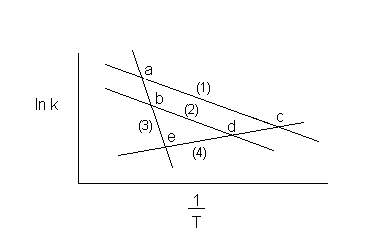
Graph of ln(k) versus 1/T with lines labeled (1), (2), (3), and (4). Points along the lines are labeled a, b, c, d, and e, highlighting intersections and slopes.

Back to Problems


7) Which reactions will dominate at high temperatures and be the slowest at low temperatures?

Ans. Reaction (1)
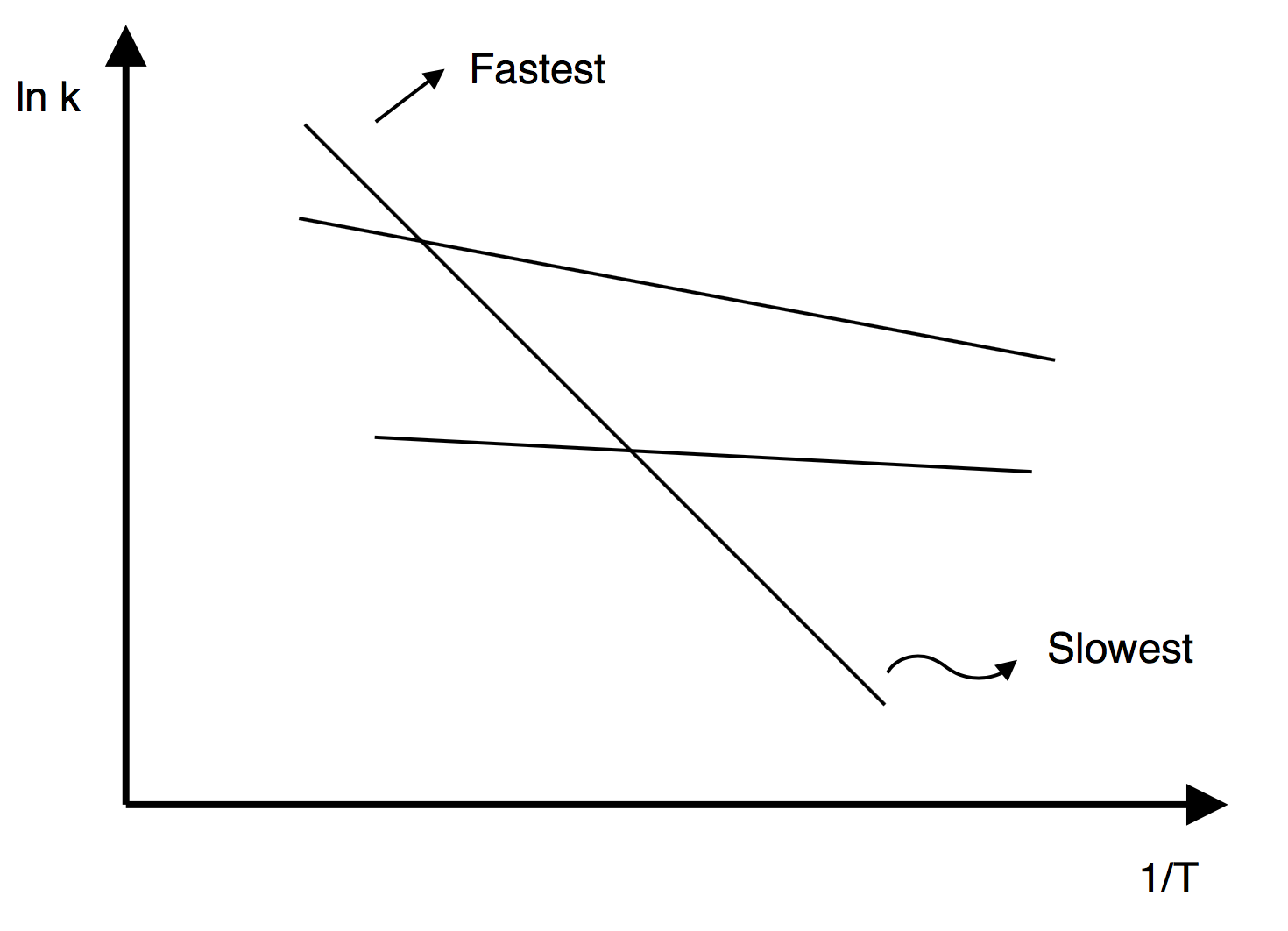
Graph of ln(k) versus 1/T showing multiple lines. The line with the steepest slope is labeled 'Fastest,' and the line with the flattest slope is labeled 'Slowest,' indicating reaction speed differences.

Back to Problems

Back to Chapter 3