90 views
60 favorited
70 photo likes
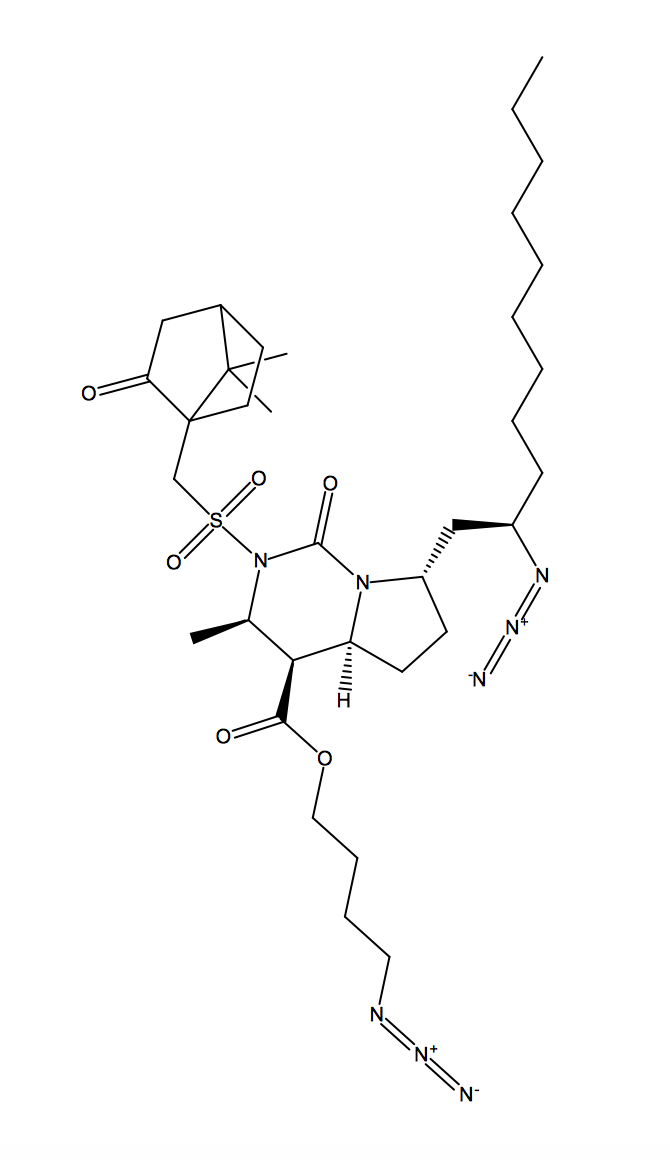
4-Azidobutyl(3R,4R,4aS,7S)-7-[(2R)-2-azidoundecyl]-2-{[(7,7-dimethyl-2-oxobicyclo[2.2.1]hept-1-yl)methyl]sulfonyl}-3-methyl-1-oxooctahydropyrrolol[1,2-c]pyrimidine-4-carboxylate
My Story:
Back in my early days, I was a simple alkyl iodide (339 mg, 0.41 mmol, azeotroped with anhydrous benzene).I mixed with some strange, crazy folks; first it was anhydrous benzene (80 ml), but then tributyltin hydride (0.17ml, 0.61 mmol) and triethylborane (0.41 ml, 0.41 mmol, 1M in hexane) joined (in that order). We were such a close knit group of friends for 5 minutes--it felt like such a long time, but you know, the good things never last. But soon, I began to change under their influence. The TLC tests were all the proof I needed. And so, I realized I had to separate myself from them, or else dangerous things would happen. After being concentrated by vacuum, I was further purified with flash chromatography (eluting with 1:6 EtOH:hexanes). Alas, I was no longer the alkyl iodide that I was before, rather a bicyclic pyrimidine, a colorless oil. At least I lost some weight (280 mg, 80%)!
Since then, I've been searching for some real color in my life. My younger radical days are over, but that doesn't mean I'm not looking for excitement!
Real experimental: Compound 16, an alkyl iodide (339 mg, 0.41 mmol, azeotroped with anhydrous benzene) was dissolved in (80 ml) of anhydrous benzene and stirred at room temperature under dry air. Tributyltin hydride (0.17 ml, 0.61 mmol), triethylborane (0.41 ml, 0.41 mmol, 1M in hexane) were added in the respective order and stirred at room temperature for 5 minutes. The mixture was monitored by TLC. To afford the crude reaction mixture and remove the solvent, the reaction was concentrated under a vacuum. The final product was purified using flash chromatography (eluting with 1:6 EtOH:hexanes). The bicyclic pyrimidine, Compound 17, results as a colorless oil (280 mg, 80%).
Tributyltin Hydride: A source of hydrogens
Triethylborane: Initiator in radical reactions
Benzene: Solvent

