Haouamine A:
The biological studies of the natural product and their implications.
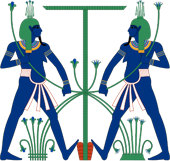
As a water god, Hapi was a deity of fertility - he provided water, food and the yearly inundation of the Nile. He is also the source of life of all the people, animals and plants around the nile. The excessive fascination with the power of Nile River and its blessings made them give him a great role in their myths. He was also known as 'Lord of the Fishes and Birds of the Marshes,' indicating that he provided these creatures to the Egyptians along with the Nile itself. Without Hapi, Egypt would have died, and so he was sometimes revered even above Ra, the sun god. Hapi was both god of Upper and Lower Egypt which is why he is depicted by twin Hapi deities, one wearing the papyrus of the north (Lower Egypt) as a headdress, the other wearing the south's (Upper Egypt) lotus as a headdress.
Haouamine A:
The biological studies of the natural product and their implications.
-Haouamine A was originally discovered in tunicates off the coast of Spain. Tunicates are a subphylum of a group of underwater saclike filter feeders. They are stationary, attached to the sea floor, and resemble a vase-like structure. Haouamine A was specifically found in the tunicate species Aplidium haouarianum.
-Haouamine A is a metabolite, an intermediate or product found in metabolic reactions, generally classified as a naturally occuring paracyclophane. A cyclophane is composed of two building blocks, an aromatic ring and an aliphatic unit that bridges the aromatic ring at two positions or more. Haouamine A and its counterpart Haouamine B are characterized by two strained ring systems. Haouamine A has a complex frame consisting of an indeno tetrahydropyridine structure and a highly strained azaparacyclophane with a bent phenol ring (Garrido 2003). The indeno tetrahydropyridine structure is connected to the highly strained 11-member azaparacyclophane structure (Grundl 2006). The main focus of many biological studies is to find a way to synthesize haouamine A. The inherent problem is that because the molecule is highly strained, the challenge becomes synthetisizing that same uncharacteristic high strain.
-Haouamine A is a highly complex and potent anti-cancer agent. A molecule’s potency as an effective treatment in hindering a biological or biochemical function is measured by how much of a particular substance is needed to inhibit a particular biological process by half, known as the IC50. Haouamine A is selectively cytotoxic against the HT-29 carcinoma cell line in the human colon with an IC50 of 0.1 μg/mL. How the chemical structure and properties of Haouamine A relate to its anti-canceral function remains unkown.