
Transformation of 44 to 46 via 45 - References
April 2006
Created By Keyvan Mirsaeedi, Paul Dinh, Garrett Coyan
All Rights Reserved




Original Citation:
Sanford, M. S.; Love, J. A.; Grubbs, R.H. J. Am. Chem. Soc. 2001 , 123 , 6543.
This paper details the basic reagents and processes behind the Wittig olefination reaction. Specific RCM reactions are explored and tested for possible outcomes. An example on an RCM reagent (ring-closing metathesis reagent) is a Ruthenium containing molecule that acts like an oxidizing agent in a typical oxidation reaction; two pi-type bonds are combined while binding with the Ruthenium atom to selectively close rings. Familiar types of these include the Grubb's catalysts. One type of these reagents is drawn below.

RCM reagents are typically associated with normal olefin metathesis reactions. For the RCM to work, side-chains on the molecule in question need to be charged to activate the catalyst complex to allow for the metathesis to close the chains to form a ring. The RCM reagent series causes a ring-closing reaction between two alkenes, with one alkene remaining while the other attacks. This method is cited here because of the various tests to close the ring on 46 by the investigators. This would lead to more productive, easier, and quicker steps in the experimental, and could prove useful in other applications, like those cited below using the above original citation. This work proved to be a useful resource for the investigators to attempt the ring closure of 46 , but it ultimately failed to produce positive results in this context.
Citation A:
Funk, T. W.; Berlin, J. M.; Grubbs, R. H. J. Am. Chem. Soc. 2006 , 128 , 1840-1846.
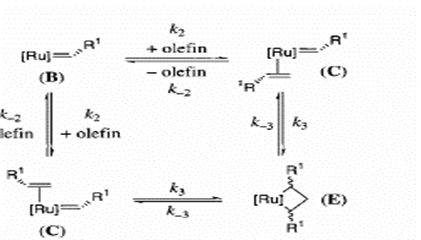
This paper shows the normal use of RCM reagent in a typical ring-closure reaction.
Citation B:
Poirier, M.; Aubry, N.; Boucher, C.; Ferland, J. M.; LaPlante, S.; Tsantrizos, Y. S. J.
Org. Chem. 2005 , 70 , 10765-10773.
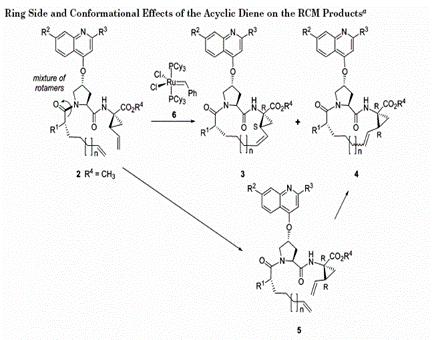
This paper, once again, shows RCM reagent being used in a ring-closure reaction.
Citation C:
Castoldi, D.; Caggiano, L.; Panigada, L.; Sharon, O; Costa, A. M.; Gennari, C.
Chemistry-A European Journal 2005 , 12 , 51-62.
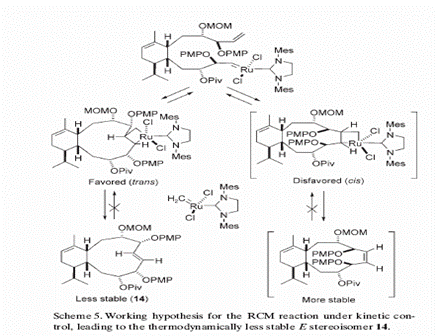
This paper details the use on how to use RCM reagent in a kinetic-controlled environment. This leads to the less stable isomer of the ring-closure, the E isomer in the above case.
Other Citations:
Scholl, S.; Ding, S.; Lee, C. W.; Grubbs, R. H. Org. Lett. 1999 , 1 , 953.
McMurry, J. E.; Chem. Rev. 1989 , 89 , 1513.
May the Force be With You...