
Transformation of 44 to 46 via 45 - Leading Questions
April 2006
Created By Keyvan Mirsaeedi, Paul Dinh, Garrett Coyan
All Rights Reserved



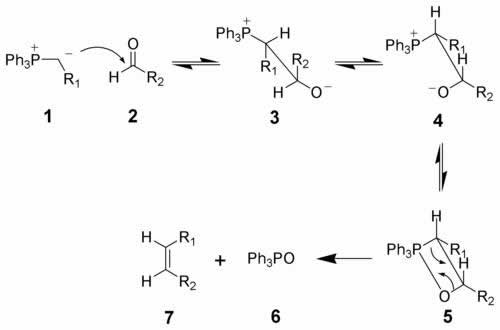
What is the classical mechanism for Wittig Reaction and how does it differ from more modern developments?
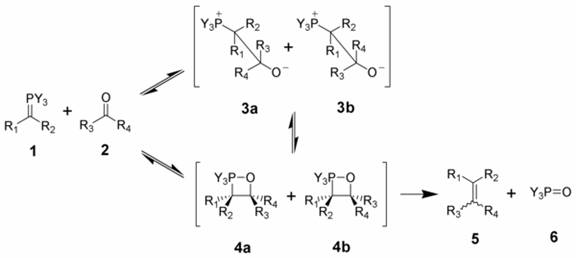
Recent research has shown that the reaction mechanism presented above does not account for all experimental results. Mechanistic studies have been done mostly on unstablilized ylides, because the intermediates can be followed by NMR more easily. The existence and interconversion of the molecules 3a and 3b is still under debate and a subject of ongoing research. There is evidence that phosphonium ylides ( 1 ) can react with carbonyl compounds ( 2) via cycloaddition to directly form the oxaphosphatanes 4a and 4b . The stereochemistry of the product 5 is due to the addition of the ylide 1 to the carbonyl 2 and to the ability of the intermediates to equilibrate .
What is a ylide, its structure, and its relationship to the Wittig Reaction?
A ylide consists of a metallic, positively charged atom bonded to a negatively charged atom. In the case of the Wittig reaction, the positive atom is phosphorus and the negative atom is carbon (see below). The Wittig reagent specializes in selectively changing carbon-oxygen p-bonds to carbon-carbon p-bonds.
The Wittig reagent may be written in the phosphorane form (the more familiar representation) or the ylide form:
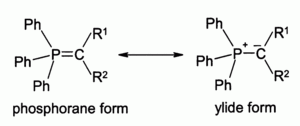
However this resonance requires expansion of the octet on phosphorus, meaning that the p-bond involves the overlap of a s -orbital on phosphorus with a p -orbital . Such resonance is rather less favored than the more familiar p-p overlap seen in such compounds as alkenes or imines . This means that the ylide form is a significant contributor, and the carbon is quite nucleophilic , which leads to the success of this particular ylide in organic synthesis.
May the Force be With You...