


Two assumptions motivate our model for presidential targeting of LFEs. The first is that the President's targeting decisions are based on forecasts of the support he (or his party's successor candidate) will receive in each area in the next election. The second is that those forecasts are strongly informed by the support the President received from each area in the most recent election. Even if the President is not running for reelection, he and his administration ought to support a targeting plan to try to maintain party control of the White House.
Suppose each individual voter i in local area s in year t decides
whether to vote for the incumbent based on a continuous index
 , according to the rule
 if
 ,
 if
 , where
indicates a vote for the incumbent and indicates a vote
against the incumbent. Specifically,
where  is a row vector of variables,
 is a row
vector of variables measuring the LFEs supplied to the local area,
 is a scalar and
 and
 are column vectors of constant
coefficients,
 is a vector of coefficients constant for each
individual, and
 is a stochastic disturbance identically and
independently across individuals, local areas and time.
The President cares about the aggregate distribution of the vote in each area.
Given the Electoral College, the President's direct interest is in winning
half or more of the electoral votes. Because a direct model of the
President's choice among all the possible electoral vote majority patterns
would be unwieldy, we simplify by assuming that the President is interested in
the aggregate vote in each local area. Specifically, we assume that the
President cares about the mean value of in area s at the
time  of the upcoming election, i.e., about
 , where
 denotes the set and
 denotes the number of voters in
area s at
 .
The President targets LFEs to each area to increase his expected support
there, according to some strategy. The strategy is a function of the
information  that the President has at time t about
 , and is tailored to each type of expenditure. We use
 to denote the targeting function the President uses for the kth
type of LFE. For each value of , this function indicates how
much of the kth type of LFE ought to be supplied to area s. The set of
possible strategies for each kind of LFE includes the null possibility that
the President does no targeting related to at all. In
this case
 is a constant.
We allow the targeting function to differ between the first two years and the
last two years of the President's term. Our specification for the amount
 of the kth type of LFE going to area s in year t is
where  during the first two years and
 during
the second two years,
 and
 denote targeting
functions for early and late in the term,
 is a fixed vector of
observed exogenous variables,
 is a scalar and
 is a
vector of constant coefficients, and
 and
 are
respectively area-specific and time-specific fixed effects. The area-specific
effects would capture any adjustment in the level of the LFE done throughout
whole States pursuant to a plan to build a majority in the Electoral College.
The disturbance
 has expectation
 and
variance
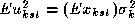 . We use the
exponential form in equation (2) because virtually all observed
local aggregations of LFEs are nonnegative. An additive disturbance with the
specified form of heteroscedasticity is frequently appropriate for models with
loglinear expectations (McCullagh and Nelder 1989:193ff).
 The disturbances
and
 are assumed to be uncorrelated for
all k, i, s and t.

