Chapter 11: Nonisothermal Reactor Design: The Steady State Energy Balance and Adiabatic PFR Applications
Second Order Reaction in a CSTR.
The acid catalyzed irreversible liquid phase reaction
\( A \rightarrow B \)
is carried out adiabatically in a CSTR. The reaction is second order in A. The feed, which is equal molar in water (which contains the catalyst) and A, enters the reactor at a temperature of 52˚C and a total volumetric flow rate of 10 dm3/min. The concentration of A entering the reactor is 4 molar.
a) What is the reactor volume to achieve 80% conversion
b) What conversion can be achieved in a 1000 dm3 CSTR? What is the exit temperature?
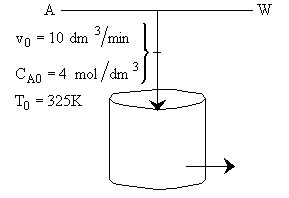
Additional Information:
\( \Delta H_{\text{Rx}} = -3000 \, \text{cal/mol} \)
\( C_{P_A} = 15 \, \text{cal/mol} \cdot \text{°C} \)
\( C_{P_B} = 15 \, \text{cal/mol} \cdot \text{°C} \)
\( C_{P_W} = 18 \, \text{cal/mol} \cdot \text{°C} \)
\( k = 0.0005 \, \text{at} \, 25 \, \text{°C} \)
\( E = 15000 \, \text{cal/mol} \)
Hint 1: What is the combined mole balance, rate law and stoichiometry that gives the reactor value as a function of temperature and conversion?
Hint 2: What is the equation that gives X, solely as a function of t, k, and CA0?
Hint 3: What is the equation that one obtains from the energy balance that gives X as a function of T?
Hint 4: What is the specific reaction rate 3?
Hint 5: What CSTR reactor volume is necessary to achieve 80% conversion?
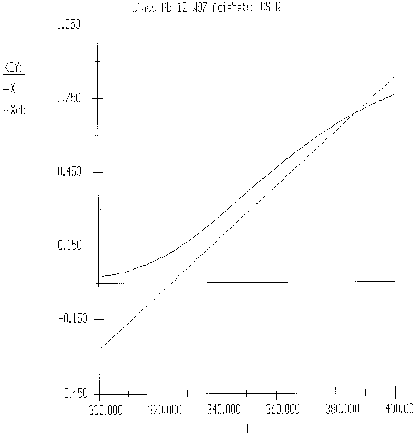
Hint 1: Sketch the conversion obtained from the mole balance and energy balance as a function of T.
Hint 2: Write a Polymath program to obtain the exit conversion and temperature. Use the output to plot XEB and EMB.
Hint 1
Mole Balance
\( V = \frac{F_{A0} X}{-r_A} \)
\( -r_A = k C_A^2 \)
\( C_A = C_{A0} (1 - X) , F_{A0} = C_{A0} \nu_0 , \tau = \frac{V}{\nu_0} \)
\( V = \frac{F_{A0} X}{k C_{A0}^2 (1 - X)^2} , \tau = \frac{1}{k C_{A0}} \frac{X}{(1 - X)^2} \)
Hint 2
\( \tau k C_{A0} = \frac{X}{(1 - X)^2} \)
\( \tau k C_{A0} - 2 \tau k C_{A0} X + \tau k C_{A0} X^2 = X \)
\( \tau k C_{A0} X^2 - (2 \tau k C_{A0} + 1) X + \tau k C_{A0} = 0 \)
\( X = \frac{(2 \tau k C_{A0} + 1) \pm \sqrt{(2 \tau k C_{A0} + 1)^2 + 4 \tau k C_{A0}}}{2 \tau k C_{A0}} \)
\( X = \frac{2 \tau k C_{A0} + 1 - \sqrt{4 (\tau k C_{A0})^2 + 4 \tau k C_{A0} + 1 - 4 (\tau k C_{A0})^2}}{2 \tau k C_{A0}} \)
Let
\( D\alpha = \tau k C_{A0} \)
\( X_{MB} = \frac{(2 \tau k C_{A0} + 1) - \sqrt{4 \tau k C_{A0} + 1}}{2 \tau k C_{A0}} = \frac{(2 D \alpha + 1) - \sqrt{4 D \alpha + 1}}{2 D \alpha} \)
Hint 3
Energy Balance
\( X_{EB} = \sum \Theta_i C_{A} \left( \frac{T - T_0}{\Delta H_{Rx}} \right) \)
\( X = \frac{(C_{PA} + C_{PW}) (T - T_0)}{\Delta H_{Rx}} \)
\( T = T_0 + \left( \frac{-\Delta H_{Rx}}{C_{PA} + C_{PW}} \right) X \)
\( T = 325 \, \text{K} + \left( \frac{-3000 \, \text{cal}}{\text{mol}} \right) \left( \frac{1}{15 + 18 \, \text{cal/mol · K}} \right) X \)
\( T = 325 + 90.1X \)
For 80% conversion, \( T = 325 + 72.7 = 397.7 \)
Hint 4
\( @397.7 \, k = 0.005 \exp \left[ \frac{15,000 \, \text{cal/mol}}{1.987 \, \text{cal/mol · K}} \left( \frac{1}{298} - \frac{1}{397.7} \right) \right] = (0.005)(572.8) \, \frac{\text{dm}^3}{\text{mol · s}} \)
\( = 0.29 \, \frac{\text{dm}^3}{\text{mol · s}} \)
Hint 5
\( V = \frac{1}{k C_{A0}} \left( \frac{X}{(4 - X)^2} \right) = \frac{1}{(0.29)(4)(1 - 0.8)^2} = 8.62 \, \text{dm}^3 \)
Part (b) What conversion can be achieved in a 1000 dm3 CSTR?
Hint 1
\( X_{MB} = \frac{(2 D_\alpha + 1) - \sqrt{4 D_\alpha + 1}}{2 D_\alpha} \)
where \( D_\alpha = \tau k C_{A0} = C_{A0} k_1 e^{\frac{E}{R} \left( \frac{1}{T_1} - \frac{1}{T} \right)} \)
\( X_{EB} = T_0 + \frac{-\Delta H_{Rx} X}{C_{pA} + C_{pW}} \)
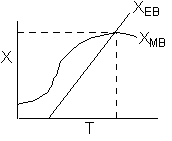
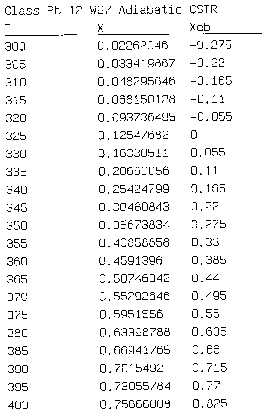
The exit temperature and conversion are determined from the intersection of XEB and XMB
Hint 2
We can generate XEB and X vs. T curves by incrementing T and calculating the conversion.
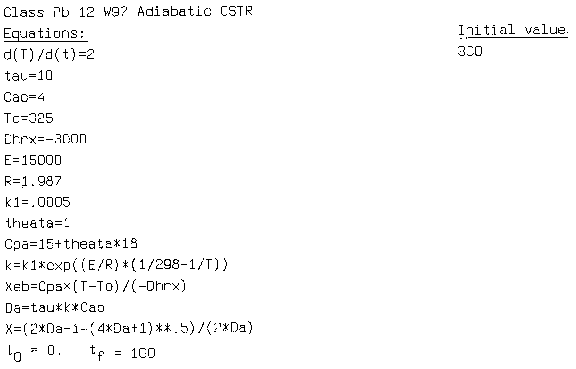
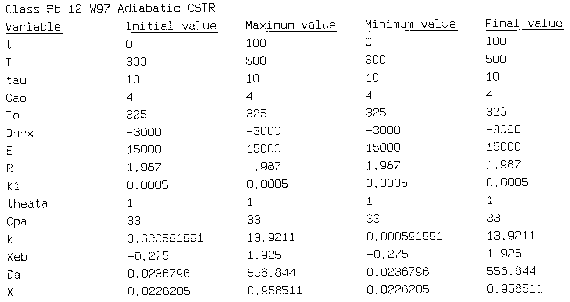
Equation for Figure
\( v_0 = 10 \, \text{dm}^3/\text{min} \)
\( C_{A0} = 4 \, \text{mol}/\text{dm}^3 \)
\( T_0 = 325 \, \text{K} \)