Chapter 11: Nonisothermal Reactor Design: The Steady State Energy Balance and Adiabatic PFR Applications
Sketch XEB versus T
For an adiabatic reaction with \( \dot{W}_s \) and
\( \Delta C_p = 0 \), sketch the conversion, XEB as a
function of temperature for:
a. an exothermic reaction
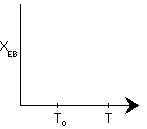
Hint 1: What is the adiabatic energy balance?
b. an endothermic reaction
c. give XMB=f(T) using the combined mole balance,
rate law, and stoichiometry for a first order irreversible
reaction \( A \rightarrow B \)
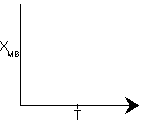
i.e. show how to locate the steady state conversion and
temperature
|
|
Hint 1
Energy Balance to Determine XEB=f(T)
\(\dot{Q} - W_s - F_{A0}X \left| \Delta H_{Rx}(T_R) + \hat{C}_p(T - T_R) \right| = F_{A0} \sum \theta_i C_p (T - T_0)\)
\(\dot{Q} = 0, W_s = 0, \Delta C_p = 0 \Rightarrow \Delta H_{Rx} = \Delta H_{Rx}^\circ\)
\(X[\Delta H_{Rx}(T_R)] = \left( \sum \theta_i C_p (T - T_0) \right)\)
\(X_{EB} = \left[ \sum \theta_i C_p \right] \left[ \frac{[T - T_0]}{-\Delta H_{Rx}} \right]\)
For and adiabatic reaction with \( \dot{W}_s \) and \( \Delta C_p = 0 \), sketch conversion as a function of temperature.
Solution: Part A
Energy Balance to Determine XEB=f(T)
\(\dot{Q} - W_s - F_{A0}X \left| \Delta H_{Rx}(T_R) + \hat{C}_p(T - T_R) \right| = F_{A0} \sum \theta_i C_p (T - T_0)\)
\(\dot{Q} = 0, W_s = 0, \Delta C_p = 0 \Rightarrow \Delta H_{Rx} = \Delta H_{Rx}^\circ\)
\(X[\Delta H_{Rx}(T_R)] = \left( \sum \theta_i C_p (T - T_0) \right)\)
\(X_{EB} = \left[ \sum \theta_i C_p \right] \left[ \frac{[T - T_0]}{-\Delta H_{Rx}} \right]\)
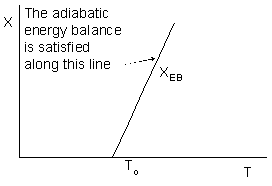
For an exothermic reaction,ΔHRX is negative,[
e.g., ΔHRX= -100 kJ/mole A]. Therefore,
[-ΔHRX] is a positive number.
\(X_{EB} = \frac{\left( \sum \theta_i C_p \right) (T - T_0)}{[ \text{a positive number} ]}\)
X increases with increasing T.
Solution: Part B
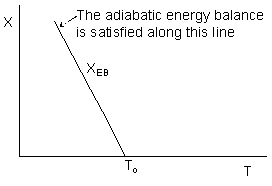
For an endothermic reaction, ΔHRX is
positive (+), XEB increases with decreasing T. [e.g.
ΔHRX=100 kJ/mol A] And therefore
[-ΔHRX] is a negative number.
\(X_{EB} = \frac{\left( \sum \theta_i C_p \right) (T - T_0)}{[ \text{a positive number} ]}\)
Solution: Part C
Mole Balance to Determine XMB=f(T)
For a first order reaction
\( V = \frac{F_{A0} X}{-r_A} = \frac{v_0 C_{A0} X}{k C_{A0} (1 - X)}, \quad \tau = \frac{X}{k (1 - X)} \)
rearranging...
\( X_{MB} = \frac{\tau k}{1 + \tau k} = \frac{\tau A e^{-E/RT}}{1 + \tau A e^{-E/RT}} \) -> 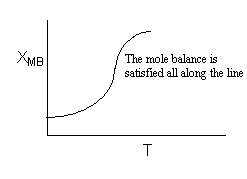
At the intersection of XMB vs. T and XEB vs.
T both the mole balance and the energy balances are
satisfied. The steady-state conditions
(XSS,TSS) occur here.
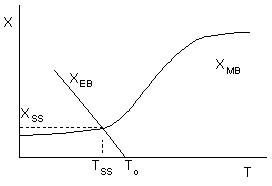
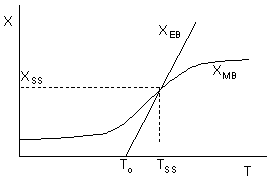
Endothermic Reaction Exothermic Reaction
Both the mole and energy balances are satisfied when XMB=XEB. The steady state temperature and conversion are TSSand XSS respectively for an entering temperature TO.