Chapter 10: Catalysis and Catalytic Reactors
Moving Bed Reactors
The elementary irreversible gas phase catalytic reaction
\(\text{A} + \text{B} \xrightarrow{k} \text{C} + \text{D}\)
is to be carried out in a moving bed reactor at constant temperature. The reactor contains 5 kg. of catalyst. The feed is stoichiometric in A and B. The entering concentration of A is 0.2 mol/dm3. The catalyst decay law is zero order with kD = 0.2 s–1. What catalyst loading rate is necessary to achieve 40% conversion?
Additional information:
k = 1.0 dm6/(mol•kg. cat•s)
vo = 1 dm3/s
Hint 1 What are the mole balance and the rate law?
Hint 2 What is the equation for catalyst activity as a function of loading rate?
Hint 3 What is the differential equation that combines the mole balance, activity law and rate law?
Hint 4 What is the solution to the equation in Hint 3?
Hint 5 What conversion will be achieved for a catalyst feed rate of 0.5 kg/s?
Hint 6 Sketch the catalyst activity as a function of catalyst weight (i.e., distance) down the length such for a catalyst feed rate of 0.5 kg/s.
Hint 7 What is the maximum conversion that could be achieved (i.e. at infinite catalyst loading rate)?
Hint 8 At what catalyst loading rate (kg/s) will the catalyst activity be exactly zero at the exit of the reactor?
Hint 1. Mole balance and rate laws
\(\frac{dX}{dW} = \frac{-r'_A}{F_{A0}}\)
\(-r'_A = a(t) \left( -r'_A(t = 0) \right)\)
\(-r'_A(t = 0) = k C_A C_B\)
Hint 2. Equation for catalyst activity
\(\frac{da}{dt} = k_D a^n\)
\(W = U_S t\)
\(\frac{da}{dW} = -\frac{k_D}{U_S} a^n\)
\(n = 0\)
\(\frac{da}{dW} = -\frac{k_D}{U_S} \quad W = 0 \quad a = 1\)
\(a = 1 - \frac{k_D W}{U_S}\)
Hint 3. Combine mole balance, rate law, decay law, and stoichiometry
\(-r'_A = \left(1 - \frac{k_D W}{U_S}\right) k C_A C_B\)
\(C_A = C_{A0}(1 - X), \quad C_B = C_{A0}(1 - X)\)
\(\frac{dX}{dW} = \frac{k C_{A0}^2}{F_{A0}} \left(1 - \frac{k_D W}{U_S} \right)(1 - X)^2 \)
Hint 4. Solution to Hint 3.
\(\frac{dX}{(1 - X)^2} = k' \left(1 - \frac{k_D W}{U_S}\right) dW, \quad \text{where } k' = \frac{k C_{A0}^2}{F_{A0}} = \frac{k C_{A0}^2}{\nu_0 C_{A0}} = \frac{k C_{A0}}{\nu}\)
\(X = 0 \quad W = 0\)
\(\frac{X}{1 - X} = k' \left(W - \frac{k_D}{U_S} \frac{W^2}{2} \right)\)
Hint 5. What is conversion
\( k' = \frac{1 \, \text{dm}^6}{\text{mol} \cdot \text{kg cat} \cdot \text{s}} \times \left( \frac{0.2 \, \text{mol}/\text{dm}^3}{1 \, \text{dm}^3/\text{s}} \right) = 0.2 \, \text{kg}^{-1} \text{cat}^{-1} \)
\( \frac{X}{1 - X} = 0.2 \left( 5 - \frac{(0.2)(25)}{(0.5)(2)} \right) = 0.2 (5 - 5) = 0 \)
Zero conversion. NONSENSE!
Hint 6. Sketch a vs. W
Look at a vs. W
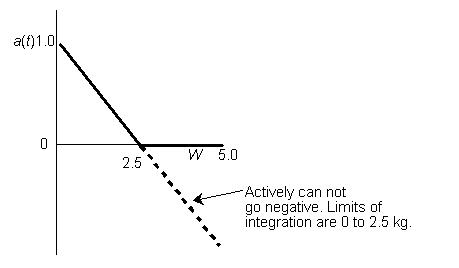
Therefore
\( a = 1 - \frac{kW}{U_s} = 1 - \frac{0.2 \, \text{s}^{-1}}{0.5 \, \frac{\text{kg}}{\text{s}}} \)
\( \boxed{a = 1 - 0.4W} \)
when
\( W = 2.5 \, \text{kg} \), \( a = 0 \)
therefore
\( \boxed{ \begin{aligned} a &= 1 - 0.4W \quad &W \leq 2.5 \\ a &= 0 \quad &W > 2.5 \end{aligned} } \)
Rearranging Equation (1) and integrating
\(\int_0^X \frac{dX}{(1 - X)^2} = k' \int_0^{2.5} \left(1 - \frac{W k_D}{U_s} \right) dW\)
\(\frac{X}{1 - X} = k' \left[ W - \frac{W^2 k_D}{2 U_s} \right]_0^{2.5}\)
\(\frac{X}{1 - X} = \left( \frac{0.2}{\text{kg cat}} \right) \left[ 2.5 - \frac{(2.5)^2 (0.2)}{0.5 \cdot 2} \right] = 0.25\)
\(X = 0.2\)
Hint 7. Conversion at infinite loading rate
\(\frac{X}{1 - X} = k' W = (0.2)(5) = 1\)
\(X = 0.5\)
Hint 9. Loading rate for which a is exactly zero at the exit of reaction.
\( a = 1 - \frac{W k_D}{U_S} = 0 \)
\( W k_D = U_S \)
\( U_S = (5)(0.2) = 1 \, \text{kg/s} \)
at a loading of 1 kg/s the catalyst activity will be exactly zero at the exit of the reactor.
What does an activity of zero mean? Can catalyst activity be less than zero?