Chapter 10: Catalysis and Catalytic Reactors
Catalyst Decay in a Batch Reactor
The elementary irreversible gas phase catalytic reaction
\( \mathrm{A} \xrightarrow{k_1} \mathrm{B} \)
is carried out isothermically in a batch reactor. The catalyst deactivation follows a first order decay law and is independent of the concentrations of both A and B.
Additional information:
CA0 = 1 mol/dm3
V0 = 1 dm3
W = 1 kg
kd = 0.1 min-1 at 300 K Ed/R = 2,000 K
k1 =0.2 dm3/(kg cat · min) at 300 K Ea/R = 500 K
Hint 1 Write the algorithm and determine a general expression for catalyst activity as a function of time.
Hint 2 Make a qualitative sketch of catalyst activity as a function of time. Does a(t) ever equal zero for a first order decay law?
Hint 3 Write out the general algorithm and derive an expression for conversion as a function of time, the reactor parameters and the catalyst arameters.
Fill in the following algorithm
Mole balance
Rate Law
Decay Law
Stoichiometry
Combine
Solve
1) Separate
2) Integrate
\(\text{ans: } X = 1 - \exp\left[ \frac{-k_1 W}{k_d V_0} \left(1 - \exp(-k_d t)\right) \right]\)
Hint 4 Calculate the conversion and catalyst activity in the reactor after 10 minutes at 300 K.
Hint 1. Algorithm and a(t)
Batch
Mole Balance
\(\frac{dX}{dt} = -r'_A \frac{W}{N_{A0}}\)
Rate Law
\(-r_A = a(t) \, k_1 \, C_A\)
Decay Law
First-order decay law
\(\frac{da}{dt} = -k_d a\)
\(\int_1^a \frac{da}{a} = \int_0^t -k_d \, dt\)
\(\ln a = -k_d t\)
\(a = e^{-k_d t}\)
Hint 2
Sketch a(t)
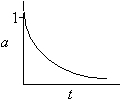
a(t) never equals zero for a first-order decay law
Hint 3. Determine X(t)
Stoichiometry \(C_A = C_{A0}(1 - X)\)
Combine \(\frac{dX}{dt} = e^{-k_d t} \, k_1 \, C_{A0}(1 - X) \, \frac{W}{N_{A0}}\)
Separate and Integrate
\(\int_0^X \frac{dX}{1 - X} = \frac{k_1 C_{A0} W}{N_{A0}} \int_0^t e^{-k_d t} dt\)
\(\ln \frac{1}{1 - X} = \frac{k_1 C_{A0} W}{N_{A0}} \left( \left. \frac{-e^{-k_d t}}{k_d} \right|_0^t \right)\)
\(\ln \frac{1}{1 - X} = \frac{k_1 C_{A0} W}{C_{A0} V_0} \left( \frac{1}{k_d} - \frac{e^{-k_d t}}{k_d} \right)\)
\(\ln \frac{1}{1 - X} = \frac{k_1 W}{k_d V_0} (1 - e^{-k_d t})\)
\( X = 1 - \exp\left[-\frac{k_1 W}{k_d V_0}(1 - e^{-k_d t})\right] \)
where
\( k_1 = 0.2 \exp\left[\frac{E_a}{R} \left(\frac{1}{300} - \frac{1}{T} \right)\right] \, \text{dm}^3/\text{kg cat min} \)
\( k_d = 0.1 \exp\left[\frac{E_d}{R} \left(\frac{1}{300} - \frac{1}{T} \right)\right] \, \text{min}^{-1} \)
Hint 4
Calculate conversion after 10 minutes
300 K – No temperature correction needed for k1, kd since T = T1
Results the same for both catalysts
\( a = \exp[-k_d t] = \exp\left[-(0.1)\,\text{min}^{-1} \cdot (10)\,\text{min} \right] = 0.368 \)
\( X = 1 - \exp\left[ -\frac{(0.2)\,\frac{\text{dm}^3}{\text{kg cat min}} \cdot (1)\,\text{kg}}{(0.1)\,\frac{\text{dm}^3}{\text{min}} \cdot (1)\,\text{dm}^3} \cdot (1 - 0.368) \right] = 0.717 \)
For both catalysts 1 and 2 at 300 K
Full Solution
Hint 1. Algorithm and a(t)
Batch
Mole Balance
\(\frac{dX}{dt} = -r'_A \frac{W}{N_{A0}}\)
Rate Law
\(-r_A = a(t) \, k_1 \, C_A\)
Decay Law
First-order decay law
\(\frac{da}{dt} = -k_d a\)
\(\int_1^a \frac{da}{a} = \int_0^t -k_d \, dt\)
\(\ln a = -k_d t\)
\(a = e^{-k_d t}\)
Hint 2
Sketch a(t)
a(t) never equals zero for a first-order decay law
Hint 3. Determine X(t)
Stoichiometry \(C_A = C_{A0}(1 - X)\)
Combine \(\frac{dX}{dt} = e^{-k_d t} \, k_1 \, C_{A0}(1 - X) \, \frac{W}{N_{A0}}\)
Separate and Integrate
\(\int_0^X \frac{dX}{1 - X} = \frac{k_1 C_{A0} W}{N_{A0}} \int_0^t e^{-k_d t} dt\)
\(\ln \frac{1}{1 - X} = \frac{k_1 C_{A0} W}{N_{A0}} \left( \left. \frac{-e^{-k_d t}}{k_d} \right|_0^t \right)\)
\(\ln \frac{1}{1 - X} = \frac{k_1 C_{A0} W}{C_{A0} V_0} \left( \frac{1}{k_d} - \frac{e^{-k_d t}}{k_d} \right)\)
\(\ln \frac{1}{1 - X} = \frac{k_1 W}{k_d V_0} (1 - e^{-k_d t})\)
\( X = 1 - \exp\left[-\frac{k_1 W}{k_d V_0}(1 - e^{-k_d t})\right] \)
where
\( k_1 = 0.2 \exp\left[\frac{E_a}{R} \left(\frac{1}{300} - \frac{1}{T} \right)\right] \, \text{dm}^3/\text{kg cat min} \)
\( k_d = 0.1 \exp\left[\frac{E_d}{R} \left(\frac{1}{300} - \frac{1}{T} \right)\right] \, \text{min}^{-1} \)
Hint 4
Calculate conversion after 10 minutes
300 K – No temperature correction needed for k1, kd since T = T1
Results the same for both catalysts
\( a = \exp[-k_d t] = \exp\left[-(0.1)\,\text{min}^{-1} \cdot (10)\,\text{min} \right] = 0.368 \)
\( X = 1 - \exp\left[ -\frac{(0.2)\,\frac{\text{dm}^3}{\text{kg cat min}} \cdot (1)\,\text{kg}}{(0.1)\,\frac{\text{dm}^3}{\text{min}} \cdot (1)\,\text{dm}^3} \cdot (1 - 0.368) \right] = 0.717 \)
For both catalysts 1 and 2 at 300 K