Chapter 10: Catalysis and Catalytic Reactors
Finding the rate law and mechanism for A+B<=>C+D
The following data were reported for the reaction A + B goes to C + D
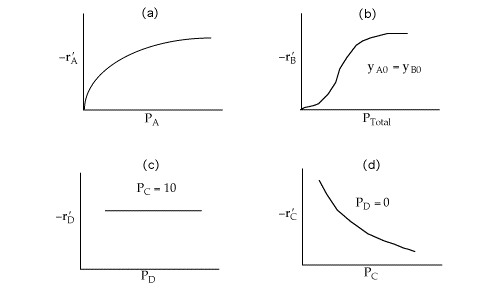
Which of the following mechanisms is consistent with the above data?
|
(a) \( A + S \rightarrow A \cdot S \) \( B \cdot S \rightleftharpoons B + S \) \( A \cdot S + B \cdot S \rightarrow C \cdot S + D \cdot S \) \( C \cdot S \rightleftharpoons C + S \) \( D \cdot S \rightleftharpoons D + S \) |
(b) \( A + S \rightleftharpoons A \cdot S \) \( B \cdot S \rightleftharpoons B + S \) \( A \cdot S + B \cdot S \rightleftharpoons C \cdot S + D \cdot S \) \( C \cdot S \rightleftharpoons C + S \) \( D \cdot S \rightleftharpoons D + S \) |
|
(c) \( A + S \rightleftharpoons A \cdot S \) \( B + S \rightleftharpoons B \cdot S \) \( A \cdot S + B \cdot S \rightleftharpoons C \cdot S + D \cdot S \) \( C \cdot S \rightleftharpoons C + S \) |
(d) \( A + S \rightleftharpoons A \cdot S \) \( B + S \rightarrow B \cdot S \) \( A \cdot S + B \cdot S \rightarrow C \cdot S + S + D \) \( C \cdot S \rightleftharpoons C + S \) |
Solution
Solution
Answer:(d)
Recall
-r'A=-r'B=r'C=r'D
Figure (a) suggests
\( -r'_A \sim \frac{P_A}{1 + K_A P_A + \dots} \quad \therefore A \text{ is on the surface} \)
Figure (b) suggests
\( P_A = y_A P_T \)
\( P_B = y_B P_T \)
\( P_C = y_C P_T \)
\( -r'_A \sim \frac{P_T^2}{\left[ 1 + (K_A + K_B) P_T + \dots \right]^2} \sim \frac{P_T^2}{1 + K P_T^2} \)
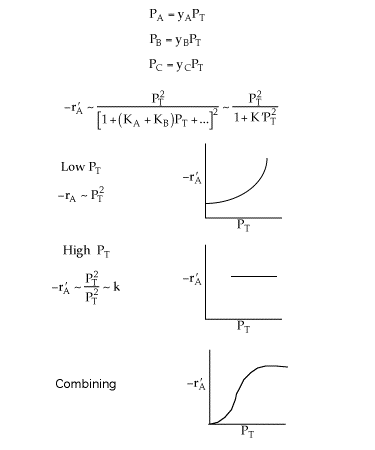
\( -r'_A \sim \frac{P_A P_B}{\left[ 1 + K_A P_A + K_B P_B + \dots \right]^2} \)
Figure (c) suggests
-rA is not a function of PD, therefore the reaction is irreversible and D is not on the surface.Figure (d) suggests
\( -r'_A \sim \frac{1}{1 + K_C P_C + \dots} \)
\( \therefore C \text{ is on the surface} \)
Combining all the above
\( -r'_A = \frac{k P_A P_B}{[1 + K_A P_A + K_B P_B + K_C P_C]^2} \)
Therefore, (d)is consistent
\( A + S \rightleftharpoons A \cdot S \quad \Rightarrow C_A \cdot S = K_A P_A C_V \)
\( B + S \rightleftharpoons B \cdot S \quad \Rightarrow C_B \cdot S = K_B P_B C_V \)
\( A \cdot S + B \cdot S \rightarrow C \cdot S + D \quad -r_A = r_S = k_S [ C_A \cdot S C_B \cdot S ] \)
\( = k_S K_A K_B P_A P_B C_V^2 \)
\( C \cdot S \rightleftharpoons C + S \quad C_C \cdot S = K_C P_C C_V \)
\( C_T = C_V + C_A \cdot S + C_B \cdot S + C_C \cdot S \)
\( = C_V + K_A P_A C_V + K_B P_B C_V + K_C P_C C_V \)
\( C_T = (1 + K_A P_A + K_B P_B + K_C P_C) C_V \)
\( C_V = \frac{C_T}{1 + K_A P_A + K_B P_B + K_C P_C} \)
\( -r'_A = \frac{k}{k_S K_A K_B C_T P_A P_B} \cdot \frac{1}{[1 + K_A P_A + K_B P_B + K_C P_C]^2} \)