Chapter 10: Catalysis and Catalytic Reactors
Finding the Mechanism
\( 2 \text{CO} + \text{O}_2 \rightleftharpoons 2 \text{CO}_2 \quad \text{(cat)} \)
The following data were obtained for the oxidation of CO over a catalyst. All rates are initial rates
|
\( -r_{\text{CO}} \left( \frac{\text{mol}}{\text{dm}^3 \cdot \text{s}} \right) \) |
\( C_{\text{CO}} \left( \frac{\text{mol}}{\text{dm}^3} \right) \) |
\( C_{\text{CO}_2} \left( \frac{\text{mol}}{\text{dm}^3} \right) \) |
|
.020 |
0.01 |
1 |
|
.035 |
0.01 |
3 |
|
.049 |
.01 |
6 |
|
.060 |
.01 |
9 |
|
.196 |
.1 |
1 |
|
.384 |
.2 |
1 |
|
.902 |
.5 |
1 |
|
1.653 |
1 |
1 |
|
4.44 |
5 |
1 |
|
5.00 |
10 |
1 |
|
4.44 |
20 |
1 |
|
2.77 |
50 |
1 |
The initial rate was found to be independent of CO2.
a) Suggest a rate law consistent with the data
Hint 1 Sketch \( -r_{\text{CO}} \) versus CO2.
Hint 2 Sketch \( -r_{\text{CO}} \) versus CCOat low concentration.
Hint 3 Sketch \( -r_{\text{CO}} \) versus CCO at high concentration.
Full Solution What is the rate law?
b) Suggest mechanisms consistent with the rate law
Hint 1 What do the trends suggest?
Hint 2 What is the mechanism?
Hint 1
Use only the data points for which the concentration of CO is the same.
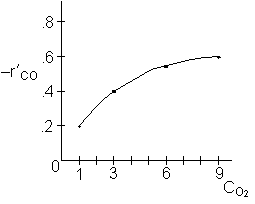
at \( C_{\text{O}_2} = 1 \), \( -r_{\text{CO}} = 0.02 \, \text{mol}/\text{dm}^3 \cdot \text{s} \)
at \( C_{\text{O}_2} = 9 \), \( -r_{\text{CO}} = 0.06 \, \text{mol}/\text{dm}^3 \cdot \text{s} \)
\( \left( \frac{0.06}{0.02} \right) = \left( \frac{9}{1} \right)^n \)
\( n = \frac{1}{2} \)
\( -r_{\text{CO}} \sim C_{\text{O}_2}^{1/2} \)
Hint 2: Low concentration
For constant CO2
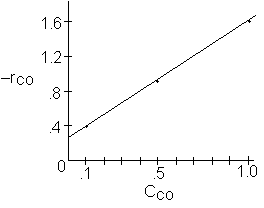
We see at low concentration the rate is linear in CO and \( -r'_{\text{CO}} \sim C_{\text{CO}} \)
Hint 3: High concentration
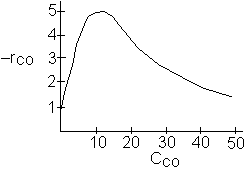
At high concentrations the rate decreases with increasing concentration
\( -r'_{\text{CO}} \sim \frac{1}{C_{\text{CO}}} \)
Full Solution: Part A
Combining
\( -r_{\text{CO}}' = \frac{k C_{\text{CO}} C_{\text{O}_2}^{1/2}}{(1 + K_{\text{CO}} C_{\text{CO}})^2} \)
For fixed concentration of O2 and low concentration of CO and
\( K_{\text{CO}} C_{\text{CO}} \ll 1 \)
Rate increases linearly with CO: agrees with data
\( -r_{\text{CO}}' \sim C_{\text{CO}} \)
High concentration
\( -r_{\text{CO}}' \sim \frac{k C_{\text{CO}}}{(K_{\text{CO}} C_{\text{CO}})^2} \sim \frac{1}{C_{\text{CO}}} \)
\( K_{\text{CO}} C_{\text{CO}} \gg 1 \)
Rate decreases with increasing CO: agrees with data
Consequently the rate law
\( -r'_{\text{CO}} = \frac{k C_{\text{CO}} C_{\text{O}_2}^{1/2}}{(1 + K_{\text{CO}} C_{\text{CO}})^2} \)
Satisfies the data
Hint 1
From the denominator of the rate law, we see that CO is adsorbed and that O2 is either weakly adsorbed (KO2PO21/2 << 1) or not adsorbed at all.
The 1/2 order with respect to oxygen suggests dissociative adsorption.
Because the initial rate is independent of CO2, it is either not adsorbed on the surface or weakly adsorbed.
Hint 2
The following mechanism is consistent with the rate law
Molecular Adsorption
\( \text{CO} + S \rightleftharpoons \text{CO} \cdot S \quad -r_{\text{ADCO}} = k_{\text{ACO}} \left[ C_{\text{CO}} C_{\nu} - \frac{C_{\text{CO}S}}{K_{\text{CO}}} \right] \)
Dissociative Adsorption
\( \text{O}_2 + 2S \rightleftharpoons 2O \cdot S \quad -r_{\text{ADO}} = k_{\text{AO}} \left[ C_{\text{O}_2} C_{\nu}^2 - \frac{C_{\text{CO}S}^2}{K_{\text{O}_2}} \right] \)
Surface Reaction
\( \text{CO} \cdot S + O \cdot S \rightarrow \text{CO}_2 + 2S \)
\( r_S = k C_{\text{CO}} \cdot S C_{\text{CO}_S} \)
Full Solution: Part B
The following mechanism is consistent with the rate law
Molecular Adsorption
\( \text{CO} + S \rightleftharpoons \text{CO} \cdot S \quad -r_{\text{ADCO}} = k_{\text{ACO}} \left[ C_{\text{CO}} C_{\nu} - \frac{C_{\text{CO}S}}{K_{\text{CO}}} \right] \)
Dissociative Adsorption
\( \text{O}_2 + 2S \rightleftharpoons 2O \cdot S \quad -r_{\text{ADO}} = k_{\text{AO}} \left[ C_{\text{O}_2} C_{\nu}^2 - \frac{C_{\text{CO}S}^2}{K_{\text{O}_2}} \right] \)
Surface Reaction
\( \text{CO} \cdot S + O \cdot S \rightarrow \text{CO}_2 + 2S \)
\( r_S = k C_{\text{CO}} \cdot S C_{\text{CO}_S} \)
Assume surface reaction limits
\( -r'_{\text{CO}} = r_S = k_S C_{\text{CO}} \cdot S C_{\text{CO}} \)
\( r_{\text{AdCO}} \sim 0 = C_{\text{CO}} C_{\nu} - \frac{C_{\text{CO}S}}{K_{\text{CO}}} \)
\( C_{\text{CO}S} = K_{\text{CO}} C_{\text{CO}} C_{\nu} \)
\( r_{\text{AdO}_2} \sim 0 = C_{\text{O}_2} C_{\nu}^2 - \frac{C_{\text{CO}S}^2}{K_{\text{O}_2}} \)
\( C_{\text{OS}} = C_{\nu} \sqrt{K_{\text{O}_2} C_{\text{O}_2}} \)
\( r_{\text{CO}_2} = -r_{\text{CO}} = k_{\text{CO}} \cdot S C_{\text{CO}} = k K_{\text{CO}} K_{\text{O}_2} C_{\text{CO}}^{1/2} C_{\text{O}_2}^{1/2} C_{\nu}^2 \)
\( C_T = C_{\nu} + C_{\text{CO}_S} + C_{\text{CO}S} \)
\( = C_{\nu} + K_{\text{CO}} C_{\text{CO}} C_{\nu} + K_{\text{O}_2} C_{\text{O}_2}^{1/2} C_{\text{O}_2}^{1/2} C_{\nu} \)
\( C_{\nu} = \frac{C_T}{1 + K_{\text{CO}} C_{\text{CO}} + K_{\text{O}_2} C_{\text{O}_2}^{1/2} C_{\text{O}_2}} \)
\( r_{\text{CO}_2} = -r_{\text{CO}} = \frac{k}{1 + K_{\text{CO}} C_{\text{CO}} + K_{\text{O}_2} C_{\text{O}_2}^{1/2}} \)
We see that oxygen is weakly adsorbed (very small \( K_{\text{O}_2} \)) such that \( K_{\text{O}_2}^{1/2} C_{\text{O}_2}^{1/2} \ll 1 \)
\( -r_{\text{CO}} = \frac{k C_{\text{CO}} C_{\text{O}_2}^{1/2}}{(1 + K_{\text{CO}} C_{\text{CO}})^2} \)