Chapter 10: Catalysis and Catalytic Reactors
Example Exam Questions
Question 1
|
\( A + B \rightleftharpoons C \) |
|
|
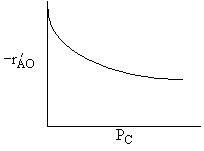
Figure 1: Data from a differential reactor. |
|
Which of the following best describe the data in the above figure?
|
|
\( A + B \rightarrow C \) |
|
Assume the reaction is irreversible |
|
|
|
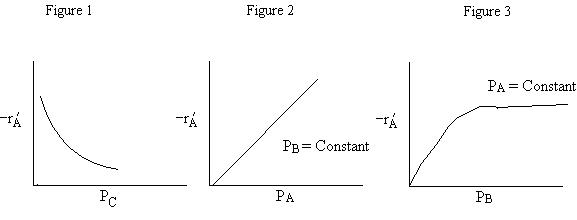
What can you tell from the above figures? |
|
|
\( A + B \rightleftharpoons C + D \)
The following data were reported for the reaction
A+B goes to C+D
| A | B |
|
|
| C | D |
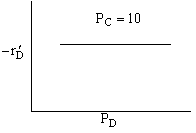
|
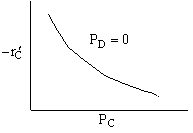
|
Which of the following mechanism is consistent with the above data
| (a) | (b) | (c) |
|
\( A + S \rightleftharpoons A \cdot S \) \( B + S \rightleftharpoons B \cdot S \) \( A \cdot S + B \cdot S \rightleftharpoons C \cdot S + D \cdot S \) \( C \cdot S \rightleftharpoons C + S \) |
\( A + S \rightleftharpoons A \cdot S \) \( B + S \rightleftharpoons B \cdot S \) \( A \cdot S + B \cdot S \rightleftharpoons C \cdot S + D \) \( C \cdot S \rightleftharpoons C + S \) |
\( A + S \rightleftharpoons A \cdot S \) \( A \cdot S + B \rightleftharpoons C \cdot S + D \) \( C \cdot S \rightleftharpoons C + S \) |
| (d) | (e) | |
|
\( B + S \rightleftharpoons B \cdot S \) \( A + B \cdot S \rightarrow C \cdot S + D \) \( C \cdot S \rightarrow C + S \) |
\( A + S \rightarrow A \cdot S \) \( B \cdot S \rightleftharpoons B \cdot S \) \( A \cdot S + B \cdot S \rightarrow C + D \cdot S + S \) \( C \cdot S \rightarrow C + S \) \( D \cdot S \rightleftharpoons D + S \) |
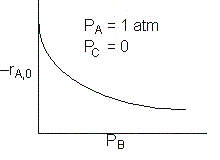
Question 4
\( A \rightleftharpoons B + C \)
The initial rate of reaction is shown below
| (a) | (b) | (c) |
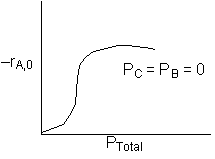
|
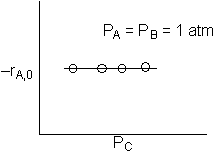
|
|
|
|
Question 5
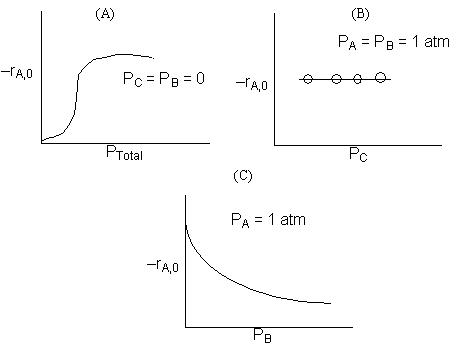
\( A \rightleftharpoons B + C \)
The initial rate of reaction is shown below
1. The rate law is
|
(A) \(-r_A = \frac{k P_A}{1 + K_A P_A + K_B P_B}\) |
(B) \(-r_A = \frac{k P_A^2}{\left(1 + K_A P_A + K_C P_C\right)^2}\) |
|
(C) \(-r_A = \frac{k P_A^2}{\left(1 + K_A P_A + K_B P_B\right)^2}\) |
(D) \(-r_A = \frac{k P_A}{1 + K_A P_A + K_C P_C}\) |
For the reaction \( A \rightleftharpoons B + C \) from Self Tests 12 and 13 we found
|
\( -r_A = \frac{k P_A^2}{(1 + K_A P_A + K_C P_C)^2} \) |
which mechanism is consistent with the rate law
|
(A) \( A + S \rightleftharpoons A \cdot S \) \( A \cdot S \rightleftharpoons B \cdot S + C \) \( B \cdot S \rightleftharpoons B + S \) |
(B) \( A + S \rightleftharpoons A \cdot S \) \( A \cdot S \rightarrow B + C \cdot S \) \( C \cdot S \rightleftharpoons C + S \) |
|
(C) \( A + S \rightleftharpoons A \cdot S \) \( A \cdot S + A(g) \rightarrow B + C \cdot S \) \( C \cdot S \rightleftharpoons C + S \) |
(D) \( A + S \rightleftharpoons A \cdot S \) \( A \cdot S + A \cdot S \rightarrow B \cdot S + C \cdot S \) \( C \cdot S \rightleftharpoons C + S \) |
|
(E) \( A + S \rightleftharpoons A \cdot S \) \( A \cdot S + A \cdot S \rightarrow B \cdot S + C + S \) \( B \cdot S \rightleftharpoons B + S \) |
|
|
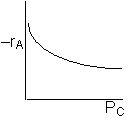
If the reaction is reversible the increase in PC will decrease the rate. If C is on the surface it will be in the denomination of the rate law and thus increasing PC will decrease the rate. Ans: C |
A is not on the surface or if it is KAPA << 1. B is on the surface and we see as we increase PB, the rate reaches a plateau. The curves from A, B, and C partial pressure suggest a rate law of the for
| Figure 1 |
\(-r'_A \sim \frac{1}{P_C}\) |
| Figure 2 |
\(-r_A \sim P_A\) |
| Figure 3 |
\(-r_A \sim \frac{P_B}{1 + K_B P_B}\) |
| Combining |
\(-r'_A = \frac{k P_A P_B}{1 + K_B P_B + K_C P_C}\) |
| Possible Mechanism | |
|
\( B + S \rightleftharpoons B \cdot S \) \( r_{AD} = k_A \left[ P_B C_V - \frac{C_{BS}}{K_B} \right] \) \( A + B \cdot S \rightleftharpoons C \cdot S \) \( r_S = k_S \left[ P_A C_A C_{BS} - \frac{C_{CS}}{K_S} \right] \) \( C \cdot S \rightleftharpoons C + S \) \( r_D = k_D \left[ C_{CS} - K_C P_C C_V \right] \) |
|
|
\( C_{BS} = K_B P_B C_V \) \( C_{CS} = K_C P_C C_V \) \( r_S = k_S K_B \left[ P_A P_B - P_C \right] C_V \) \( C_t = C_V + C_{BS} + C_{CS} = C_V (1 + K_B P_B + P_C K_C) \) \( r_S = \frac{k (P_A P_B - P_C)}{K_P} \cdot \frac{1}{1 + K_B P_B + K_C P_C} \) |
|
|
From the rate law we know species B and C are adsorbed on the surface. From the data you can’t tell whether or not C is adsorbed on the surface. |
|
| Ans: E | |
\( A + B \rightleftharpoons C + D \)
| Recall: | |
| \( -r'_A = -r'_B = r'_C = r'_D \) | |
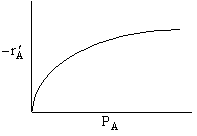
| Figure (a) suggests: | |
| \( -r'_A \sim \frac{P_A}{1 + K_A P_A + \dots} \quad \therefore A \text{ is on the surface} \) | |
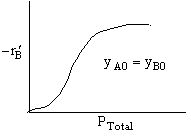
| Figure (b) suggests: | |
|
\( P_A = y_A P_T \) \( P_B = y_B P_T \) \( P_C = y_C P_T \) \( -r'_A \sim \frac{P_T^2}{[1 + (K_A + K_B)P_T + \dots]^2} \sim \frac{P_T^2}{1 + K P_T^2} \) |
|
|
Low \( P_T \): \( -r'_A \sim P_T^2 \) |
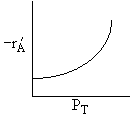
|
|
High \( P_T \): \( -r'_A \sim \frac{P_T^2}{P_T^2} \sim k \) |
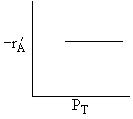
|
| Combining: |
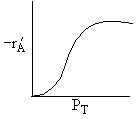
|
| \( -r'_A \sim \frac{P_A P_B}{[1 + K_A P_A + K_B P_B + \dots]^2} \) | |
| Figure (c) suggests: | |
| \( -r'_A \neq f(P_D) \Rightarrow \text{Reaction is irreversible and D is not on the surface} \) | |
| Figure (d) suggests: | |
|
\( -r'_A \sim \frac{1}{1 + K_C P_C + \dots} \) \( \therefore C \text{ is on the surface} \) |
|
| Combining all the above: | |
| \( -r'_A = \frac{k P_A P_B}{\left[ 1 + K_A P_A + K_B P_B + K_C P_C \right]^2} \) | |
| Therefore (b) is consistent: | |
|
\( A + S \rightleftharpoons A \cdot S \quad \Rightarrow C_A \cdot S = K_A P_A C_V \) \( B + S \rightleftharpoons B \cdot S \quad \Rightarrow C_B \cdot S = K_B P_B C_V \) \( A \cdot S + B \cdot S \rightarrow C \cdot S + D + S \) \( -r'_A = r_S = k_S \left[ C_A \cdot S \cdot C_B \cdot S \right] = k_S K_A K_B P_A P_B C_V^2 \) \( C_C \cdot S = K_C P_C C_V \) |
|
|
\( C_T = C_V + C_A \cdot S + C_B \cdot S + C_C \cdot S \) \( = C_V (1 + K_A P_A + K_B P_B + K_C P_C) \) \( C_V = \frac{C_T}{1 + K_A P_A + K_B P_B + K_C P_C} \) \( -r'_A = \frac{k P_A P_B}{K} \cdot \frac{1}{(1 + K_A P_A + K_B P_B + K_C P_C)^2} \) |
|
|
1. The reaction is irreversible because when PB = 1 atm, increasing the product C does not change the rate. (TRUE) |
|
2. Species B is on the surface because in 1 we showed that the reaction is irreversible, therefore the only way the rate could decrease were if were in the denominator of the rate law. If a species is in the denominator of the rate law it’s on the surface. (TRUE) |
|
3. Species C is not on the surface because increasing PC does not affect the rate.(FALSE) |
| Ans: A |
A and B are on the surface. C is not on the surface.
|
\( -r_A = \frac{k P_A^2}{(1 + K_A P_A + K_B P_B)^2} \) \( P_A = y_A P_T \) \( -r_A = \frac{k y_A^2 P_T^2}{(1 + K_A y_A P_T)^2} \) |
|
Low PT |
\( -r_A \sim P_T^2 \) |
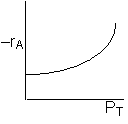
|
|
High PT |
\( -r_A \sim \frac{k}{K_A} \) |
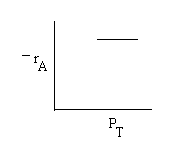
|
|
Combining |
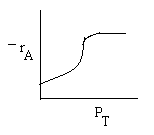
|
|
\( -r_A \sim \frac{1}{\left[ 1 + \dots + K_C P_C \right]^2} \) |
|
|
Ans: (c) |
\( -r_A = r_S = k_S C_A^2 S \)
\( C_A \cdot S = K_A P_A C_V \)
\( C_B \cdot S = K_B P_B C_V \)
\( C_T = C_V + K_A P_A C_V + K_B P_B C_V \)
\( C_V = \frac{C_T}{[1 + K_A P_A + K_B P_B]^2} \)
\( -r_A = \frac{k P_A^2}{[1 + K_A P_A + K_B P_B]^2} \)
Ans: (e)