Chapter 9: Reaction Mechanisms, Pathways, Bioreactions and Bioreactors
Active Intermediates
Problem Statement
The rate law for the reaction
\( A \rightarrow B + C \)
is found from experiment to be
\( -r_A = \frac{k C_A^2}{1 + k' C_A} \)
Suggest a mechanism consistent with the rate law.
Solution
Solution:
Solution
Two A molecules collide and energy is transferred from one A molecule to the other molecule making it highly reactive.
\( (1) \quad A + A \xrightarrow{k_1} A^* + A \quad \quad r_{1A^*} = -k_1 C_A^2 \)
This activated molecule (A*) can do one of two things. It (A*) can collide with another molecule to become deactivated (A).
\( (2) \quad A^* + A \xrightarrow{k_2} A + A \quad \quad r_{2A^*} = -k_2 C_{A^*} C_A \)
or (2) the activated molecule, A* can decompose to form B and C
\( (3) \quad A^* \xrightarrow{k_3} B + C \quad \quad r_{3A^*} = -k_3 C_{A^*} \)
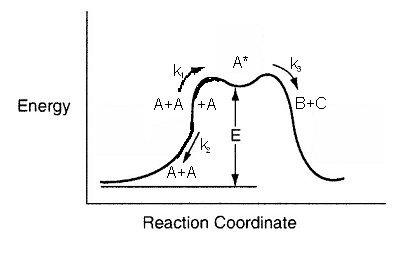
For reactions with active intermediates, the reaction coordinated discussed in Chapter 3 now has trough in it and the active intermediate, A*, sit in this trough
Rate Laws
\(\text{Reaction (1)} \quad r_{1A^*} = k_1 C_A^2 \quad \quad (1)\)
\(\text{Reaction (2)} \quad r_{2A^*} = -k_2 C_A C_{A^*} \quad \quad (2)\)
\(\text{Reaction (3)} \quad r_{3A^*} = -k_3 C_{A^*} \quad \quad (3)\)
Relative Rates
\( r_{1A} = -2 r_{1A^*} \quad , \quad r_{3B} = -r_{3A^*} \quad \quad (4) \)
Net Rates: Rate of Formation of Product
\( r_B = r_{3B} = -r_{3A^*} = k_3 C_{A^*} \quad \quad (4) \)
Need to find an expression for CA* because we cannot easily measure the concentration of A*, use PSSH to solve for CA*.
\( r_{A^*} = \sum r_{1A^*} = r_{1A^*} + r_{2A^*} = r_{3A^*} \quad \quad (5) \)
\( = k_1 C_A^2 - k_2 C_A C_{A^*} - k_3 C_{A^*} = 0 \quad \quad (6) \)
Solving for CA*
\( C_{A^*} = \frac{k_1 C_A^2}{k_3 + k_2 C_A} \quad \quad (7) \)
Substituting for CA* in Equation (4) the rate of formation of B is
\( r_B = \frac{k_1 k_3 C_A^2}{k_3 + k_2 C_A} \quad \quad (8) \)
Relative rates overall
\( A \rightarrow B + C \)
\( \frac{r_B}{1} = \frac{r_A}{-1} \)
\( r_A = -r_B = \frac{- k_1 k_3 C_A^2}{k_3 + k_2 C_A} \quad \quad (9) \)
For high concentrations of A, we can neglect k3 with regard to k2CA, i.e.,
\( k_2 C_A \gg k_3 \)
and the rate law becomes
\( r_A = - \frac{k_1 k_3}{k_2} C_A = -k C_A \quad \quad (10) \)
Apparent first order.
For low concentrations of A, we can neglect k2CA with regard to k3, i.e.,
\( k_3 \gg k_2 C_A \)
and the rate law becomes
\( -r_A = - \frac{k_3 k_1}{k_3} C_A^2 = - k_1 C_A^2 \quad \quad (11) \)
Apparent second order
Dividing by k3 and letting \( k' = \frac{k_2}{k_3} \) and k = k1 we have the rate law we were asked to derive
\( \boxed{ -r_A = - \frac{k C_A^2}{1 + k' C_A} } \quad \quad (12) \)