Chapter 4: Stoichiometry
Matching CA vs. X Curves
Match the following concentration- conversion curves (a-g) with the corresponding reaction and reaction conditions for a flow reactor at constant temperature and pressure.
| (a) | 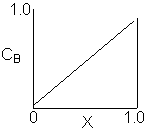 |
(b) | 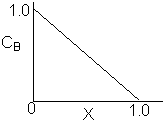 |
(c) | 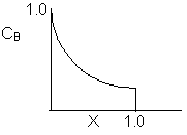 |
| (d) | 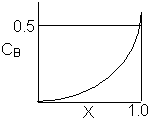 |
(e) | 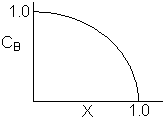 |
(f) | 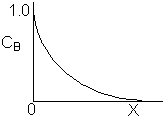 |
| (g) | 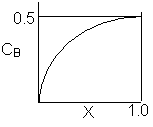 |
1) Gas phase, Pure A, CA0=1
\(A \longrightarrow B + C\)
2) Gas phase, CA0=CB0=1
\(A + B \longrightarrow C + D\)
3) Liquid phase, Pure A, CA0=1
\(A \longrightarrow B + C\)
4) Gas phase, Stoichiometric Feed, CA0=1/2
\(A + 2B \longrightarrow C\)
5) Gas phase, CA0=CB0=0.5
\(A + \frac{1}{2}B \longrightarrow 4C\)
Full Solution
|
|
Solution 1
Ans(G) |
Solution 2
Ans(B) |
Solution 3
Ans(A) |
Solution 4
Ans(E) |
Solution 5
Ans(C) |
Match the following concentration- conversion curves (a-g) with the corresponding reaction and reaction conditions for a flow reactor at constant temperature and pressure.
1) Gas phase, Pure A, CA0=1
\(A \longrightarrow B + C\)
2) Gas phase, CA0=CB0=1
\(A + B \longrightarrow C + D\)
3) Liquid phase, Pure A, CA0=1
\(A \longrightarrow B + C\)
4) Gas phase, Stoichiometry Feed, CA0=1/2
\(A + 2B \longrightarrow C\)
5) Gas phase, CA0=CB0=0.5
\(A + \frac{1}{2}B \longrightarrow 4C\)
| (a) | |
(b) | |
(c) | |
| (d) | |
(e) | |
(f) | |
| (g) | |
Solution
| 1) |
|
\(C_B = \frac{F_B}{\nu} = \frac{F_{A0} X}{\nu_0 (1 + \varepsilon X)} = \frac{C_{A0} X}{1 + \varepsilon X}, \, \varepsilon = y_{A0} \delta = (1)(1 + 1 - 1) = 1\) \(C_B = \frac{X}{1 + X} \) Ans(G) |
| 2) |
|
\(C_B = \frac{F_B}{\nu} = \frac{F_{B0} \left( \theta_B - X \right)}{\nu_0 (1 + \varepsilon X)} = \frac{C_{A0} \left( \theta_B - X \right)}{1 + \varepsilon X}, \, \varepsilon = 1(1 + 1 - 1 - 1) = 0, \, \theta_B = \frac{1}{1} = 1\) \(C_B = (1 - X) \) Ans(B) |
| 3) |
|
\(C_B = \frac{F_B}{\nu} = \frac{F_B}{\nu_0} = \frac{F_{A0} X}{\nu_0} = C_{A0} X\) Ans(A) |
| 4) |
|
\(C_B = \frac{F_B}{\nu} = \frac{F_{A0} \left(\theta_B - 2X\right)}{\nu_0 (1 + \varepsilon X)} = \frac{C_{A0} \left(\theta_B - 2X\right)}{(1 + \varepsilon X)}, \, \varepsilon = \frac{1}{3}(1 - 2 - 1) = -\frac{2}{3}, \, \theta_B = \frac{2}{1} = 2\) \(C_B = \frac{(1 - X)}{\left(1 - \frac{2}{3}X\right)} \) Ans(E) |
| 5) |
|
\(C_B = \frac{F_B}{\nu} = \frac{F_{A0} \left(\theta_B - 2X\right)}{\nu_0 (1 + \varepsilon X)} = \frac{C_{A0} \left(\theta_B - \frac{1}{2}X\right)}{1 + \varepsilon X}, \, \varepsilon = \frac{1}{2} \left(4 - 1 - \frac{1}{2}\right) = \frac{5}{4}\) \(C_B = \frac{\left(1 - \frac{1}{2}X\right)}{\left(1 + \frac{5}{4}X\right)} \) Ans(C) |