Chapter 4: Stoichiometry
Oxidation of Naphthalene to Phtahalic Anhydride
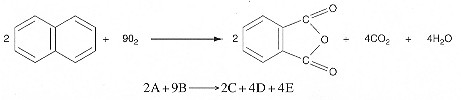
We are going to rework the class problem for the case of 3.5% naphthalene and 96.7% air and for a pressure of 10 atm and a temperature of 500K. A feed under these conditions naphthalene is the limiting reactant.
- Stoichiomentric Table - Batch System
Species Symbol In Change Out Naphthalene A \(N_{A0}\) \(-N_{A0}X\) \(N_A = N_{A0}(1 - X)\) Oxygen B \(N_{B0} = \Theta_B N_{A0}\) \(-\frac{9}{2}N_{A0}X\) \(N_B = N_{A0}(\Theta_B - \frac{9}{2}X)\) Phthalic Anhydride C \(N_C = 0\) \(+N_{A0}X\) \(N_C = N_{A0}X\) Carbon Dioxide D \(N_D = 0\) \(+2N_{A0}X\) \(N_D = 2N_{A0}X\) Water E \(N_E = 0\) \(+2N_{A0}X\) \(N_E = 2N_{A0}X\) Nitrogen I \(N_I = \Theta_I N_{A0}\) --- \(N_I = \Theta_I N_{A0}\) Total \(N_{T0}\) \(N_T = N_{T0} + \Theta N_{A0}X\) \(\delta = [1 + 2 + 2 - \frac{9}{2} - 1] = -1/2\)
Stoichiometric Table - Flow System
Species Symbol In Change Out Naphthalene A \(F_{A0}\) \(-F_{A0}X\) \(F_A = F_{A0}(1 - X)\) Oxygen B \(F_{B0} = \Theta_B F_{A0}\) \(-\frac{9}{2}F_{A0}X\) \(F_B = F_{A0}(\Theta_B - \frac{9}{2}X)\) Phthalic Anhydride C \(F_C = 0\) \(+F_{A0}X\) \(F_C = F_{A0}X\) Carbon Dioxide D \(F_D = 0\) \(+2F_{A0}X\) \(F_D = 2F_{A0}X\) Water E \(F_E = 0\) \(+2F_{A0}X\) \(F_E = 2F_{A0}X\) Nitrogen I \(F_I = \Theta_I F_{A0}\) --- \(F_I = \Theta_I F_{A0}\) Total \(F_{T0}\) \(F_T = F_{T0} + \delta F_{A0}X\)
-
\(\Theta_B = \frac{F_{B0}}{F_{A0}} = \frac{y_{B0}F_{T0}}{y_{A0}F_{T0}} = \frac{(0.21)(0.965)}{(0.035)} = 5.79\)
\(\Theta_I = \frac{F_{I0}}{F_{A0}} = \frac{y_{I0}F_{T0}}{y_{A0}F_{T0}} = \frac{(0.754)(0.21)}{0.035} = 20.78\)
\(y_{A0} = 0.035 \, (\text{given})\)
\(\delta = \left[1 + 2 + 2 - \frac{9}{2} - 1\right] = -\frac{1}{2}\)
\(\varepsilon = y_{A0}\delta = (0.035)\left(-\frac{1}{2}\right) = -0.0175\)
\(C_{A0} = y_{A0}C_{T0} = y_{A0} \frac{P_0}{RT_0} = \frac{(0.035)(10 \, \text{atm})}{0.082 \, \frac{\text{dm}^3 \cdot \text{atm}}{\text{mol} \cdot \text{K}} \cdot 500 \, \text{K}} = 0.0085 \, \frac{\text{mol}}{\text{dm}^3}\)
\(C_{B0} = \Theta_B C_{A0} = (5.79)(0.0085 \, \frac{\text{mol}}{\text{dm}^3}) = 0.049 \, \frac{\text{mol}}{\text{dm}^3}\)
- Determine each of the following solely as a function of the conversion of naphthalene, X for a
constant-pressureisothermal flow reactor.
- Find the concentration of O2
Gas Phase Flow System:
\(C_B = \frac{F_B}{\nu} \quad \text{where} \quad \nu = \nu_0(1 + \varepsilon X) \frac{P_0}{P} \frac{T}{T_0}\)
\(C_B = \frac{F_B}{\nu} = \frac{F_A\left(\Theta_B - \frac{9}{2}X\right)}{\nu_0(1 + \varepsilon X)} \frac{P}{P_0} \frac{T_0}{T}\)
\(= C_{A0} \frac{\left(\Theta_B - \frac{9}{2}X\right)}{(1 + \varepsilon X)} \frac{P_0}{P} \frac{T_0}{T}\)
Constant pressure and isothermal: P = Po; T = To
\(\varepsilon = y_{A0} \delta = (0.035)\left(-\frac{1}{2}\right) = -0.0175\)
\(C_B = (0.0085) \frac{\left(5.79 - \frac{9}{2}X\right)}{(1 - 0.0175X)}\)
- Find the volumentric flowrate
\(\nu = \nu_0 (1 + \varepsilon X) \frac{P_0}{P} \frac{T}{T_0}\)
Constant pressure and isothermal: P = Po; T = To
\(\nu = \nu_0 (1 - 0.0175X)\)
- Find the reaction rate
Rate Law: -rA = kAC2ACB
\(-r_A = k_A C_A^2 C_B = k_A \left(\frac{F_{A0}(1 - X)}{\nu_0 (1 - 0.0175X)}\right)^2 \left(\frac{F_{A0}\left(5.79 - \frac{9}{2}X\right)}{\nu_0 (1 - 0.0175X)}\right)\)
\(-r_A = \frac{k_A C_{A0}^3 (1 - X)^2 \left(5.79 - \frac{9}{2}X\right)}{(1 - 0.0175X)^3}\)
\(-r_A = (6.14 \times 10^{-1}) \frac{(1 - X)^2 \left(5.79 - \frac{9}{2}X\right)}{(1 - 0.0175X)^3}\)
- Find the concentration of O2
- The concentration of O2
For Batch: V = V0, CB = NB/V = NB/V0
\(C_B = \frac{N_B}{V_0} = \frac{N_{A0} \left(\Theta_B - \frac{9}{2}X\right)}{V_0} = C_{A0} \left(5.79 - \frac{9}{2}X\right)\)
\(\text{where } C_{A0} = y_{A0} \frac{P_0}{RT} = \frac{(0.035)(10 \, \text{atm})}{\left(0.082 \, \frac{\text{dm}^3 \cdot \text{atm}}{\text{mol} \cdot \text{K}}\right)(500 \, \text{K})}\)
\(C_{A0} = 0.0085\)
\(C_B = 0.0085 \left(5.79 - \frac{9}{2}X\right)\)
- The total pressure, P.
\(P = \frac{P_Q}{y_Q} = \frac{C_B RT_0}{y_Q} = \frac{C_B RT_0}{\left(C_B / C_T\right)} = C_T RT_0\)
\(P = \left(\frac{N_{T0} + \delta N_{A0} X}{V}\right)RT = \left(C_{T0} - \frac{1}{2}C_{A0} X\right)RT\)
\(P = \left(28.57C_{A0} - \frac{1}{2}C_{A0} X\right) = \left(28.57 - \frac{1}{2}X\right)(0.0085)\left(0.082 \, \frac{\text{dm}^3 \cdot \text{atm}}{\text{mol} \cdot \text{K}}\right)(500 \, \text{K})\)
\(P (\text{atm}) = 0.3485 \left(28.57 - \frac{1}{2}X\right)\)
- The rate law
Rate Law: -rA = kAC2ACB
\(-r_A = k_A C_A^2 C_B = k_A \left(\frac{N_A}{V_0}\right)^2 \left(\frac{N_B}{V_0}\right)\)
\(-r_A = k_A \left(\frac{N_{A0}(1 - X)}{V_0}\right)^2 \left(\frac{N_{A0} \left(5.79 - \frac{9}{2}X\right)}{V_0}\right)\)
\(-r_A = k_A \left(C_{A0}^2 (1 - X)^2\right) \left(C_{A0} \left(5.79 - \frac{9}{2}X\right)\right)\)
\(-r_A = [6.23 \times 10^{-1}] (1 - X)^2 \left(5.79 - \frac{9}{2}X\right)\)