Chapter 4: Stoichiometry
Stoichiometric Table - Conversion
Let’s consider the production of ethyl benzene
\( 2 \, \text{Ethylene} + \text{Toluene} \longrightarrow \text{Ethyl Benzene} + \text{Propylene} \)
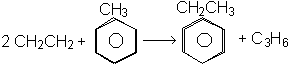
The gas feed consists of 25% toluene and 75% ethylene. Set up a stoichiometric table to determine the concentrations of each of the reacting species and then to write the rate of reaction solely as a function of conversion. Assume the reaction is elementary with \( k_T = 250 \, \left( \text{dm}^6/\text{mol}^2 \cdot \text{s} \right) \) . The entering pressure is 8.2 atm and the entering temperature is 227°C and the reaction takes place isothermally with no pressure drop.
Hint 1: What is your basis of calculation?
Hint 2: What are the entering concentrations of ethylene and toluene?
Hint 4: Write the row in the stoichiometric table for toluene.
Hint 5: Write the row in the stoichiometric table for ethylene.
Hint 6: Write the complete stoichiometric table including total molar flow rates.
Hint 7: Write the volumetric flow rate in terms of conversion.
Hint 8: Write the concentration of toluene and ethylene in terms of conversion
Hint 9: Write the rate of disappearance of A, –rA solely as a function of conversion
Hint 10: What are the relative rates of reaction of A and B?
Hint 1
The stoichiometric ratio is one toluene to two ethylene (1/2). However, the feed is one toluene to three ethylene (1/3) and there is not sufficient toluene to consume all the ethylene. Therefore toluene is the limiting reactant and thus the basis of calculation.
Hint 2
Let A = toluene, B = ethylene, C = ethyl benzene and D = propylene
\( A + 2B \longrightarrow C + D \)
\( C_{A0} = y_{A0} C_{T0} = y_{A0} \frac{P_0}{RT_0} \)
\( = 0.25 \left( \frac{8.2 \, \text{atm}}{0.082 \, \text{atm} \cdot \text{dm}^3 \cdot \text{mol}^{-1} \cdot \text{K}^{-1}} (500\,\text{K}) \right) = (0.25)(0.2 \, \text{mol} \cdot \text{dm}^{-3}) = 0.05 \, \text{mol} \cdot \text{dm}^{-3} \)
\( C_{T0} = \frac{P_0}{RT_0} = 0.2 \, \text{mol} \cdot \text{dm}^{-3} \)
Ethylene: \( C_{B0} = y_{B0} C_{T0} = (0.75)(0.2 \, \text{mol} \cdot \text{dm}^{-3}) = 0.15 \, \text{mol} \cdot \text{dm}^{-3} \)
Hint 3
Since toluene, i.e. A, is the limiting reactant and has a stoichiometric coefficient of 1
\( y_{A0} = 0.25 \)
\( A + 2B \longrightarrow C + D \)
\( \delta = (1 + 1 - 1 - 2) = -1 \)
\( \varepsilon = y_{A0} \delta = (0.25)(-1) = -0.25 \)
Hint 4
| Species | Symbol | Entering | Change | Leaving |
|---|---|---|---|---|
| Toluene | \( A \) | \( F_{A0} \) | \( -F_{A0}X \) | \( F_A = F_{A0}(1 - X) \) |
Hint 5
| Species | Symbol | Entering | Change | Leaving |
|---|---|---|---|---|
| Toluene | \( A \) | \( F_{A0} \) | \( -F_{A0}X \) | \( F_A = F_{A0}(1 - X) \) |
| Ethylene | \( B \) | \( F_B = \Theta_B F_{A0} \) | \( -2F_{A0}X \) | \( F_B = F_{A0}(\Theta_B - 2X) \) |
\( \Theta_B = \frac{y_{B0}}{y_{A0}} = \frac{0.75}{0.25} = 3 \)
Leaving \( F_B \): \( = F_{A0}(3 - 2X) \)
Hint 6.
Complete the stoichiometric table including coolant flow rates
| Species | Symbol | Entering | Change | Leaving |
|---|---|---|---|---|
| Toluene | \( A \) | \( F_{A0} \) | \( -F_{A0}X \) | \( F_A = F_{A0}(1 - X) \) |
| Ethylene | \( B \) | \( F_B = 3F_{A0} \) | \( -2F_{A0}X \) | \( F_B = F_{A0}(3 - 2X) \) |
| Ethyl benzene | \( C \) | 0 | \( +F_{A0}X \) | \( F_C = F_{A0}X \) |
| Propylene | \( D \) | 0 | \( +F_{A0}X \) | \( F_D = F_{A0}X \) |
| Total | \( F_T = 4F_{A0} \) | \( F_T = 4F_{A0} - F_{A0}X \) |
\[ F_T = F_{T0} + \delta F_{A0}X \]
\[ \delta = -1, \quad F_{T0} = 4F_{A0} \]
\[ F_T = 4F_{A0} - F_{A0}X \]
Hint 7.
Write the volumetric flow rate in terms of conversion
\(v = v_0 \left(1 + \varepsilon X\right) \frac{P_0}{P} \frac{T}{T_0}\)
\(P = P_0 \text{ and } T = T_0\)
\(\varepsilon = y_{A0} \delta = \left(0.25\right)\left(1 + 1 - 1 - 2\right) = -0.25\)
\(v = v_0 \left(1 - 0.25X\right)\)
Hint 8.
In terms of conversion
\(C_A = \frac{F_A}{v}\)
For a flow system at constant T and P
\(C_A = \frac{F_A}{v} = \frac{F_{A0}(1 - X)}{v_0 (1 + \varepsilon X)} = C_{A0} \frac{(1 - X)}{(1 + \varepsilon X)}\)
\(C_A = \frac{0.05(1 - X)}{1 - 0.25X}\)
\(C_B = \frac{F_B}{v} = \frac{F_{A0}(3 - 2X)}{v_0 (1 + \varepsilon X)} = C_{A0} \frac{(3 - 2X)}{(1 - 0.25X)}\)
Hint 9.
In terms of conversion
\(-r_A = k C_A C_B^2\)
\(C_A = C_{A0} \frac{(1 - X)}{(1 + \varepsilon X)}\)
\(C_B = C_{A0} \frac{(3 - 2X)}{(1 + \varepsilon X)}, \, \varepsilon = -0.25\)
\(-r_A = k C_{A0}^3 \frac{(1 - X)(3 - 2X)^2}{(1 - 0.25X)^3}\)
\(k C_{A0}^3 = y_{A0} \delta k C_{T0}^3 = (0.25) \left( 2 \times 10^{-1} \, \frac{\text{mol}}{\text{dm}^3} \right)\)
\(= 3.13 \times 10^{-3} \, \frac{1}{\text{s}} \, \frac{\text{mol}}{\text{dm}^3}\)
\(-r_A = 3.13 \times 10^{-3} \, \frac{1}{\text{s}} \, \frac{\text{mol}}{\text{dm}^3} \frac{(1 - X)(3 - 2X)^2}{(1 - 0.25X)^3}\)
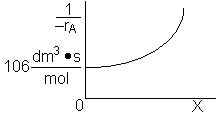
We now have –rA solely as a function of X and can use the methods in Ch.2 to design reactors.
\(\text{at } X = 0 \quad \frac{1}{-r_A} = 106 \, \frac{\text{dm}^3 \cdot \text{s}}{\text{mol}}\)
Hint 10
\(\text{A} + 2\text{B} \longrightarrow \text{C} + \text{D}\)
\(\frac{-r_A}{1} = \frac{-r_B}{2} = \frac{r_C}{1} = \frac{r_D}{1}\)
\(-r_B = 2r_A\)
\(-r_B = 2(-r_A)\)
\(-r_B = 2\left[ 3.13 \times 10^{-3} \, \frac{\text{mol}}{\text{dm}^3 \cdot \text{s}} \frac{(1 - X)(3 - 2X)^2}{(1 - 0.25X)^3} \right]\)
\(-r_B = 6.26 \times 10^{-4} \, \frac{\text{mol}}{\text{dm}^3 \cdot \text{s}} \frac{(1 - X)(3 - 2X)^2}{(1 - 0.25X)^3}\)