Chapter 3: Rate Laws
Crickets
The following sound of chirping crickets was recorded in the woods during the summer evening. What was the temperature in the woods the evening the crickets were recorded? (The recording is ten seconds long.)
Hint 2: How will you use the data to find the temperature?
There are 22 chirps in the 10 second interval.
The frequency of flashing of fireflies and the frequency of chirping of crickets as a function of temperature are given below [J. Chem. Educ., 5, 343 (1972) Reprinted by permission.].
|
T(°C) |
14.2 |
20.3 |
27.0 |
|
Chirps/min |
80 |
126 |
200 |
Can you use a form of the Arrhenius equation (Ae-E/RT) to make an appropriate plot of the cricket data?
The following sound of chirping crickets was recorded in the woods during the summer evening. What was the temperature in the woods the evening the crickets were recorded?
Solution
Assume:
\(\ln F = \ln A - \frac{E}{R} \left[\frac{1}{T}\right]\)
Answer=
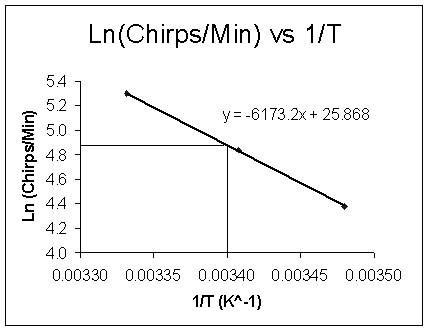
Using data from the chart below (P3-3A), graph ln(chirps/min) vs 1/T.
T (°C) T (K) Chirps/Min 1/T LN(Chirps/Min) 14.2 287.35 80 0.00348 4.382 20.3 293.45 126 0.00341 4.836 27 300.15 200 0.00333 5.298
From the recording, we know that the crickets were chirping 11 times in five seconds, or 132 times per minute. Find this point on the graph and find the corresponding temperature.
Parameter Value E/R (K) 6173.2 A 1.71526E+11 Chirps/Min 132 ln(Chirps/Min) 4.88 1/T 0.00340 T 294.17 Temp (°C) 21.02 Temp (°F) 69.8
Consequently, the night Prof. Fogler measured the cricket chirps in the bushes, the temperature was 69.8 degrees Fahrenheit.