Chapter 3: Rate Laws
Determination of the Activation Energy
This is Example 3-1 from the book page 95.Calculate the activation energy for the decomposition of benzene diazonium chloride to give chlorobenzene and nitrogen:
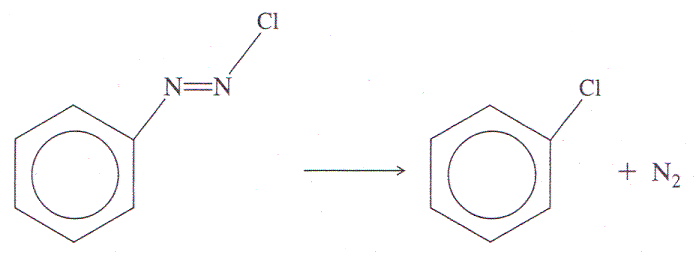
using the information in Table E3-1.1 for this first order reaction.
| k (s⁻¹) | 0.00043 | 0.00103 | 0.00180 | 0.00355 | 0.00717 |
|---|---|---|---|---|---|
| T (K) | 313.0 | 319.0 | 323.0 | 328.0 | 333.0 |
Solution
Solution
We start by recalling Equation (3-20)
\(\ln k_A = \ln A - \frac{E}{R} \left(\frac{1}{T}\right) \tag{3-20}\)
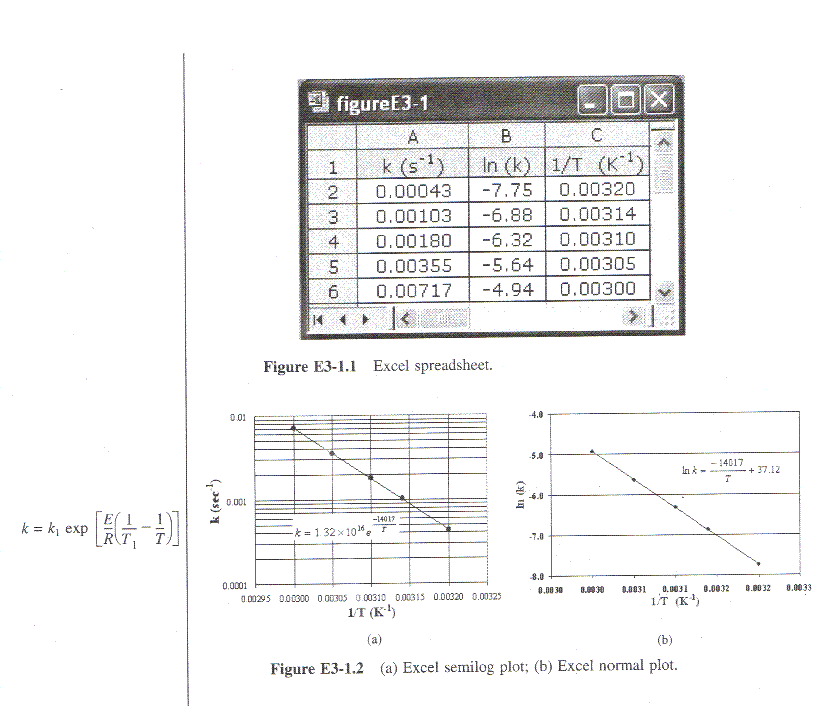
We can use the data in Table E3-1.1 to determine the activation energy, E, and frequency factor, A, in two different ways. One way is to make a semilog plot of k vs. (1/T) and determine E from the slope. Another way is to use Excel or Polymath to regress the data. The data in Table E3-1.1 was entered in Excel and is shown in Figure E3-1.1 which was then used to obtain Figure E3-1.2.
A step-by-step tutorial to construct both an Excel and a Polymath spread sheet is given in the Chapter 3 Summary Notes on the CD-ROM.
(a)Graphical Solution
Figure E3-1.2(a) shows the semilog plots from which we can calculate the activation energy. From CD-ROM Appendix D, we show how to rearrange Equation (3-20) in the form
\(\log \frac{k_2}{k_1} = -\frac{E}{2.3R} \left(\frac{1}{T_2} - \frac{1}{T_1}\right)\) - (E3-1.1)
Rearranging
\(E = -\frac{(2.3)(R) \log(k_2 / k_1)}{\frac{1}{T_2} - \frac{1}{T_1}}\) - (E3-1.2)
To use the decade method, choose 1/T1 and 1/T2 so that k2= 0.1k1. Then, log(k1/k2)=1.
When k1 = 0.005: 1/T1 = 0.003025 and when k2= 0.0005: 1/T2 = 0.00319
\(E = \frac{2.303R}{\frac{1}{T_2} - \frac{1}{T_1}} = \frac{(2.303)(8.314 \, \text{J/mol} \cdot \text{K})}{(0.00319 - 0.003025)/\text{K}}\)
\(= 116 \, \frac{\text{kJ}}{\text{mol}} \, \text{or} \, 28.7 \, \text{kcal/mol}\)
From Figure E3-1.2(b) and Equation (E3-1.3), we see
ln A = 37.12
taking the antilog
\(A = 1.32 \times 10^{16} \, \text{s}^{-1}\)
\(k = 1.32 \times 10^{16} \exp\left[\frac{-14,017 \, \text{K}}{T}\right]\) - (E3-1.4)