
References
Navigation:
| Home Page | Mechanism | H-NMR | Experimental | References | Leading Questions | About Us |
Currently on: References
Original Article:
Sources used by Original Article:

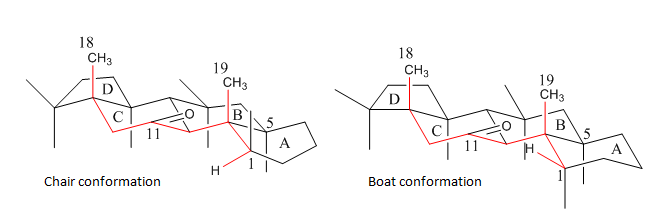
The paper “Über Steroide und Sexualhormone” disucsses the reasons for the high yield and the high regioselectivity of photochemical reactions involving 11-oxo-pregnan-derivates (11-oxo-5α-pregnane derivate). Unlike other keto-group containing steroids, steroids containing a carbonyl-group at C11 tend to undergo cyclization more easily.
According to this paper this is because the γ-Hydrogens on γ-Carbons 18, 19 and 1, with respect to the carbonyl group, sterically hinder the ketone group to undergo several reactions. This idea is reinforced since, apart from the γ-Hydrogen on Carbon 1, the conformation does not change much, so that Carbons 18 and 19 are continuously preventing the carbonyl group to react. The γ-Hydrogen on Carbon 1 does not hinder the carbonyl group as much, because of its significant position change when in the boat conformation.
Since Carbons 18 and 19 are close to the carbonyl-group, the latter easily undergoes cyclization with one of them. This paper also analyzes and discusses the data collected, in order to prove that Carbon 19, rather than Carbon 18 undergoes cyclization. The reason for this selectivity is not mentioned.
The following are a few other papers that cited the article:

Ana: The steric hindrance created by the Hydrogens from Carbon 19 are used to explain the unusual chemical shifts obtained at the experiment.
William: One of the byproducts of this reaction was the formation of a cyclobutane ring within the steroid, and cites the “Über Steroide und Sexualhormone” article.
Kristine: In the photochemical and photo-physical data for the steroids in the paper, the steroid, 3alpha-(dimethylphenylsiloxy)-5alpha-androstane-11,17-dione, has a significantly lower excitation energy than the other steroids. The article cites the “Über Steroide und Sexualhormone” article explaining that this observed energy loss may be due to the steric hindrance by the gamma-carbon 19.

Ana: This article expands the idea of the formation of a cyclobutane, by presenting a reaction that has a 100% yield.
William: This article includes the same protection reaction used in our Oubagenin article, and cites the Uber Steroide article in the same way to explain why one ketone does not get altered by the protecting groups that are being added to the other ketones of the molecule.
Kristine: The article confirms that the photochemical induced reaction only results in a cyclobutane, just a cyclobutane.

Ana: Referring back to Schaffner’s article is a good way to avoid further explanations on why there is a cyclobutane formation between the keto-group at C11 and the Hydrogens at Carbon 19.
William: Once again, cyclobutane is being formed from the sterically crowded ketone and methyl group. This case is slightly different, as they have an alkyne as well, which will switch stereochemistry within the same process.
Kristine: The article involves the formation of a cyclobutane. The cyclization is observed by the absence of characteristic resonance of the C19 methyl group.

