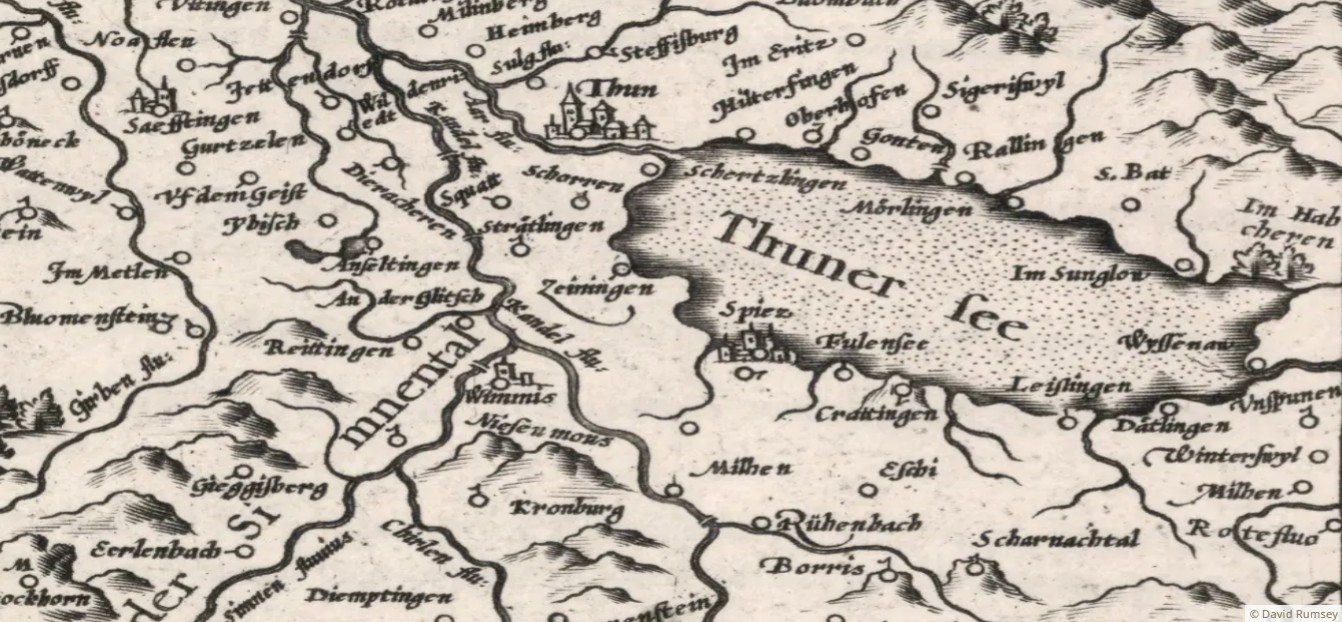
Blumenstein [center left] and Erlenbach [lower left], Switzerland
1585 map by Gerhard Mercator [1]
Hans Herr and Elsbeth Bürcky lived in Blumenstein, Bern, Switzerland when their children Christian and Hans were baptized at the Reformed Church.
1300s [2]
The Reformed church of Blumenstein, originally dedicated to St. Nicholas, was built in the early 14th century on the site of the destroyed Blumenstein Castle. Its oldest part is the Romanesque tower of the predecessor building (13th century), the foundations of which were discovered during excavations in the nave between 1972 and 1975. The church is characterized by its low rectangular nave under a gable roof, its high, recessed chancel with a polygonal apse, and its five tracery windows in the style of courtly High Gothic architecture of the Upper Rhine. Inside, the hall church features a distinctive, laterally sloping wooden ceiling with rich flat carvings and carefully restored wall frescoes on the chancel arch depicting the simple figure of St. Christopher. The medieval complex, comprising the church, cemetery, rectory, tithe barn, granary, and cowshed, forms a remarkable ensemble.


1500s Natural mineral springs were discovered in the municipality in the 16th century. [5] By 1790, the spa was a tourist destination.

1643 Hans Herr and Elsbeth Bürcky were married at the Reformed church in Blumenstein, Bern, Switzerland on February 13. [7] [8] Five of their children were baptized at the church: Christian on May 5, 1644 [9]; Barbara on October 31, 1647 [10]; Hans on January 27, 1650 [11]; Madlen on December 25, 1653 [12]; and Ueli on January 27, 1656 [13].
1665 Son Christen Zher and Margret Lötscher were married on February 20 at the Reformed church in Blumenstein, Bern, Switzerland [14].
1666-1670 Michael Ritter, pastor of the Reformed church, entered a report in the church minutes of March 3, 1666 that Hans Zher, a Chorrichter (member of the church morals court), was questioned as to why he allowed his wife to encourage their son (Christen) and their son's wife (Margret Lötscher) to follow the Anabaptist sect. Hans Herr replied that he was not her [his wife's] master. The pastor and Hans Herr went to the Herr house and discussed the issue with the family. The son and his wife were given a respite of 14 days to attend worship or to submit their reasons in writing. On March 18, Hans Zher was questioned again, but no change in attitude had occurred. Hans Herr, himself, was questioned on June 16, 1670 about his failure to attend worship services and other church functions. [15]
1671 Sons Christian and Hans and their wives left Bern, Switzerland with other refugees and went to Mannheim, Germany, where they purchased a house.
1671 "On December 14, 1671, Valentine Hutwohl wrote a letter that listed Mennonite arrivals in the Palatinate, among whom were "Christens Herr, aged 30; wife Grietgen Lotscher, 28." Next on the list were "Hans Herr, aged 20; wife Elsbeth Lotscher, aged 22; no children. Have linen sheets." [16] [17] [18]
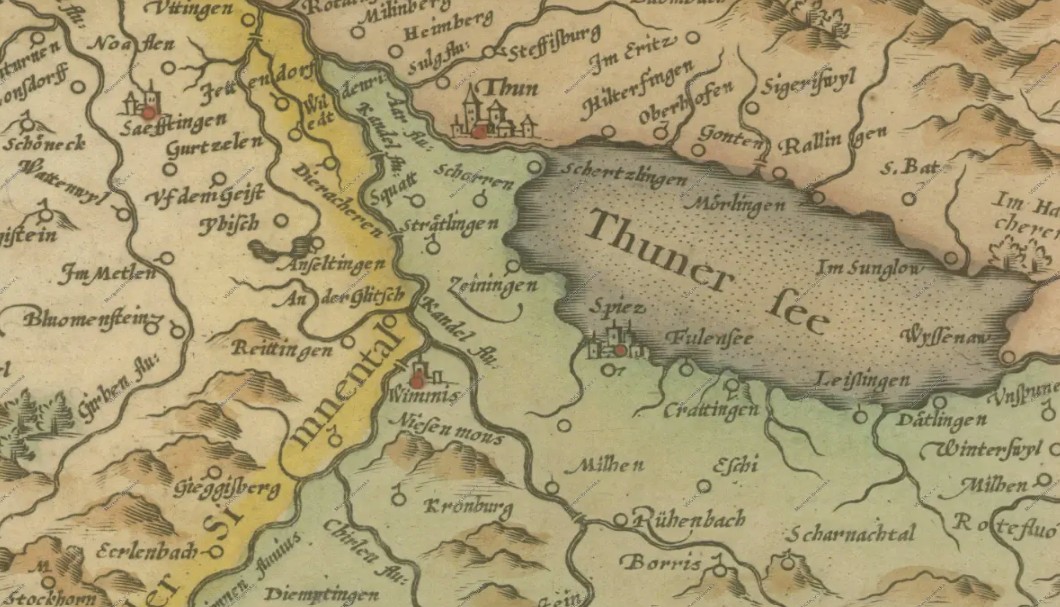
[1] Gerhard Mercator, Blumenstein and Erlenbach, Bern, Switzerland (1585), [Old Maps Online 1585].
[2] Blumenstein Church History, [URL].
[3] Wikimedia Commons: Kirche_Blumenstein_Innenraum_hinten.jpg, content subject to change, [Wikimedia Commons].
[4] Wikimedia Commons: Kirche_Blumenstein05046.jpg, content subject to change, [Wikimedia Commons].
[5] Wikipedia article about Blumenstein, content subject to change, [Wikipedia].
[6] Wikimedia Commons: CH-NB_-_Blumenstein,_Bad,_Badehaus_(%3F)_-_Collection_Gugelmann_-_GS-GUGE-WYSS-CL-C-2.tif, content subject to change, [Wikimedia Commons].
[7] Hanspeter Jecker, "The Swiss Origins of Pioneer Settler Hans Herr in Pennsylvania, Myths, Legends, and New Insights" Pennsylvania Mennonite Heritage 42:3 (2019), 70-81, at 78.
[8] K Blumenstein 2 Taufrodel (1600-1704), Eherodel (1600-1704), Totenrodel (1726-1753), fol. 269-270, page 136 of pdf, [BernStateArchivesImage], [BernStateArchivesCatalog].
[9] K Blumenstein 2 Taufrodel (1600-1704), Eherodel (1600-1704), Totenrodel (1726-1753), fol. 94, page 50 of pdf, [BernStateArchivesImage], [BernStateArchivesCatalog].
[10] K Blumenstein 2 Taufrodel (1600-1704), Eherodel (1600-1704), Totenrodel (1726-1753), fol. 99, page 52 of pdf, [BernStateArchivesImage], [BernStateArchivesCatalog].
[11] K Blumenstein 2 Taufrodel (1600-1704), Eherodel (1600-1704), Totenrodel (1726-1753), fol. 103, page 54 of pdf, [BernStateArchivesImage], [BernStateArchivesCatalog].
[12] K Blumenstein 2 Taufrodel (1600-1704), Eherodel (1600-1704), Totenrodel (1726-1753), fol. 107, page 56 of pdf, [BernStateArchivesImage], [BernStateArchivesCatalog].
[13] K Blumenstein 2 Taufrodel (1600-1704), Eherodel (1600-1704), Totenrodel (1726-1753), fol. 111, page 58 of pdf, [BernStateArchivesImage], [BernStateArchivesCatalog].
[14] K Blumenstein 2 Taufrodel (1600-1704), Eherodel (1600-1704), Totenrodel (1726-1753), fol. 277, page 140 of pdf, [BernStateArchivesImage], [BernStateArchivesCatalog].
[15] Hanspeter Jecker, "The Swiss Origins of Pioneer Settler Hans Herr in Pennsylvania, Myths, Legends, and New Insights" Pennsylvania Mennonite Heritage 42:3 (2019), 70-81, at 79.
[16] Hanspeter Jecker, "The Swiss Origins of Pioneer Settler Hans Herr in Pennsylvania, Myths, Legends, and New Insights" Pennsylvania Mennonite Heritage 42:3 (2019), 70-81, at 72.
[17] Jane Evans Best, The Groff Book, A Continuing Saga, Vol. 2 (Ronks, Pennsylvania: Groff History Associates, 1997), 35, [GoogleBooks], [FHLCatalog].
[18] Jane Evans Best, "Martin Kendig's Swiss Relatives," Pennsylvania Mennonite Heritage 15 (January, 1992), 2-18, at 5, 9, 15, HH1, KA36.
[19] Gerhard Mercator, Blumenstein and Erlenbach, Bern, Switzerland (1623), [Old Maps Online 1623].