Janet and Robert Wolfe Genealogy --- Go to Genealogy Page for Jacob Hiller --- Go to Genealogy Page for Dorothea Hilt
Notes for Jacob Hiller and Dorothea Hilt
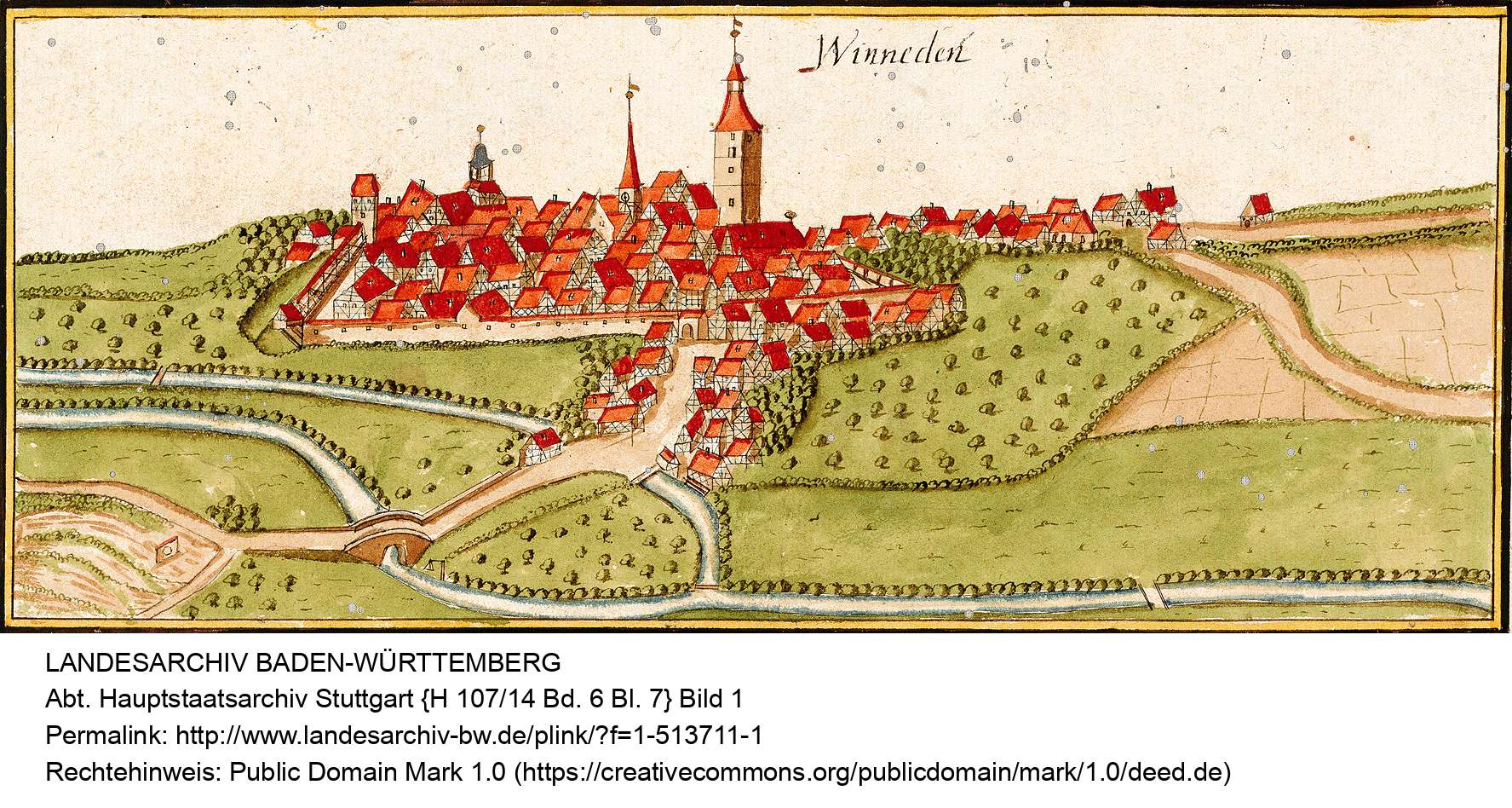
Sketch of Winnenden, made in 1686 by Andreas Kieser, then a lieutenant colonel in the service of the Duke of Württemberg. He was commissioned to survey the Württemberg forests.
Jacob Hiller and wife Dorothea Hilt lived in Hofen, less than a mile outside the walls of the city of Winnenden. [1]
1636 Jacobus, son of Jacob Hiller and Ursula, of Höffen, was baptized on April 29. His sponsors were H. Joann Hagenlach Vogt allhir. [2]
1669 Jacob Hiller, Jacob Hillers seelig Sohn zu Höffen, und Dorothea, Hanß Heldts ehel. Tochter zu Berg" were married on February 16. [3]
1690 "30. Maij. begraben Jacob Hiller Weingärtner, starb s. allters 54: Höfen." [4]
During the Thirty Years' War the city was pillaged twice, in 1638 and 1643, and Imperial, French, and Swedish troops occasionally occupied Winnenden during this conflict. Around the same time the town's castle became the seat of the Württemberg-Winnental line of the House of Württemberg. [5]
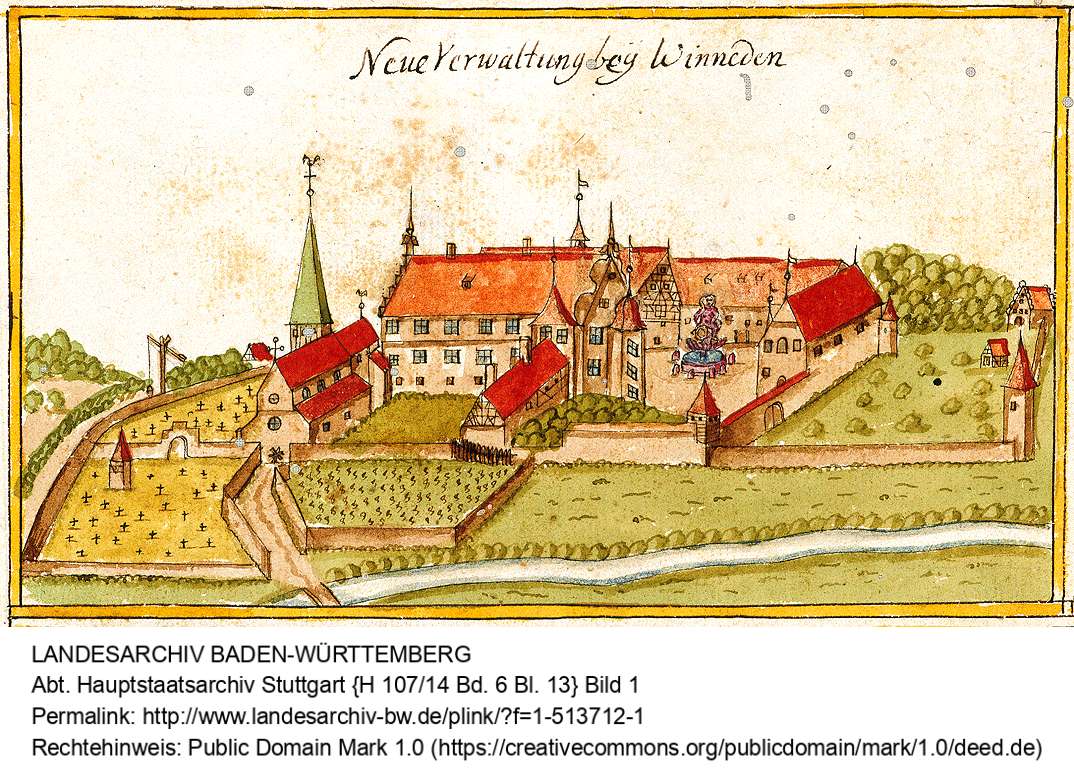
Sketch of the new administration in Winnenden, made in 1686 by Andreas Kieser
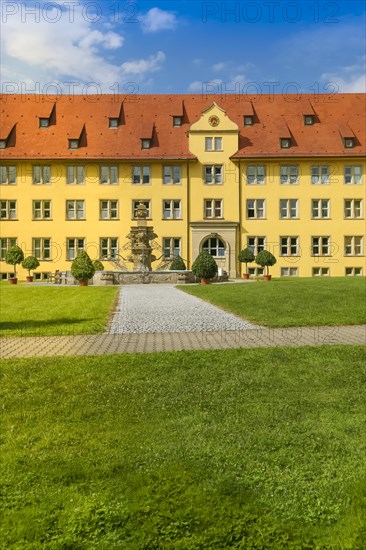
Winnental Castle was built in the 15th century by the Teutonic Knights
as the seat of the Winnender Kommende, former castle of the Teutonic Order.
The castle became the seat of the Württemberg-Winnental line of the House of Württemberg in the 17th century
Today Winnenden Castle is a Clinic Centre for Psychiatry in Winnenden, Germany.
Photo by Katharina Hild [6]
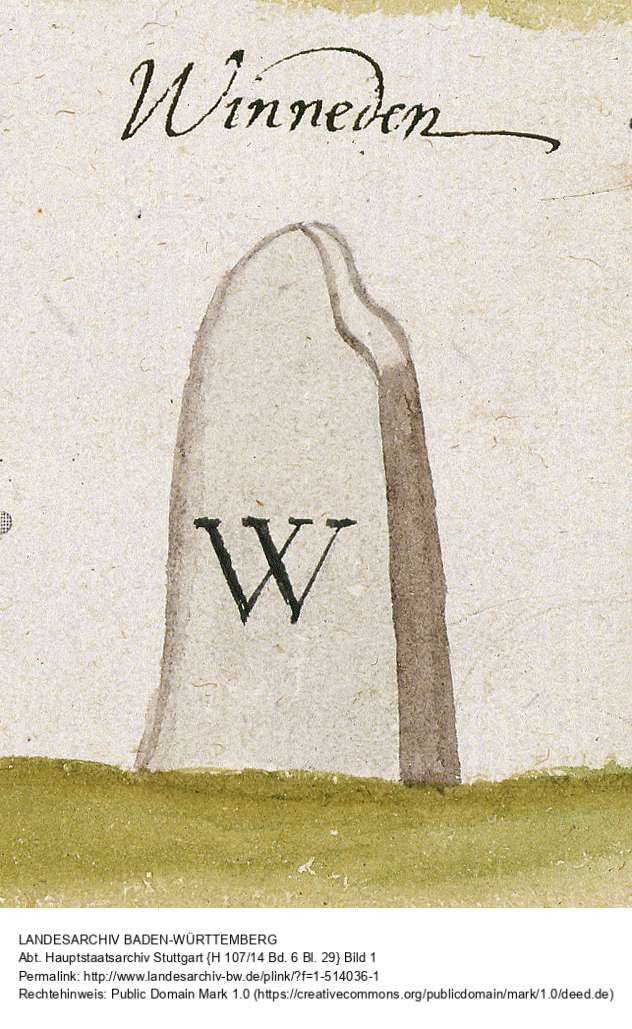
1686 Milepost marker for Winnenden

Schlosskirche St. Jakobus in Winnenden
The Schlosskirche St. Jakobus (Castle Church of St. James) is the parish church of the Protestant parish of Winnenden.
In the Middle Ages it was a station for Christian pilgrims on their way to the shrine of the apostle James in Santiago de Compostela on the coast of Spain.
Close to the Schlosskirche was a pilgrim’s hostel.
Knights of the Teutonic Order in Winnental watched over the pilgrims’ safety and security.
History [7]
1603 St. Batholomew’s stock book is created (Hertmannsweiler).
1605 Pistorius publishes his hexameter chronicle of Winnenden history.
1607 Plague year. --- The Buchenbach Bridge near the Mühltor (mill gate) is built.
1608 Johann von Gleichen, Komtur of the Teutonic Order, is buried near the Altar of St. James.
1611 Bernhard Wilhelm of Schwalbach is appointed Komtur of the Teutonic Order.
1612 The peasants of Bretzenacker and Rettersburg get harassed by Breuning of Buchenbach. --- Breuning publishes his travelogue Die orientalische reyß in Straßburg. --- Duke Johann Friedrich of Württemberg prevents Wilhelm of Schwalbach, Commander of the Teutonic Order, from expanding and fortifying the Order’s property near the castle.
1619 A year after the Thirty Years’ War started, Winnenden fortifies its gate (particularly its gate tower) and restores the old walls.
1626 In a devastating year of bad harvest and famine, 1126 of Winnenden’s inhabitants die of the plague. On several days in July, 30 to 40 victims need to be buried. Winnenden loses 515, Hertmannsweiler 110, Birkmannsweiler 97, Hanweiler 52, Bürg 38, Höfen 34 and Breuningsweiler 27.
1628 Maria Schneider is tried for witchcraft and executed.
1631 The Duke calls the men of Winnenden to arms. In what is commonly referred to as the “Cherry War” (since it happened in June), the ducal troups surrender to the imperial army led by Count Fürstenberg. --- 1/7: The imperial cavalry is given quarter in Winnenden.
1634 Parish priest Georg Wieland dies of the plague. After the Battle of Nördlingen, imperial troups destroy several places along the River Rems (including Korb) – Winnenden suffers from famine.
1635 --- 668 people in Winnenden starve to death or die of the plague.
1638 27/3: Winnenden is pillaged by imperial soldiers. They had previously retreated from a Swedish army of 1500 in Stuttgart.
1639 Parish priest Zacharias Greims dies of the plague.
1643 1/1: A French and Swedish force of 80 cavalrists attack Winnenden. The city is pillaged again and afterwards set on fire.
1645 April: Bavarian troups are cantoned in Winnenden.
1648 2/11: Once again, Winnenden is plundered by Swedish troups.
1656 Records show that Winnenden has lost 640 of its inhabitants and 602 buildings in the Thirty Years’ War. Several farmsteads are abandoned: a homestead near Schnarrenberg, the Stolpenhof, the Stuhlhof and the Siebenhof.
1659 The Buchenbachhof is sold by Hans Ernst Imhof from Kirchentellinsfurt to Johann Leonhardt Breitschwert.
1665 29/9: The Teutonic Order sells the castle and the entire commandry to Duke Eberhard III. of Württemberg. The price of 40.000 gulden includes the villages of Höfen and Hanweiler.
1686 [8]
1686 [9]
http://www.landesarchiv-bw.de/plink/?f=1-513711
http://www.landesarchiv-bw.de/plink/?f=1-513712
Footnotes:
[1] Haupstaatsarchiv.Stuttgart, [URL].
[2] Evangelische Kirche Winnenden (OA. Waiblingen), Württemberg, Germany, Kirchenbuch, Taufen 1558-1641, Heiraten 1559-1627, Taufen 1641-1760, FHL film 1056954, [AncestryImage], [AncestryRecord], [FHLCatalog].
[3] Evangelische Kirche Winnenden (OA. Waiblingen), Württemberg, Germany, Kirchenbuch, Heiraten 1628-1881, FHL film 1056958, [AncestryImage], [AncestryRecord], [FHLCatalog].
[4] Evangelische Kirche Winnenden (OA. Waiblingen), Württemberg, Germany, Kirchenbuch, Tote 1607-1820, FHL film 1056959, [AncestryImage], [AncestryRecord], [FHLCatalog].
[5] Wikipedia article about Winnenden, content subject to change, [Wikipedia].
[6] Photo License, [URL].
[7] pangloss website, [URL].
[8] Andreas Kieser, Württembergischen Ortsansichten, 1681-1686, Landesarchiv Baden-Württemberg, Hauptstaatsarchiv Stuttgart, [HauptstaatsarchivStuttgart].
[9] Andreas Kieser, Württembergischen Ortsansichten, 1681-1686, Landesarchiv Baden-Württemberg, Hauptstaatsarchiv Stuttgart, [HauptstaatsarchivStuttgart].