STATS 413: Lecture 21
-
Test-based methods
-
Criterion-Based methods
Model Selection
Through our discussion of nonlinear regression, we understand the importance of choosing the right level of "complexity."
-
Too complex: the resulting fit might have high variance and can start fitting to noise.
-
Too simple: it cannot fully account for true trends in the data.
In linear regression, complexity arises as the number of predictor variables that we choose to include in our model.
-
We want to include any predictor variable that is truly meaningful for predicting the response; otherwise there would be bias.
-
We want to ignore irrelevant predictors; they just add noise to our predictions and increase variance.
Model Selection
Q: How can we use our observed data to help select the right number of predictor variables?
Q: How can we choose the right size for our linear model?
General Setup
Imagine that we have $p$ covariates, and that linearity holds:
\begin{align*} \mathbf{E}(y \mid x) &= x^\top \beta, \end{align*}where $\beta = (\beta_0,\beta_1,\dots,\beta_p)^\top$ as before.
Of the covariates $x_1,\dots,x_p$, we imagine that only some of them have nonzero slope coefficients.
General Setup
-
If $\beta_j \neq 0$, we'd like to use that variable for prediction.
-
If $\beta_j = 0$, we'd like to eliminate this variable from our model. It is irrelevant.
-
Keeping it in our regression would add noise to predictions without helping us uncover true trends.
-
Objective: find the subset $\mathcal{M}_m \subseteq \{1,\dots,p\}$ of $m \leq p$ indices for covariates with nonzero slope coefficients.
How Many Possible Models are There?
We proceed imagining we'll always include an intercept coefficient. How many possible models are there?
-
How many distinct subsets of $\{1,\dots,p\}$ are there?
How Many Possible Models are There?
We proceed imagining we'll always include an intercept coefficient. How many possible models are there?
-
How many distinct subsets of $\{1,\dots,p\}$ are there?
Answer: $2^p$.
- For each variable: do I include it or not (2 options).
- Make this choice $p$ times: $2^p$.
How Many Possible Models are There?
Explodes quickly as $p$ grows.
- $p=5$: $2^5=32$ models.
- $p=20$: $2^{20} \approx$ 1 million models.
-
$p=79$: $2^{79} \approx 6\times 10^{23}$ models (Avogadro's number).
Even for moderate $p$, there is a massive space of possible models to sift through.
Finding the "Best Model" For a Given Model Size
For a given model size $0 \leq m \leq p$, we could imagine looking at all $\binom{p}{m}$ models with those $m$ predictor variables. For each possible subset:
-
Run a regression of $y$ on those $m$ predictor variables.
-
Calculate the $SSE$ for that model, or equivalently the $R^2$.
Finding the "Best Model" For a Given Model Size
Of all models of size $m$, we could then choose the model that minimizes the $SSE$, or equivalently maximizes the $R^2$. Call the minimal value $SSE_m^*$.
-
For a particular model size $m$, using $R^2$ or $SSE$ is not so bad.
-
The deficiencies in $R^2$ have to do with comparing models of different complexities, with differing numbers of covariates.
Model Selection
If we did the previous step for each model size $m$, we'd have a collection of best sums of squared error $SSE_0^*,\dots,SSE_p^*$.
-
We also know that $SSE_0^* \geq SSE_1^* \geq \dots \geq SSE_p^*$. Why?
-
When building models, we need to account for the fact that in-sample fit will improve as the number of predictors increases.
We'll now describe some common approaches to variable selection.
-
Hypothesis Test-Based Methods.
-
Criterion-Based Methods.
Diabetes Dataset
The dependent variable is a quantitative measure of disease progression one year after baseline, and we have data on $n=442$ patients.
-
For now we'll consider 10 baseline variables thought to be predictive of disease progression.
-
Age, Sex, BMI, and so on.
-
All covariates have been standardized, so each column has mean zero and standard deviation one.
Diabetes Dataset
In this problem, there are $2^{10} = 1024$ possible models.
-
Here, $p$ is small enough that we can actually enumerate all possible models.
-
Here, $p$ is also small relative to the number of features in many modern regression applications ("big data").
Using Hypothesis Tests
When running linear regression, recall that a test of the null that $\beta_j=0$ had the following interpretation:
After controlling for the other predictor variables besides $x_j$, $\{x_\ell : \ell \neq j\}$, is there evidence that $x_j$ substantially improves the predictive power of our model?
-
In other words, do we need to include $x_j$ once we've already included the other $p-1$ variables?
-
If the null, $\beta_j = 0$, is true, the answer is no.
-
Under the stronger linear model, we can conduct this hypothesis test using a $t$-statistic.
Reminder: Partial $\mathcal{F}$-Tests
Remember that testing $\beta_j=0$ is a particular instance of a partial $\mathcal{F}$-Test.
-
Compare predictive performance of a full model to that of a reduced model where some of the variables have been removed.
The $F$-Statistic
\begin{align*} F_{stat} &= \frac{(SSE_{red}-SSE_{full})/(df_{red} - df_{full})}{SSE_{full}/df_{full}}, \end{align*}where $df$ denotes the residual degrees of freedom in each model.
Reminder: Partial $\mathcal{F}$-Tests
Fail to reject: no evidence that the more complicated full model provides an improvement in predictive power relative to the reduced model.
-
If I fail to reject the null, it seems natural to proceed using the reduced model instead of the full model.
Common in practice. Called stepwise regression using $p$-values.
Backwards Elimination with Tests
Backwards elimination starts with a linear model including all predictors, and then tries to reduce the model's size.
-
Start by fitting a regression using all $p$ predictor variables.
-
Check to see if any $p$-values fall above your significance level $\alpha$.
-
If some variables have $p$-values larger than $\alpha$, remove the single predictor variable with the largest $p$-value.
-
Re-fit your regression using the remaining $p-1$ predictors and return to step 2.
-
Stop when you have a model where all variables have $p$-values below $\alpha$.
Forward Selection with Tests
Forward selection starts with a model only including the intercept, and then iteratively adds variables to create a larger model.
-
Start by fitting a regression using only the intercept.
-
For all predictors not currently in the model, check the $p$-value for those predictors if they are added to the model.
-
If any of these $p$-values are below $\alpha$, add the one with the smallest $p$-value below $\alpha$.
-
Refit the model with the new variable added, then return to step 2.
-
Stop when no new variables would yield $p$-values below $\alpha$.
Model Building with Categorical Vars
When we have categorical predictors, we generally consider adding either all of the categories or none of the categories to the model.
-
Remember: we encode categoricals with $d-1$ dummy variables if there are $d$ categories.
-
We should not treat these as $d-1$ separate variables, but rather group them all together.
-
When deciding whether to add categoricals, we should look at the $p$-values for the partial $\mathcal{F}$-test where the categories are included in the full model and excluded in the reduced model.
Results: Diabetes Data
In the diabetes data set, the models are of the following sizes:
-
Backwards elimination, $\alpha = 0.05$: use 6 predictor variables.
-
Forward selection, $\alpha = 0.05$: use 7 predictor variables.
As you can see, the two approaches are not guaranteed to produce the same model.
-
Even if forward stepwise and backwards elimination both terminate with a model of size $m$, the variables in those models are not guaranteed to be the same.
-
Reason: multicollinearity, and its impact on the interpretation of slope coefficients.
Drawbacks of Test-Based Methods
A few drawbacks of this approach are:
-
The approach is not guaranteed to provide the model with the best out-of-sample performance; models tend to be too small.
-
It is impacted by multicollinearity.
Additionally, you cannot take the $p$-values in the chosen model at face value.
Drawbacks of Test-Based Methods
This ends up being generally true after model selection, even if you are not using $p$-values to select.
-
Issue: a massive multiple-comparisons problem. The act of selecting a model compares many $p$-values along the way.
-
Even if there were truly no signal and all our covariates had no effect, would we expect to return a model with only an intercept?
-
Watch out for this. People conduct inference after model selection without modification all the time.
Criterion-Based Methods
Alternative approaches to model selection imagine optimizing an objective function that encourages model fit while penalizing model complexity.
We know that if we consider
\begin{align*} \underset{\text{all models}}{\arg\min}\;\; \sum_{i=1}^n(y_i-\hat{y}_i)^2, \end{align*}In that case, we return the ordinary least squares regression using all $p$ predictors.
Criterion-Based Methods
Consider instead
\begin{align*} \underset{\text{all models}}{\arg\min}\;\; Criterion, \end{align*}where the criterion:
-
Decreases as the quality of the fit to the observed data increases.
-
Increases in the complexity of the model ($m$, the number of included predictors).
Adjusted-$R^2$
For a given model $\mathcal{M}_m$ with $m$ predictors and sum of squared errors $SSE$, the adjusted $R^2$ is defined as
\[ R^2_{adj}(\mathcal{M}_m) = 1 - \frac{SSE(\mathcal{M}_m)/(n-m-1)}{SST/(n-1)} \]c.f. the unadjusted $R^2$:
\[ R^2(\mathcal{M}_m) = 1 - \frac{SSE(\mathcal{M}_m)}{SST}. \]Adjusted-$R^2$
Benefits as a measure of improvement:
-
As we know, $R^2$ never decreases as we increase the number of covariates, even if they are irrelevant.
-
$R^2_{adj}$ can decrease as we add more variables. The inclusion of degrees of freedom penalizes models with larger $m$, which makes it more suitable for model selection.
-
Watch out: $R^2_{adj}$ can be negative.
Adjusted $R^2$
\begin{align*} R^2_{adj}(\mathcal{M}_m) &= 1 - \frac{SSE(\mathcal{M}_m)/(n-m-1)}{SST/(n-1)} \\ &= 1-\hat{\sigma}^2_\varepsilon(\mathcal{M}_m)/(\text{sd}(y))^2 \end{align*}-
Consequence: $\hat{\sigma}_\varepsilon(\mathcal{M}_m) = \text{sd}(y)\sqrt{1-R_{adj}^2(\mathcal{M}_m)}$.
-
Note: maximizing $R^2_{adj}$ is equivalent to minimizing $\hat{\sigma}^2_\varepsilon(\mathcal{M}_m) = SSE(\mathcal{M}_m)/(n-m-1)$.
Adjusted $R^2$
Consider then choosing a model through
\begin{align*} \underset{\text{all models}}{\arg\min}\;\; SSE(\mathcal{M}_m)/(n-m-1) \end{align*}-
Promotes quality model fit (numerator).
-
Penalizes model complexity (denominator decreases as model size $m$ increases).
Mallows's $C_p$
For a model $\mathcal{M}_m$ with $m$ predictors, Mallows's $C_p$ takes the form
\begin{align*} C_p(\mathcal{M}_m) &= \frac{SSE(\mathcal{M}_m)}{\hat{\sigma}^2_{\varepsilon}(\mathcal{M}_p)} + 2(m+1)-n, \end{align*}where $\hat{\sigma}^2_{\varepsilon}(\mathcal{M}_p)$ is estimated from the model with all $p$ predictor variables.
Mallows's $C_p$
Intuition: $C_p$ provides an estimate of the scaled sum of the reducible error at the observed values of the covariates:
\begin{align*} \text{Sum of Reducible Error} &= \frac{1}{\sigma^2_{\varepsilon}}\sum_{i=1}^n(\hat{y}_i - x_i^\top\beta)^2,\\ &= \frac{1}{\sigma^2_{\varepsilon}}\sum_{i=1}^n(\hat{f}(x_i) - f(x_i))^2, \end{align*}where $\hat{y}_i = \hat{f}(x_i)$ are the fitted values from model $\mathcal{M}_m$.
-
In a good fit, $C_p$ should be near or below $m+1$.
Information-Based Criteria
Under the stronger linear model, theoretical derivations can be used to derive additional criteria that take complexity into account. For a model $\mathcal{M}_m$ with $m$ predictors:
Akaike Information Criterion
\begin{align*} AIC(\mathcal{M}_m) &= n\log_e\{SSE(\mathcal{M}_m)/n\} + 2m \end{align*}Bayesian Information Criterion
\begin{align*} BIC(\mathcal{M}_m) &= n\log_e\{SSE(\mathcal{M}_m)/n\} + \log_e(n)m \end{align*}Information-Based Criterion
Consider finding the model $\mathcal{M}_{m}$ minimizing either of these criteria:
Akaike Information Criterion
\begin{align*} AIC(\mathcal{M}_m) &= n\log_e\{SSE(\mathcal{M}_m)/n\} + 2m \end{align*}Bayesian Information Criterion
\begin{align*} BIC(\mathcal{M}_m) &= n\log_e\{SSE(\mathcal{M}_m)/n\} + \log_e(n)m \end{align*}-
For $n=8$, $\log_e(n) = 2.079$.
-
For $n \geq 8$, $BIC$ penalizes larger models with more predictor variables more than $AIC$.
Comparing the Criteria
Here are our four suggested criteria to minimize:
-
Based on Adjusted $R^2$: $SSE(\mathcal{M}_m)/(n-m-1)$.
-
Mallows's $C_p$: $SSE(\mathcal{M}_m)/\hat{\sigma}^2_\varepsilon(\mathcal{M}_p) + 2(m+1)-n$.
-
$AIC$: $n\log_e\{SSE(\mathcal{M}_m)/n\} + 2m$.
-
$BIC$: $n\log_e\{SSE(\mathcal{M}_m)/n\} + \log_e(n)m$.
Comparing the Criteria
For a fixed model size $m$, all of these criteria would agree on the same "best model."
-
The model of size $m$ that yields the smallest $SSE$.
The difference is the nature of the penalty for complexity, namely the penalty on $m$.
Best Subset Selection with Complexity Penalization
For a chosen criterion, if we could evaluate all possible models:
-
For a given model size $m$, evaluate all $\binom{p}{m}$ models of size $m$ and find the set of $m$ predictors yielding the best value for the criterion. Call it $Criterion_m^*$.
-
All four criteria we've introduced would agree on the best model of size $m$.
-
Across values of $m$, find the minimal value for $Criterion_m^*$.
-
This is where the differences between criteria show up. Different penalties on $m$ yield different models.
This general idea is called Best Subset Selection.
Results: Diabetes Data
After penalizing complexity using our four criteria, we arrive at models of the following size:
-
Adjusted $R^2$: 8 predictor variables.
-
Mallows's $C_p$: 6 predictor variables.
-
Akaike Information Criterion ($AIC$): 6 predictor variables.
-
Bayesian Information Criterion ($BIC$): 5 predictor variables.
This ordering is fairly typical. Adjusted $R^2$ chooses larger models, $BIC$ chooses smaller models, and $AIC$/Mallows's $C_p$ falls in between. In fact, the two are asymptotically equivalent for model selection.
Extended Diabetes Data
Suppose we consider using polynomial regression to accommodate potential nonlinearities with respect to our $p=10$ predictor variables.
-
Consider a second-degree polynomial: linear, square, and interaction terms.
-
10 baseline variables (Age, Sex, BMI, and so on).
-
45 interaction variables such as BMI $\times$ Age, and so on.
Extended Diabetes Data
-
9 squared variables (we do not include the square of sex. What's the square of a binary?).
-
All covariates are then $z$-scored, so each column has mean zero and standard deviation one.
-
We have $p = 10+45+9 = 64$ covariates.
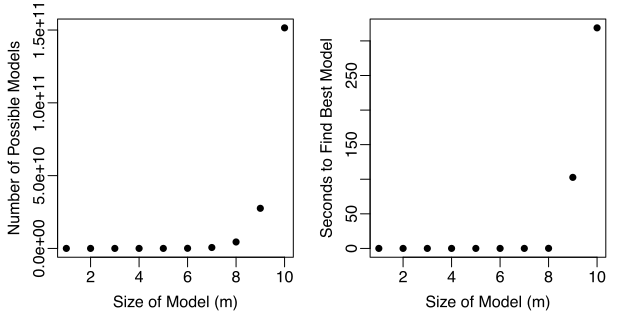
In this problem, there are now $2^{64} = 1.8\times 10^{19}$ possible models.
Walltime For Extended Diabetes Data