STATS 413: Lecture 11
-
Regression diagnostics
-
Assessing linearity
-
Assessing homoskedasticity
-
Assessing normality
If the Linear Model Holds...
To date we have derived properties of the ordinary least squares coefficients $\widehat{\boldsymbol\beta}$ under the assumption that a linear model holds. The weaker linear model states:
\[ y = X\beta + \varepsilon;\;\; \text{E}(\varepsilon)=0;\;\; \text{Var}(\varepsilon) = \sigma^2_\varepsilon I_{n\times n}. \]If this holds, we showed among many things:
-
$\text{E}(\widehat{\boldsymbol\beta}) = \beta$; $\text{Var}(\widehat{\boldsymbol\beta}) = \sigma^2_\varepsilon (X^\top X)^{-1}$; $\text{E}(y - X\widehat{\boldsymbol\beta}) = 0$.
If the Linear Model Holds...
If we further assume that $\varepsilon \sim \text{MVN}(0, \sigma^2_\varepsilon I_{n\times n})$, we were able to construct:
-
Hypothesis tests/confidence intervals for slope coefficients
-
Hypothesis tests to compare models of differing complexity
-
Confidence intervals for the conditional expectation
-
Prediction intervals for future observations
The Core Assumptions
The stronger linear model has the following core components:
-
Linearity: At any $x_i$, $\text{E}(y \mid x_i) = \beta_0 + \beta_1x_{i1} + \dots + \beta_px_{ip} = x_i^\top\beta$
-
Homoskedasticity: For any $x_i$, $\text{Var}(\varepsilon_i\mid x_i) = \sigma^2_\varepsilon$ for all $i$.
-
Normality: $\varepsilon_i$ are $iid$ normally distributed
The Core Assumptions
Violations of these assumptions can invalidate the methods we've proposed. For instance...
-
$\text{E}(y-X\widehat{\boldsymbol\beta}) \neq 0$
-
Our hypothesis tests might commit a Type I error at a rate different from $\alpha$
-
The coverage of our confidence intervals might differ from $100(1-\alpha)\%$.
-
Our prediction intervals for future observations $y^*$ might not capture future observations at rate $100(1-\alpha)\%$.
Regression Diagnostics
Regression Diagnostics are tools/methods for determining whether a regression model adequately represents the data at hand
-
Do the assumptions of the stronger linear model seem reasonable?
-
Or is there a notable violation of one or more underlying assumptions?
Regression Diagnostics
Diagnostics take two main forms:
-
Diagnostic Plots – create a plot which can visually reveal a violation of a modeling assumption.
-
Diagnostic Tests – test the null hypothesis that a given modeling assumption holds. Rejection of the null suggests a violation of the assumption under consideration.
We'll mainly discuss graphical diagnostics, but note that there are often well-established numeric diagnostic tests for these tools.
Devising a Diagnostic Plot
When devising a diagnostic plot, we need to consider
-
What the plot should display when the assumptions of the linear model hold
-
What might appear within the plot should an assumption be violated
Issue: can't visualize relationship between $y$ and $x_1,\dots,x_p$ unless $p=1$ (or $p=2$ with appropriate plotting software).
-
We need to consider low-dimensional consequences of the linear model
Properties of Residuals and Fitted Values
Many diagnostics will use the residuals $e$, and/or the fitted values $\hat{y}$. Let $H = X(X^\top X)^{-1}X^\top$ be the hat matrix, and let $h_{ij}$ denote its $i,j$ element.
\begin{align*} e &= (I-H)y\\ \hat{y} &= Hy \end{align*}Properties of Residuals and Fitted Values
We've previously discussed algebraic properties of $e$ and $\hat{y}$ when running a regression with an intercept. Letting $\widehat{\text{cov}}(\cdot, \cdot)$ be the sample covariance operator:
\begin{align*} \widehat{\text{cov}}(e, x_j) &= 0\;\; (j=1,\dots,p)\\ \widehat{\text{cov}}(e, \hat{y}) &= 0\\\textstyle \bar{e} = \frac{1}{n}\sum_{i=1}^n e_i &= 0 \end{align*}These properties are purely algebraic, and hold regardless of whether the weaker linear model holds.
Expectation of Residuals and Fitted Values
We'll now derive additional properties of $e$ and $\hat{y}$ under the assumption that the weaker or stronger linear model holds.
-
Properties represent testable implications of these models.
Expectation of Residuals and Fitted Values
Under the weaker linear model
\begin{align*} \text{E}(e) &= \text{E}((I-H)y) = 0\\ \text{E}(\hat{y}) &= \text{E}(Hy) = X\beta \end{align*}Expectation of Residuals and Fitted Values
Important to keep in mind the distinction between
-
$\text{E}(e_i) = 0$
-
$\bar{e} = 0$
The former is a statement about the expectation for any particular residual. The latter merely says that the sample average of the residuals equals zero in any particular data set, but doesn't describe components $e_i$.
Variance of Residuals
We can also derive the variance of the residual vector.
-
This variance is across data sets generated by the linear model
Variance of Residuals and Fitted Values
Under the weaker linear model
\begin{align*} \text{Var}(e) &= \sigma^2_\varepsilon (I-H)\\ \text{Var}(\hat{y}) &= \sigma^2_\varepsilon H \end{align*}Variance of Residuals
Keep in mind the distinction between
-
$\text{var}(e_i) = \sigma^2_\varepsilon (1-h_{ii})$
-
$\hat{\sigma}^2_\varepsilon = \sum_{i=1}^ne_i^2/(n-p-1)$
The former describes variability for any component $e_i$ across data sets. The latter is the sample variance for the observed residuals.
Diagonals of Hat Matrix
When performing regression with an intercept and $p$ predictors, the diagonal entries of the hat matrix $H$, $h_{ii}$, satisfy the following:
-
$\frac{1}{n}\leq h_{ii}\leq 1 \;\; (i=1,\dots,n)$
-
$\sum_{i=1}^n h_{ii} = p+1$
Implication:
\[ \text{var}(e_i) = \sigma^2_\varepsilon (1-h_{ii}) \leq \sigma^2_\varepsilon = \text{var}(\varepsilon_i). \]In words:
-
Residuals don't generally have the same variance, $\text{var}(e_i)\neq \text{var}(e_{j})$ for $i\neq j$
-
Residuals $e_i$ have smaller variance than $\varepsilon_i$
Off-Diagonals of Hat Matrix
For any $i,j = 1,\dots,n$
\begin{align*} \text{cov}(e_i, e_{j}) &= -\sigma^2_\varepsilon h_{ij}\\ \text{cov}(\hat{y}_i, \hat{y}_j) &= \sigma^2_\varepsilon h_{ij} \end{align*}For regression with an intercept, we also have the bound
\[ 1/n - 1/2 \leq h_{ij} \leq 1/2 \]Implication: despite the fact that $\text{cov}(\varepsilon_i, \varepsilon_j)=0$ under the weaker linear model, $\text{cov}(e_i, e_{j}) \neq 0$.
Covariance Between Vectors
For $Z\in \mathbb{R}^m$, $Y\in \mathbb{R}^n$ random vectors:
\begin{align*} \text{Cov}(Z,Y) &= \text{E}[(Z-\text{E}(Z))(Y-\text{E}(Y))^\top]\\ &= \text{E}(ZY^\top) - \text{E}(Z)\text{E}(Y)^\top\\ &=\left( \begin{array}{cccc} \text{cov}(Z_1, Y_1) & \cdots & \cdots & \text{cov}(Z_1, Y_n) \\ \text{cov}(Z_2, Y_1) & \text{cov}(Z_2,Y_2) & \cdots & \text{cov}(Z_2, Y_n) \\ \vdots & \ddots & \ddots & \vdots \\ \text{cov}(Z_m, Y_1) & \cdots & \cdots & \text{cov}(Z_m, Y_n) \end{array} \right) \end{align*}Covariance Between Vectors
$\text{Cov}(Z,Y) \in \mathbb{R}^{m\times n}$; $\text{Cov}(Z,Y) = \text{Cov}(Y,Z)^\top$. $\text{Cov}(Z,Z) = \text{Var}(Z)$.
Properties of Covariance
For $A\in \mathbb{R}^{d\times m}$, $B\in \mathbb{R}^{k\times n}$:
\[ \text{Cov}(AZ, BY) = A\text{Cov}(Z,Y)B^\top \]Covariance Between Residuals and Fitted Values
Using this definition, we can characterize the covariance between residuals and fitted values under the weaker linear model:
Covariance of Residuals and Fitted Values
Under the weaker linear model
\[ \text{Cov}(e,\hat{y}) = \text{Cov}((I-H)y, Hy) = 0. \]For any $i,j=1,\dots,n$, $\text{cov}(e_i, \hat{y}_j) = 0$.
Covariance Between Residuals and Fitted Values
This is distinct from the result that the sample covariance between $e$ and $\hat{y}$ equals zero when running regression with an intercept, $\widehat{\text{cov}}(e, \hat{y}) = 0$.
-
$\text{cov}(e_i, \hat{y}_i) = 0$: Property of random variables across data sets under the linear model.
-
$\widehat{\text{cov}}(e, \hat{y}) = 0$: Algebraic property.
The Distribution of Residuals and Fitted Values
Let's now consider the distribution of the residuals and fitted values:
Distribution of Residuals and Fitted Values
Under the stronger linear model,
\[ \left( \begin{array}{c} e \\ \hat{y} \end{array} \right) \sim \text{MVN}\left( \left( \begin{array}{c} 0 \\ X\beta \end{array} \right), \left( \begin{array}{c c} (I-H)\sigma^2_\varepsilon & 0 \\ 0 & H\sigma^2_\varepsilon \end{array} \right) \right) \]Implications under the stronger linear model:
-
$e_i \sim N(0, (1-h_{ii})\sigma^2_\varepsilon)$.
-
$e$ and $\hat{y}$ are independent of one another (relies crucially on multivariate normality).
Linearity
Linearity, $y = X\beta +\varepsilon$ with $\text{E}(\varepsilon) = 0$, tells us that for each $i$,
\[ \text{E}(e_i\mid x_i) = \text{E}(y_i - x_i^\top\widehat{\boldsymbol\beta}\mid x_i) = 0, \]i.e. that the expected value of our sample residual $e_i$ at any point $x_i$ equals zero.
Nonlinearity, on the other hand, could be written as:
\[ y_i = g(x_i) + \varepsilon_i;\;\; \text{E}(\varepsilon_i) = 0, \]for some nonlinear function $g(\cdot)$. In this case:
\[ \text{E}(e_i\mid x_i) = \text{E}(y_i - x_i^\top\widehat{\boldsymbol\beta}\mid x_i) = \eta(x_i) \]for some non-zero function $\eta(\cdot)$.
Residual Plots with Predictors
Expectation of sample residuals:
\[ \text{E}(e_i\mid x_i)=\text{E}(y_i - x_i^\top\widehat{\boldsymbol\beta}\mid x_i) = \eta(x_i) \]Linearity: $\text{E}(e_i\mid x_i) = 0$ for all $x_i$
-
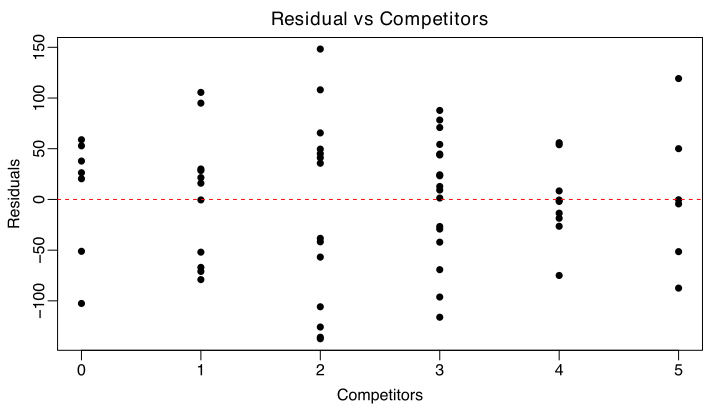
No pattern in residuals as a function of any of the predictor variables $x_{i1}, x_{i2},\dots,x_{ip}$.
Nonlinearity: $\text{E}(e_i\mid x_i) = \eta(x_i)$ for some nonlinear function $\eta(x_i)$
-
Can't generally visualize $e_i$ as joint function of $x_{i1},\dots,x_{ip}$
-
Can separately visualize relationship between $e_i$ and $x_{i1}$, $e_i$ and $x_{i2}$,... $e_i$ and $x_{ip}$ through $p$ scatterplots (2 dimensional projections).
Residual Plots with Predictors
Hope: high-dimensional nonlinearity reveals itself in lower dimensions
These plots with the residuals on the $y$ axis and predictors on the $x$ axis are examples of residual plots.
Residual Plots
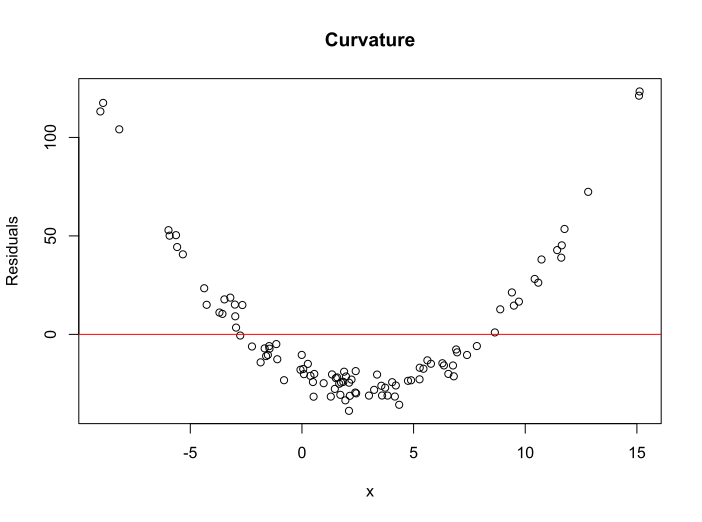
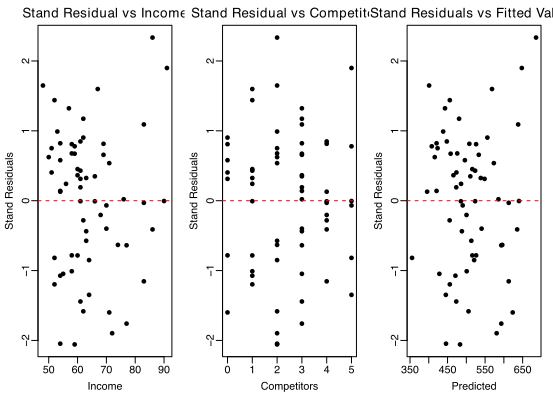
Do you see clear evidence of curvature?
-
Ideal residual plot should look like an amorphous blob. No systematic variation between residuals and $x_i$
-
Are there values of $x_i$ where the residuals are predictably positive or negative?
-
Remember: residuals will always have mean zero (the red line on these plots)
Residual Plots with Predictors
In our mall sales example:
Residuals versus Fitted Values
In addition, we also plot the relationship between residuals and fitted values: $e$ versus $\hat{y}$
-
If I had access to $\beta$, we know that $\text{E}(e_i\mid x_i^\top\beta) = 0$ for all $x_i$.
-
A plot of $e$ against $\text{E}(y) = X\beta$ would reveal no discernable pattern under linearity
Replace $x_i^\top \beta$ by our estimate, $x_i^\top\widehat{\boldsymbol\beta} = \hat{y}_i$
-
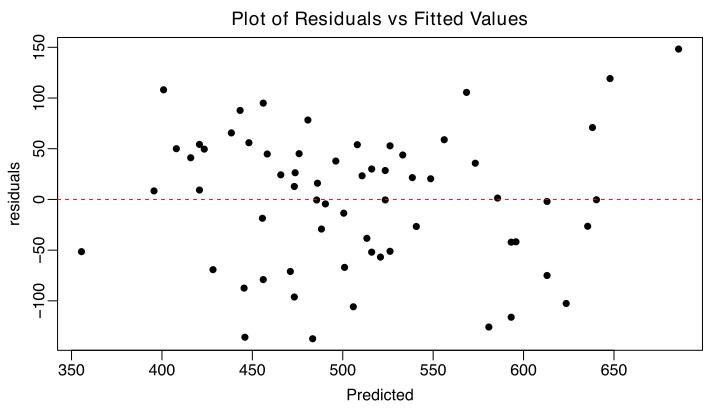
Hope: nonlinearity might reveal itself with systematic variation in residuals as a function of predicted values.
Note: of all residual plots targeting nonlinearity, this plot is the most commonly used in practice
Residuals versus Fitted Values
In our mall sales example:
Assessing Homoskedasticity
Homoskedasticity tells us that, for each $x_i$:
\[ \text{var}(\varepsilon_i\mid x_i) = \sigma^2_\varepsilon \]We don't get to observe $\varepsilon_i = y_i - x_i^\top\beta$, and instead observe its sample analogue $e_i = y_i - x_i^\top\widehat{\boldsymbol\beta}$. Can we use $e_i$ to assess homoskedasticity?
\[ \text{var}(e_i\mid x_i) = (1-h_{ii})\sigma^2_\varepsilon \]-
Generally $h_{ii}\neq h_{jj}$ for $i\neq j$.
-
Even under homoskedasticity, our sample residuals would not have constant variance. $\text{var}(e_i\mid x_i)\neq \text{var}(e_j\mid x_j)$.
Standardized Residuals
Fortunately, there's a straightforward fix under the weaker linear model:
\[ \begin{aligned} &\text{var}\left(\frac{{e}_i}{\sqrt{1-h_{ii}}}\mid x_i\right) \\ &\quad=\text{Var}(e_i\mid x_i)/(1-h_{ii}) \\ &\quad=\sigma^2_\varepsilon(1-h_{ii})/(1-h_{ii}) \\ &\quad= \sigma^2_\varepsilon \end{aligned} \]This motivates the use of an alternative residual, called the standardized residual, for assessing homoskedasticity
Standardized Residuals
Standardized / Internally Studentized Residuals
The standardized residual (also called the internally studentized residual) takes the following form for each observation $i$:
\[ r_i = \frac{e_i}{\hat{\sigma}_\varepsilon \sqrt{1-h_{ii}}} \](Division by $\hat{\sigma}_\varepsilon$ removes dependence on scale).
Detecting Heteroskedasticity
Common approaches using standardized residuals include:
-
Plot $r_i$ against $x_{ij}$ for $j=1,\dots,p$
-
Plot $r_i$ against $\hat{y}_i$
-
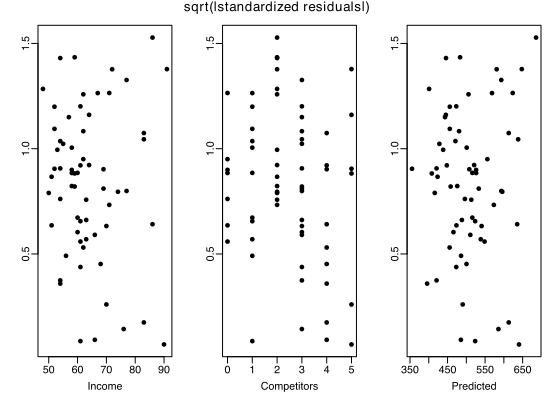
Plot $\sqrt{|r_i|}$ against $x_{ij}$ for $j=1,\dots,p$
-
Plot $\sqrt{|r_i|}$ against $\hat{y}_i$
Detecting Heteroskedasticity
With any of these approaches, want to see if the magnitude of the residuals is varying as a function of $x_{ij}$ or $\hat{y}_i$.
-
Ideal: no systematic variation (homoskedasticity)
-
Concern: magnitude of residuals varies systematically (heteroskedasticity)
-
Plotting $|r_i|$ focuses attention on magnitude.
-
Taking $\sqrt{|r_i|}$ removes skewness in plot (distribution of $|r_i|$ is right-skewed, square root makes it less so).
Standardized Residuals
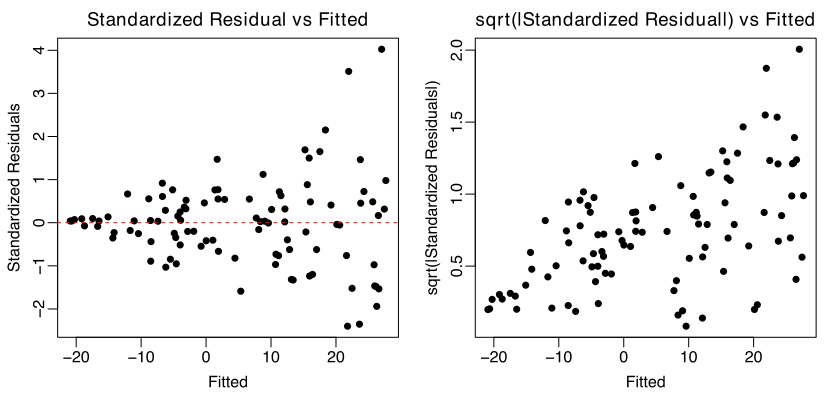
Do you see a "fanning out pattern"? Any change in variability?
$\sqrt{|\text{Standardized Residual}|}$
Do you see a pattern (linear or nonlinear)? Or is it an amorphous blob?
An Example: Heteroskedasticity
Assessing Normality
Our methods for hypothesis tests / confidence intervals / prediction intervals have so far relied crucially on the normality assumption in the stronger linear model:
\[ \varepsilon \sim \text{MVN}(0, \sigma^2_\varepsilon I) \Leftrightarrow \varepsilon_i \overset{iid}{\sim} N(0, \sigma^2_\varepsilon) \]Sample residuals $e_i$ are our best guesses for $\varepsilon_i$, so we will use these to assess normality.
$\varepsilon_i$ are identically distributed under the assumptions of the stronger linear model. What about $e_i$?
Limitations of Histograms
A seemingly natural approach might be to use a histogram to assess normality, and look for a "bell-shaped" / normally distributed.
-
Easy to distinguish a normal distribution from a distribution which is left or right skewed using a histogram
-
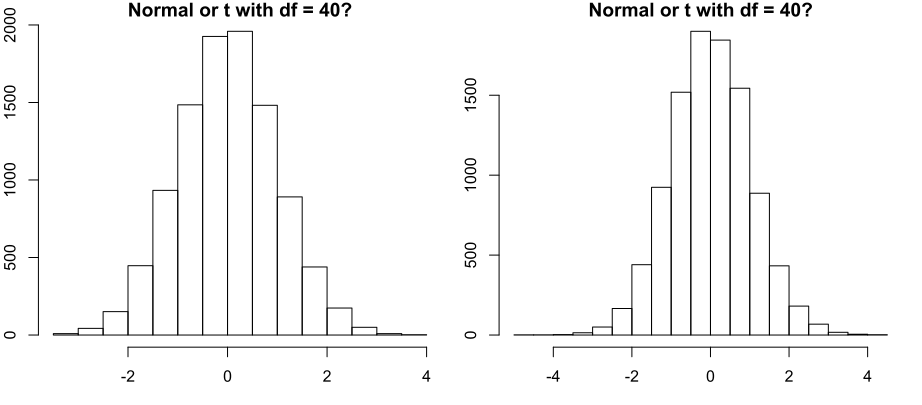
Much harder to distinguish a normal distribution from a bell-shaped distribution with heavier tails
Normal or $t$?
From these histograms, can you tell which is a Normal distribution, and which is a $t_{40}$?
Normal Quantile Plot
Also called a Q-Q Plot
qqnorm(scores)
qqline(scores)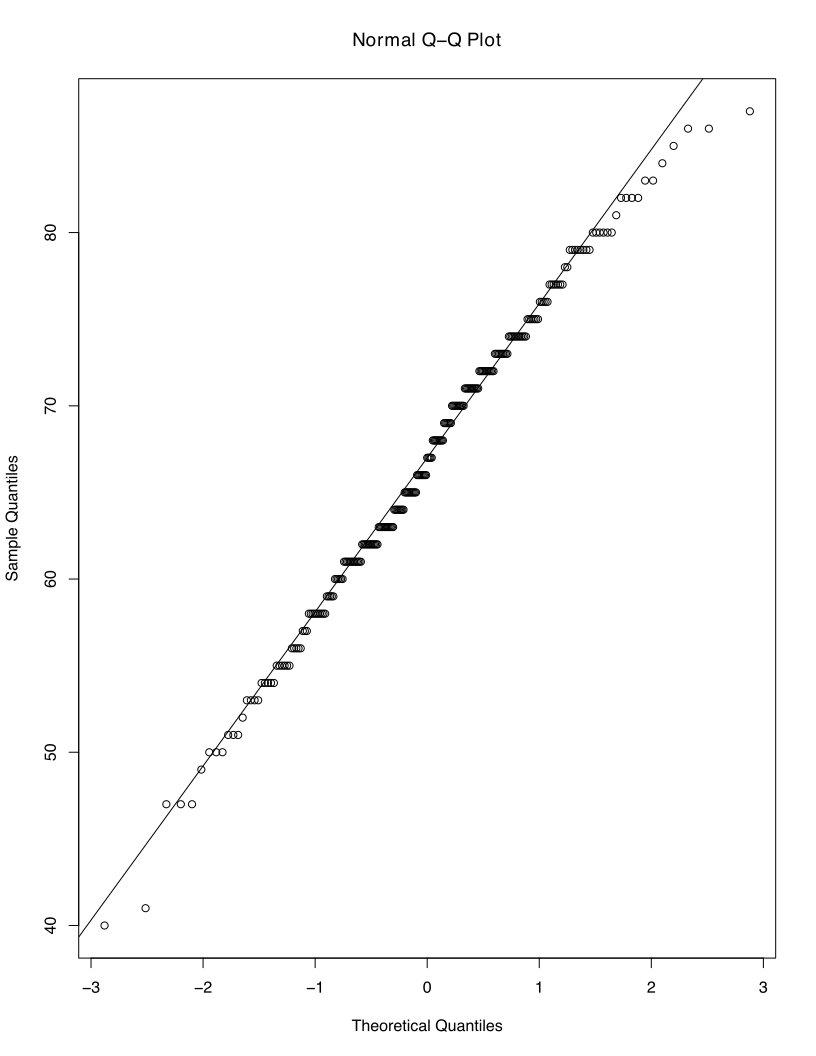
How to Read a Normal Q-Q Plot
-
Vertical axis: sorted variable values
-
Horizontal axis: "theoretical normal quantiles"
-
"Under the hood":
-
The idea is that for example the $10^{th}$ smallest value of a variable with 252 cases is roughly an estimate of the $(10/252)\times 100\%$ quantile; hence plot the sorted values against the corresponding quantiles from a normal distribution.
-
How to Read a Normal Q-Q Plot
-
The normal curve can be used to calculate 'theoretical quantiles', which are plotted on the $x$ axis
-
If the data were normally distributed, then all I need to know are the mean and the standard deviation, and I can calculate all of the quantiles
-
So, take the variable in question, compute its mean and standard deviation, and then compute what the quantiles should be if the variable was normally distributed with that mean/sd.
-
The Normal $QQ$-Plot
To create a Normal $QQ$-Plot:
-
Sort the standardized residuals $r_{[1]} \le r_{[2]} \cdots r_{[n]}$
-
Compute $u_i = \Phi^{-1} \left( \frac{i}{n+1} \right)$. [Division by $n+1$ accounts for discreteness in data.]
-
Plot $r_{[i]}$ against $u_i$.
Note: $\Phi^{-1}(\cdot) = \mathtt{qnorm(\cdot)}$. Takes as input a probability, gives as output the corresponding quantile.
The Normal $QQ$-Plot
We again use standardized residuals $r_i = e_i/(\hat{\sigma}_\varepsilon\sqrt{1-h_{ii}})$ instead of $e_i$
-
$e_i$ aren't identically distributed (different variances), but $r_i$ are.
-
$QQ$-plots are made for identically distributed variables.
How to Use a Normal Q-Q Plot
Interpreting the output:
-
Note: x-axis is in units of standard deviations above/below the mean, rather than units of the original variable.
-
Use: If the points don't deviate from the diagonal line much, then the variable is "approximately normally distributed."
-
Idea: The straight line tells where the sorted values of the variable should fall approximately IF they are normally distributed.
Normality in our Example
Make a normal quantile plot of the standardized residuals:
qqnorm(sresid.both)
qqline(sresid.both)
Do you see non-normality?
-
If yes, normality assumption of multiple regression model doesn't hold.
-
If no, nothing to refute normality
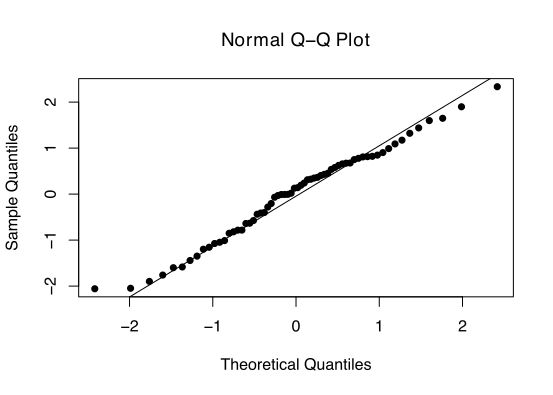
Reminder: Normality reflected by adherence to the diagonal line in the quantile plot, non normality shows a pattern.
Detecting Non-Normalities
How non-normalities show up in normal quantile plots:
-
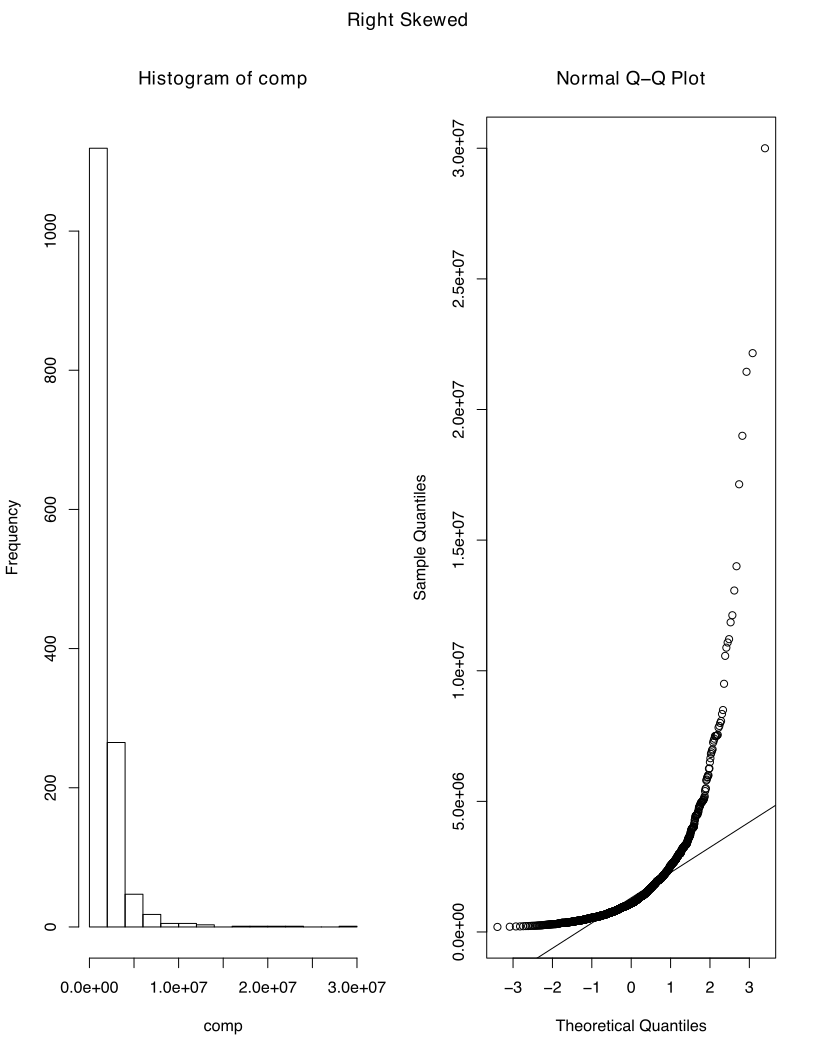
Right-Skewness: frequent in finance/econ. This causes convex (cup-shaped) curvature in normal quantile plots
-
Left-skewed – concave curvature.
-
Outlying observations cause points to be too high on the right or too low on the left
-
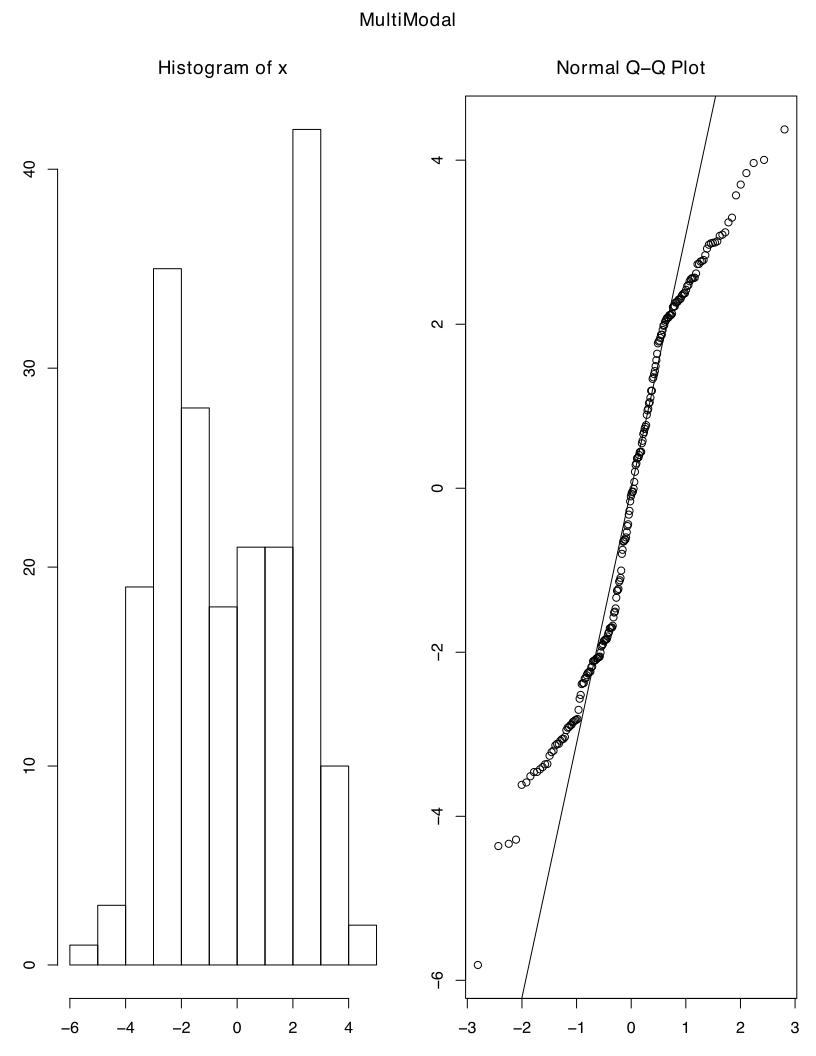
Multi-modality (rare) causes snaking of the normal quantile plot
Let's show a few examples
-
What is the nature of the non-normality?
Right-Skewed
Multi-Modal
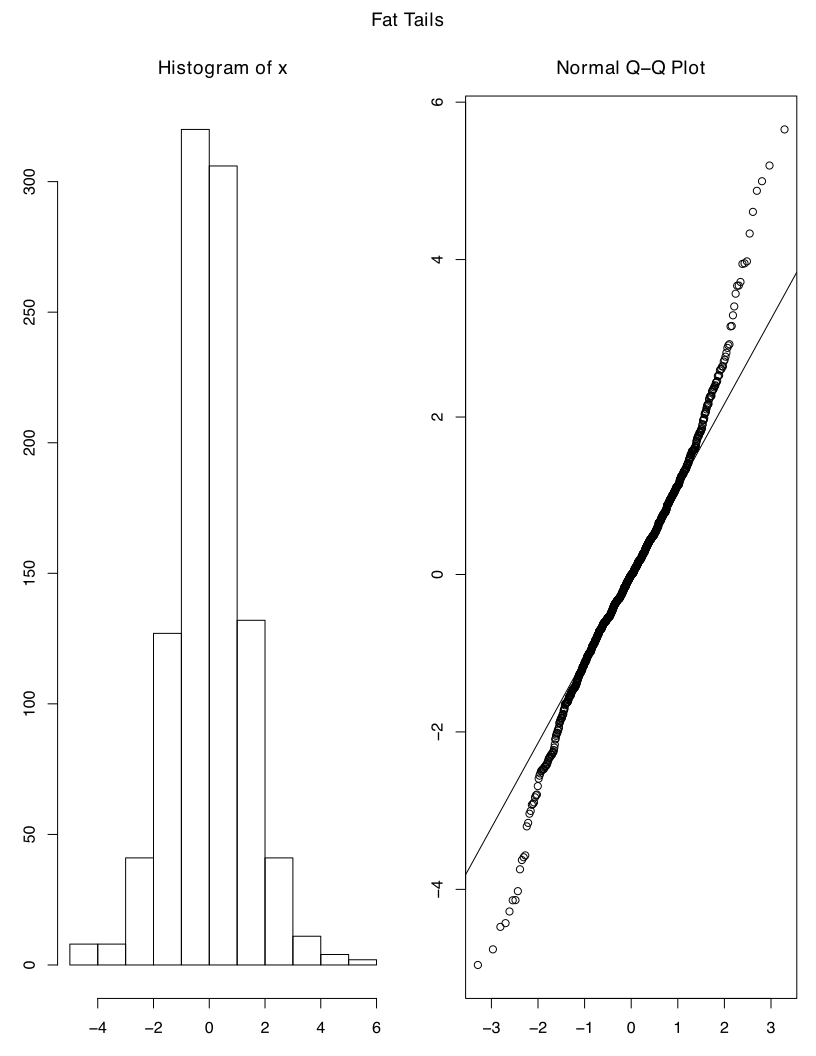
Heavy Tails