Convolutional neural net basics
DATASCI 415: Statistical Learning and Data Mining
University of Michigan
including slides by Mu Li and Alex Smola
Convolutional neural nets
convolution
pooling
residual connections
handwritten digit recognition with LeNet
2D convolutions
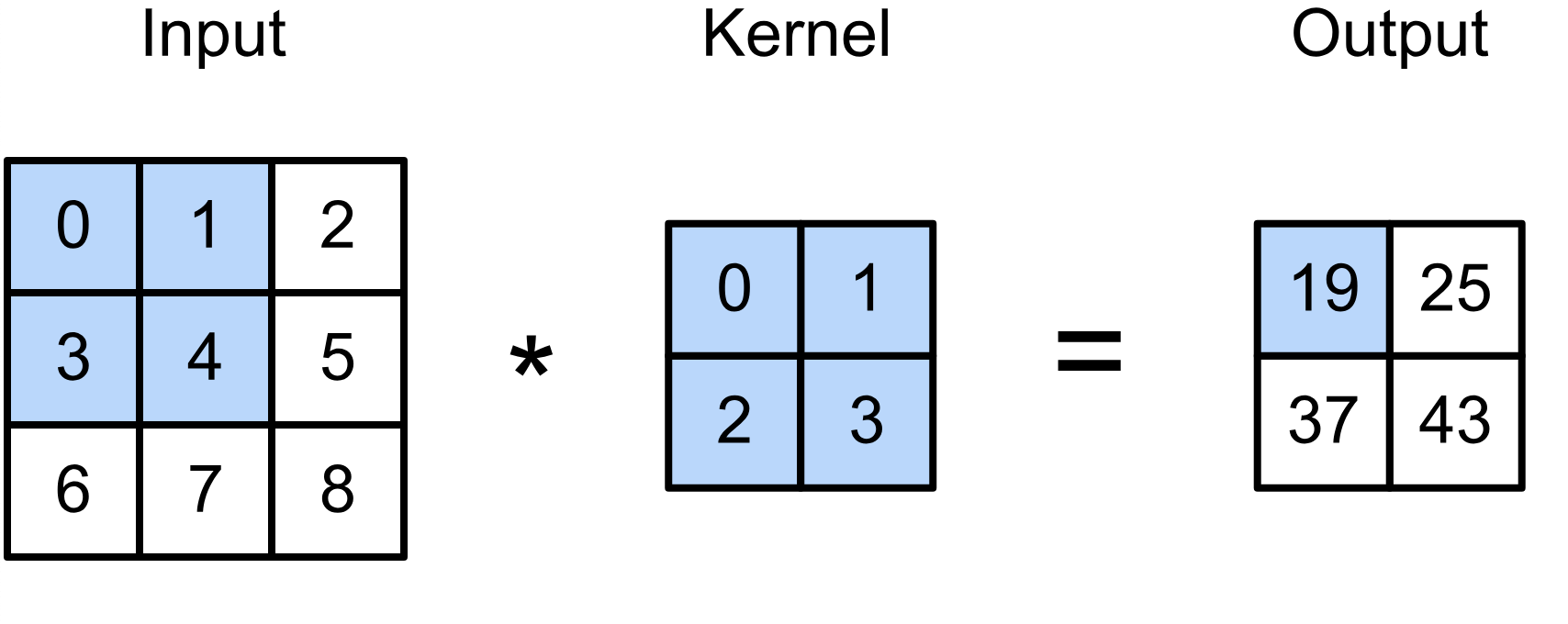
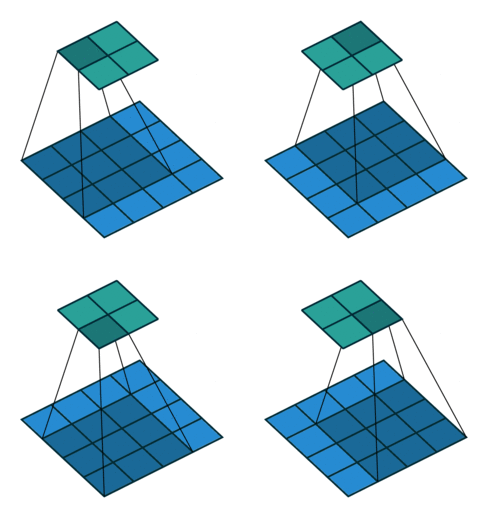
animation by Vincent Dumoulin
2D convolution layers
- $X\in\reals^{n_h\times n_w}$: $n_h\times n_w$ input matrix
- $W\in\reals^{k_h\times k_w}$: convolution kernel matrix parameter
- $b\in\reals$: bias parameter
- $Y\in\reals^{m_h\times m_w}$: output matrix
- $m_h\triangleq n_h-k_h+1$
- $m_w\triangleq n_w-k_w+1$
1D and 3D convolutions
1D convolutions
$$ y_i = \sum_{a=1}^hw_ax_{i+a} + b $$- audio
- (text)
- time series
3D convolutions
$$\begin{aligned} y_{i,j,k} &=\sum_{a=1}^h\sum_{b=1}^w\sum_{c=1}^dw_{a,b,c}x_{i+a,j+b,k+c} \\ &\qquad+ b \end{aligned}$$- video
- 3D (medical) images
Padding
The output of conv layers are smaller its inputs:
- input size: $n_w\times n_h$ input
- kernel size: $k_h\times k_w$ kernel
- output size: $n_h-k_h+1\times n_w-k_w+1$
Output shape shrinks faster with larger kernels!
animation by Vincent Dumoulin
Padding
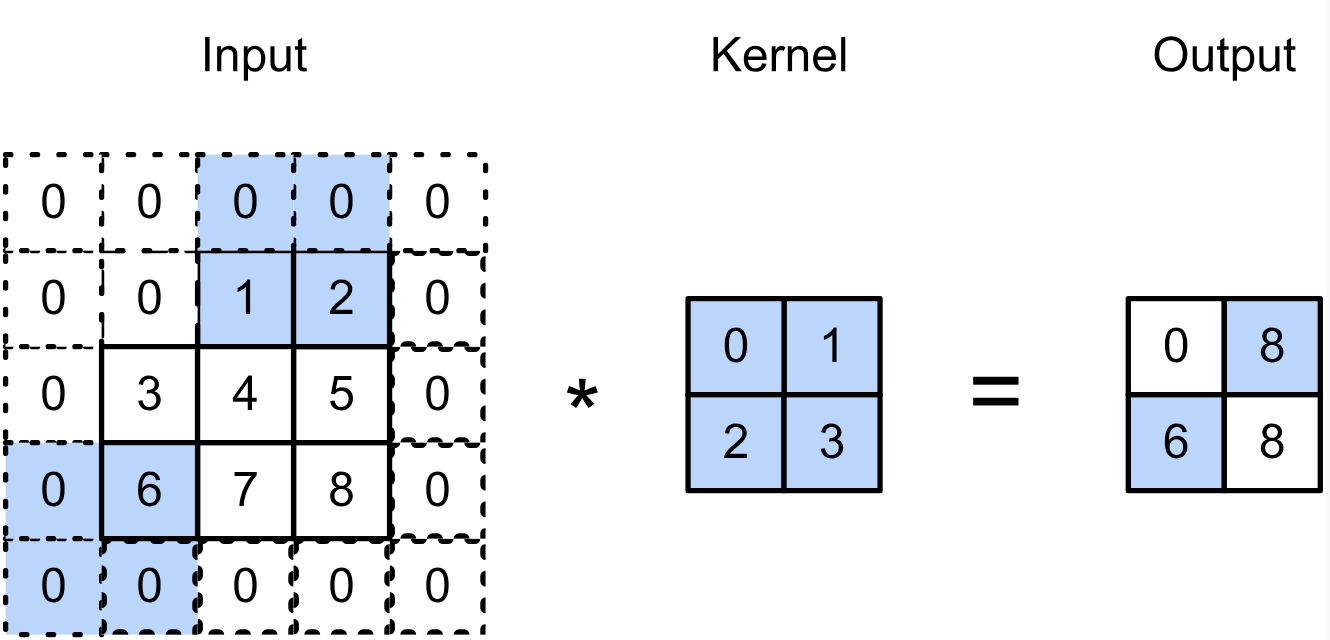
Padding adds zeros around input to increase output size.
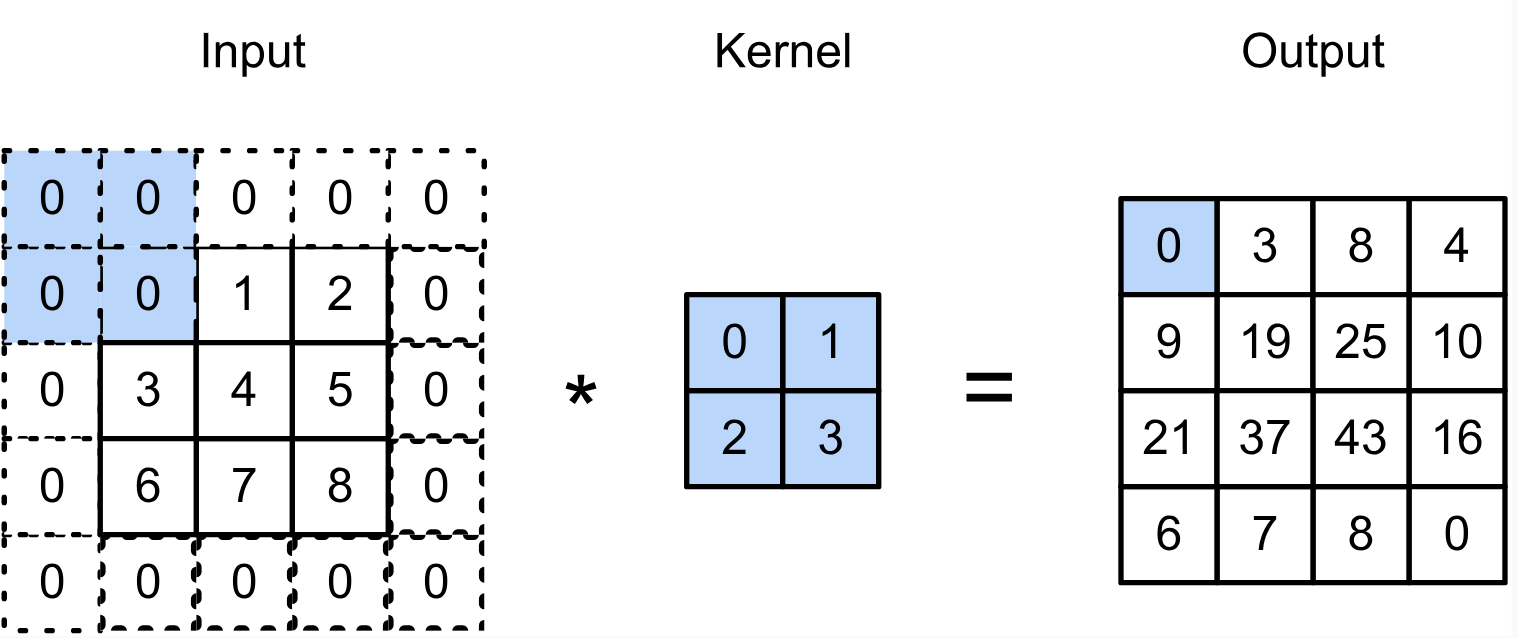
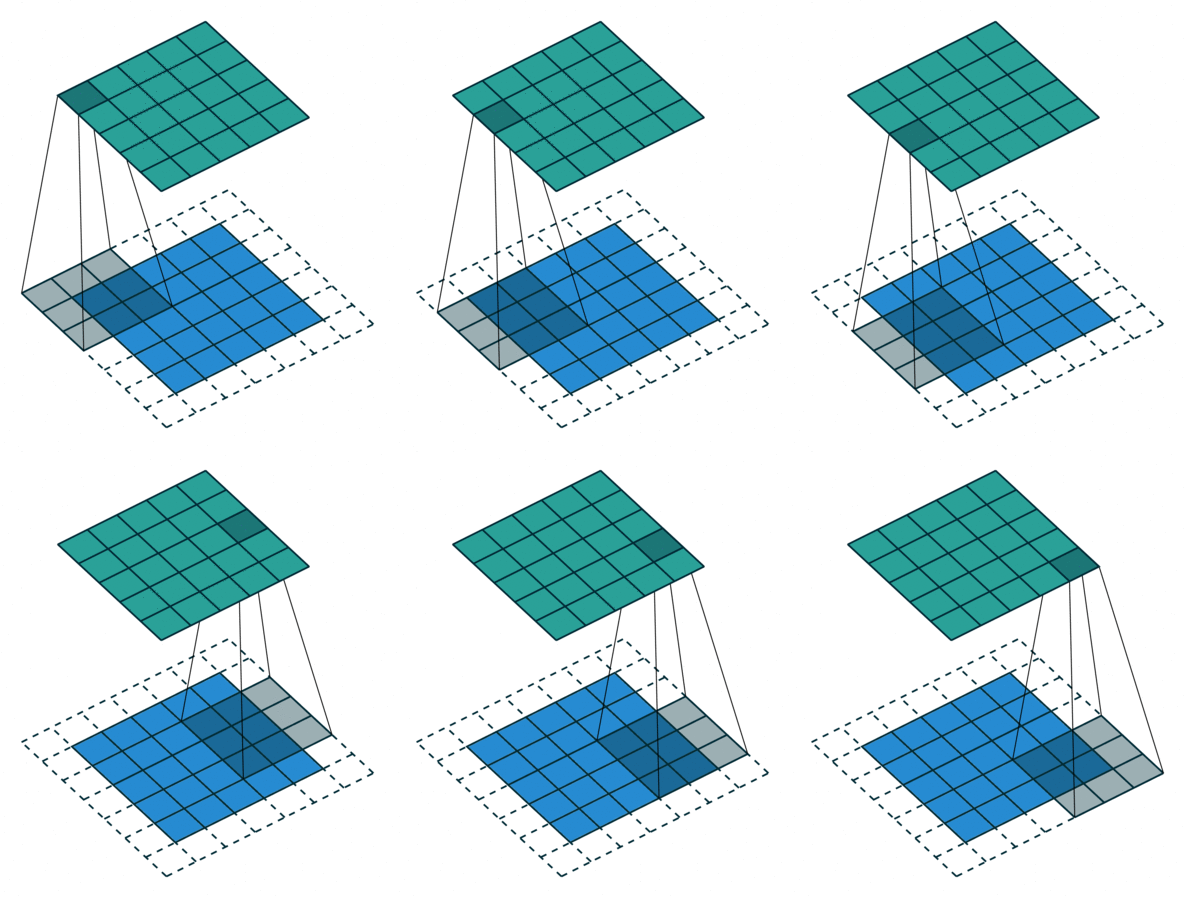
animation by Vincent Dumoulin
Padding
Output size from padding $p_h$ rows (total) on the top and bottom and $p_w$ columns on the sides is
$$(n_h - k_h + p_h + 1)\times (n_w - k_w + p_w + 1).$$- input size: $n_w\times n_h$ input
- kernel size: $k_h\times k_w$ kernel
If $k_h$ and $k_w$ are odd, then we pad by
- $\frac{p_h}{2}$ on the top and bottom,
- $\frac{p_r}{2}$ on the sides,
where $p_h = k_h - 1$, $p_w = k_w - 1$, to match input and output sizes.
Stride
Stride is the rows and columns per slide/step
Ex: stride of 3 rows and 2 columns
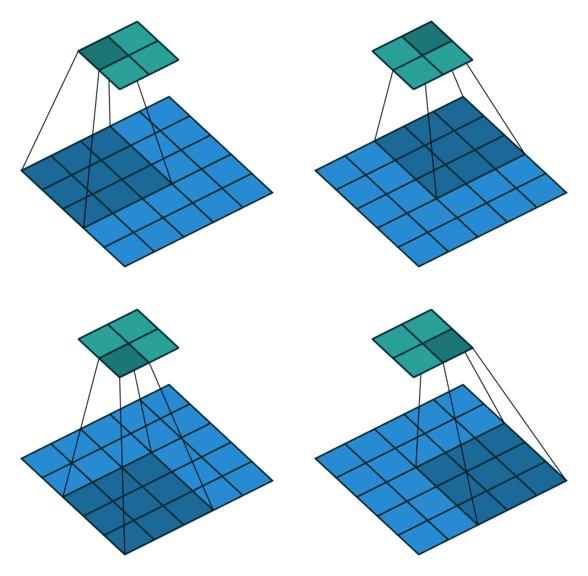
animation by Vincent Dumoulin
Stride
Output size from stride of $s_h$ rows and $s_w$ columns is
$$\lfloor(n_h - k_h + p_h + s_h)/s_h\rfloor\times\lfloor(n_w - k_w + p_w + s_w)/s_w\rfloor.$$- input size: $n_w\times n_h$ input
- kernel size: $k_h\times k_w$ kernel
- padding $p_h$ rows and $p_w$ columns