Continuing from:
Introduction
Geometry with the Discrete Fourier Transform
The pentagon construction explained
Why does the above work? It can be explained by examining this construction with a really
simple example of what can be thought of as a Geometrical Fourier Transform. In this case
it's the Discrete Fourier Transform of order 5.
Let $\omega_k$ be the simplest primitive $k$th root of unity, with $\ii := \sqrt{-1}$:
$$
\omega_k = \cos\frac {2\pi}k+ \sin\frac {2\pi}k \ii.
$$
The standard convex regular pentagon can be taken to be the ordered set of points
$$
(\omega_5^0,\omega_5^1,\omega_5^2,\omega_5^3,\omega_5^4) =(1,\omega_5^{\strut},\omega_5^2,\omega_5^3,\omega_5^4).
$$
The standard regular star pentagon, or pentagram, can be taken to be the ordered set of points
$$
(\omega_5^{2\times0},\omega_5^{2\times1},\omega_5^{2\times2}, \omega_5^{2\times3},\omega_5^{2\times4})
=(1,\omega_5^2,\omega_5^4,\omega_5^1,\omega_5^3),
$$
which is the result of taking every other point starting from $1$. Note that complex conjugation
acts as $\overline{\omega_5^j} = \omega_5^{5-j}$.
We'll do the case $n=5$ of the starting construction first, so take $\omega := \omega_5^{\strut}$
until further notice.
Remark also that
$$\cos\frac{2}{\pi}5 = \cos 72^\circ = \frac{1}{4} (-1+\sqrt5)\simeq 0.309, \quad \sin\frac{2}{\pi} 5
=\cos 18^\circ = \frac{1}{4}\sqrt{10+2\sqrt5} \simeq 0.951 .
$$
In fact, in terms of square roots,
$$
\left(
\begin{array}{c}
1\\
\omega_5^{\phantom{1}}\\
\omega_5^2\\
\omega_5^3\\
\omega_5^4
\end{array}\right) =
\frac{1}{4}
\left(
\begin{array}{c}
4\\
-1+\sqrt5 + \ii \sqrt{10+2\sqrt5}\\
-1-\sqrt5 + \ii \sqrt{10-2\sqrt5}\\
-1-\sqrt5 - \ii \sqrt{10-2\sqrt5}\\
-1+\sqrt5 - \ii \sqrt{10+2\sqrt5}
\end{array}
\right)
$$
$$=
\frac{1}{4} \left\{\, \left[
-\left(
\begin{array}{c}
1\\
1\\
1\\
1\\
1
\end{array}
\right)
+\sqrt5\,
\left(
\begin{array}{c}
\sqrt5\\
+1\\
-1\\
-1\\
+1
\end{array}
\right)
\,\right] +
\frac{\ii}{2} \sqrt{10+2\sqrt5}\,
\left[\,\,
\left(
\begin{array}{c}
0\\
2\\
1\\
-1\\
-2
\end{array}
\right)
+\sqrt5\,
\left(
\begin{array}{c}
0\\
0\\
-1\\
1\\
0
\end{array}
\right) \,
\right]\, \right\}
$$
which seems complicated enough.
Going back to examine the coordinates for $q_i$ we see
$$q_i = -\frac{\sqrt5}5 p_i + \frac{5+\sqrt5}{10} p_{i+2}+ \frac{5+\sqrt5}{10} p_{i+3}.$$
To establish properties of the shape of a pentagon we try to see what components of the
various standard types it has. The general fact is that any plane pentagon can be written
as a linear superposition, with complex coefficients, of the standard polygonal forms
with $5$ points. The 5 basic forms are:
- a degenerate collection of five points
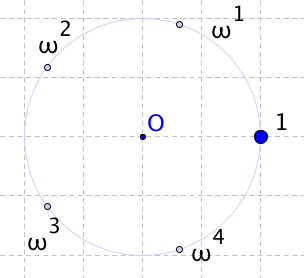
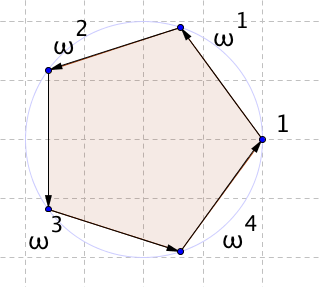
- the standard regular convex pentagon
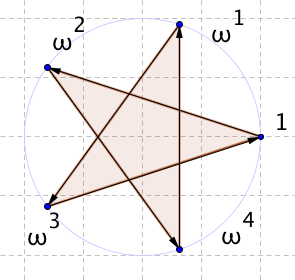
- the standard regular star pentagon
- the reversed regular star pentagon
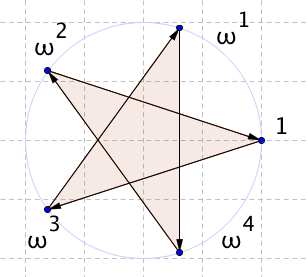
- the reversed regular convex pentagon
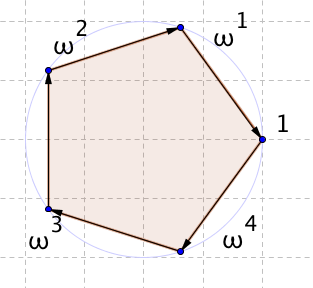
‘Standard’ means
consisting of points on the unit circle, and ‘reversed’ means the standard form described
in the opposite orientation. We will also refer to the reversed forms of the figures
as their opposites, since they have the opposite orientation. The four non-degenerate
types are illustrated below.
The coordinates of the five basic forms of a pentagon are: $$
(
1,
1,
1,
1,
1
)
\,,\quad(
1,
\omega_5^\strut,
\omega_5^2,
\omega_5^3,
\omega_5^4
)
\,,\quad(
1,
\omega_5^2,
\omega_5^4,
\omega_5^\strut,
\omega_5^3
)
\,,\quad(
1,
\omega_5^3,
\omega_5^\strut,
\omega_5^4,
\omega_5^2
)
\,,\quad(
1,
\omega_5^4,
\omega_5^3,
\omega_5^2,
\omega_5^\strut
)
$$
We shall consider a pentagon $p$ as a
function on the cyclic group ${\mathbb Z}/5 {\mathbb Z}$. In fact that's what we began to do as
soon as we adopted the convention that the indices were to be viewed modulo $5$.
The decomposition of a given pentagon into its standard components is just an example of
harmonic analysis for the cyclic group ${\mathbb Z}_{/5} := {\mathbb Z}/5 {\mathbb Z}$.
This is known as the Discrete Fourier Transform of order $5$.
The 5-dimensional space, ${\mathbb C}{\mathbb Z}_{/5} $,
of ${\mathbb C}$-valued functions on
${\mathbb Z}_{/5}$,known as the complex group algebra of ${\mathbb C}{\mathbb Z}_{/5}$ since it
has ppointwise function multiplication as well as addition, has as a basis the functions
$$\begin{eqnarray}
\chi_0&=&(
1,
1,
1,
1,
1
)
\\
\chi_1&=&(
1,
\omega_5^\strut,
\omega_5^2,
\omega_5^3,
\omega_5^4
)
\\
\chi_2&=&(
1,
\omega_5^2,
\omega_5^4,
\omega_5^\strut,
\omega_5^3
)
\\
\chi_3&=&(
1,
\omega_5^3,
\omega_5^\strut,
\omega_5^4,
\omega_5^2
)
\\
\chi_4&=&(
1,
\omega_5^4,
\omega_5^3,
\omega_5^2,
\omega_5^\strut
).
\end{eqnarray}
$$
It is also a space with a natural Hermitian inner product. Namely for
$u,v\in{\mathbb C}{\mathbb Z}_{/5}$
$$
\langle u | v\rangle := \frac{1}{|{\mathbb Z}_{/5}|}\sum_{g\in{\mathbb Z}_{/5}} \overline{u(g)}v(g) =
\frac{1}{5}\sum_{1\leq j\leq 5}\overline{u_j}v_j.
$$
So, if we note that the numbering of the basis functions above is like the characters
of ${\mathbb Z}_{/5}$ that they are, using
$$
\chi_k = (\omega_5^{k\cdot0},\omega_5^{k\cdot1},\omega_5^{k\cdot2},\omega_5^{k\cdot3},
\omega_5^{k\cdot4})\quad\quad 0\leq k\leq4,
$$
then the expansion of an arbitrary function $f\in{\mathbb C}{\mathbb Z}_{/5}$ is
$$
f = \sum_{k=0}^{4}\langle\chi_k | f\rangle \chi_k=\sum_{k=0}^{4}\hat f_k \chi_k,
$$
where $\hat f_{0}$ is the center of gravity of the value set of $f$, and
$\hat f_{1},\hat f_{2},\hat f_{3},\hat f_{4}$ are the coefficients in the expression
of the arbitrary pentagon $f$ as a linear sum of standard ones. The $(\chi_k)_{0\le k\le 4}$
form an orthonormal basis, and $\chi_0$ is the trivial (or degenerate) character of the
trivial representation. Now we examine the pentagon $q$ that Douglas derived in this connection:
The center of gravity is just an expression of where the geometric object is located,
so we don't expect any special properties for it. But for
$q_i = -\frac{\sqrt5}5 p_i + \frac{5+\sqrt5}{10} p_{i+2}+ \frac{5+\sqrt5}{10} p_{i+3}$
look at $\hat q_2$, or at
$$
\begin{eqnarray}
5\hat {q_2} &=&5 \langle \chi_2 | q\rangle (-\frac{\sqrt5}5\cdot1 +
\frac{5+\sqrt5}{10} \omega_5^{4} +
\frac{5+\sqrt5}{10} \omega_5^{1})p_1 +\\
& & (-\frac{\sqrt5}5 \omega_5^{3} + \frac{5+\sqrt5}{10} \omega_5^{2} +
\frac{5+\sqrt5}{10} \omega_5^{4})p_2 +\\
& & (-\frac{\sqrt5}5 \omega_5^{1} + \frac{5+\sqrt5}{10} \cdot1 +
\frac{5+\sqrt5}{10} \omega_5^{2})p_3 +\\
& & (-\frac{\sqrt5}5 \omega_5^{4} + \frac{5+\sqrt5}{10} \omega_5^{3} +
\frac{5+\sqrt5}{10} \cdot1)p_4 +\\
& & (-\frac{\sqrt5}5 \omega_5^{2} + \frac{5+\sqrt5}{10} \omega_5^{1} +
\frac{5+\sqrt5}{10} \omega_5^{3})p_5 .
\end{eqnarray}
$$
$$
\begin{eqnarray}
5\hat {q_2} &=&5 \langle \chi_2 | q\rangle \\
&=& 1\cdot q_1 + \overline{ \omega_5^{2}}\cdot q_2 + \overline{ \omega_5^{4}}\cdot q_3 +
\overline{ \omega_5^{1}}\cdot q_4 + \overline{ \omega_5^{3}}\cdot q_5\\
&=& q_1 +\omega_5^{3} q_2 + \omega_5^{1} q_3 + \omega_5^{4} q_4 + \omega_5^{2} q_5\\
&=& -\frac{\sqrt5}5( p_1 +\omega_5^{3} p_2 + \omega_5^{1} p_3 + \omega_5^{4} p_4 +
\omega_5^{2} p_5) +\\
& & \frac{5+\sqrt5}{10}( p_3 +\omega_5^{3} p_4 + \omega_5^{1} p_5 + \omega_5^{4} p_1 +
\omega_5^{2} p_2) +\\
& & \frac{5+\sqrt5}{10}( p_4 +\omega_5^{3} p_5 + \omega_5^{1} p_1 + \omega_5^{4} p_2 +
\omega_5^{2} p_3)\\
&=& (-\frac{\sqrt5}5\cdot1 + \frac{5+\sqrt5}{10} \omega_5^{4} +
\frac{5+\sqrt5}{10} \omega_5^{1})p_1 +\\
& & (-\frac{\sqrt5}5 \omega_5^{3} + \frac{5+\sqrt5}{10} \omega_5^{2} +
\frac{5+\sqrt5}{10} \omega_5^{4})p_2 +\\
& & (-\frac{\sqrt5}5 \omega_5^{1} + \frac{5+\sqrt5}{10} \cdot1 +
\frac{5+\sqrt5}{10} \omega_5^{2})p_3 +\\
& & (-\frac{\sqrt5}5 \omega_5^{4} + \frac{5+\sqrt5}{10} \omega_5^{3} +
\frac{5+\sqrt5}{10} \cdot1)p_4 +\\
& & (-\frac{\sqrt5}5 \omega_5^{2} + \frac{5+\sqrt5}{10} \omega_5^{1} +
\frac{5+\sqrt5}{10} \omega_5^{3})p_5 .
\end{eqnarray}
$$
The thing to note is that the coefficients of the points $p_i$ are all
multiples by powers of $\omega_5$ of the coefficient of $p_1$. Furthermore the
coefficient of $p_1$ is a real number since $\overline{\omega_5^{4}} = \omega_5^{1}$. But
$$
\begin{eqnarray}
- \frac{\sqrt5}5\cdot1 + \frac{5+\sqrt5}{10} \omega_5^{4} +
\frac{1+\sqrt5}{2}\omega_5^{1} =
-\frac{\sqrt5}5 + \frac{5+\sqrt5}{10}\left(\omega_5^{4} + \omega_5^{1}\right)
= 0 .
\end{eqnarray}
$$
$$
\begin{eqnarray}
- \frac{\sqrt5}5\cdot1 + \frac{5+\sqrt5}{10} \omega_5^{4} +
\frac{1+\sqrt5}{2}\omega_5^{1} &=&
-\frac{\sqrt5}5 + \frac{5+\sqrt5}{10}\left(\omega_5^{4} + \omega_5^{1}\right) \\
&=&
-\frac{\sqrt5}5 + \frac{5+\sqrt5}{10} 2 \Re{ \omega_5^{1}}
\\
&=&
-\frac{\sqrt5}5 + \frac{(5+\sqrt5)(-1+\sqrt5)}{10\times 2} \\
&=&
-\frac{\sqrt5}5 + \frac{-5+5-\sqrt5+5\sqrt5}{10\times 2} \\
&=&
-\frac{\sqrt5}5 + \frac{4\sqrt5}{20} = 0 .
\end{eqnarray}
$$
Thus $\hat q_2$ vanishes indentically. So there is no regular pentagram
component of the polygon $q$. Similarly look at $\hat q_3$, or at
$$
\begin{eqnarray}
5\hat { q_3} = 5\ \langle \chi_3 | q\rangle = 5\ \overline{\langle \overline q,\chi_2\rangle} = 0 .
\end{eqnarray}
$$
$$
\begin{eqnarray}
5\hat { q_3} &=& 5\ \langle \chi_3 | q\rangle \\
&=& 1\cdot q_1 + \overline{ \omega_5^{3}}\cdot q_2 + \overline{ \omega_5^{1}}\cdot q_3 +
\overline{ \omega_5^{4}}\cdot q_4 + \overline{ \omega_5^{2}}\cdot q_5\\
&=& q_1 +\omega_5^{2} q_2 + \omega_5^{4} q_3 + \omega_5^{1} q_4 + \omega_5^{3} q_5\\
&=& 5\ \langle \overline{\chi_2} | q\rangle \\
&=& 5\ \overline{\langle \overline q,\chi_2\rangle} \\
&=& 0 .
\end{eqnarray}
$$
This is because the reason that $\langle \chi_3 | q\rangle = 0$ has little to do with
the properties of the $q_i$ as complex numbers, but was entirely the result of the
interaction between the $5$th roots of unity, and the real coefficients in the specific
make-up of the $q_i$ starting from arbitrary complex numbers $p_i$. If this
is unconvincing, then a similar argument to the previous one goes through but
involves the verification
$$
- \frac{\sqrt5}5\cdot1 + \frac{5+\sqrt5}{10} \omega_5^{1} + \frac{5+\sqrt5}{10}\omega_5^{4} = 0.
$$
We have thus shown that $q = {\hat q}_0 + {\hat q}_1 \chi_1 + {\hat q}_4\chi_4={\hat q}_0 +
{\hat q}_1 \chi_1 + {\hat q}_4 \overline{\chi_1}$. This means that $q$ is an affine image
of the regular convex pentagon, as will be discussed below.
We could have convinced ourselves geometrically that the coefficients vanish by looking at
the diagrams for the pentagon in the unit circle, but it seemed useful to do the simple algebra.
Next consider the other similarly constructed pentagon $r$, the one whose points are
given by
$$
r_i = \frac{\sqrt5}5 p_i + \frac{5-\sqrt5}{10} p_{i+2}+
\frac{5-\sqrt5}{10} p_{i+3}.
$$
For this case we examine correspondingly the
components ${\hat r}_1$ and ${\hat r}_4$. Again we can group the coefficients of
the points $p_i$, and see that they are all multiples of any one of them. For instance,
the coefficient of $p_1$ is
$$
\frac{\sqrt5}5\cdot1 + \frac{5-\sqrt5}{10} \omega_5^{2} + \frac{5-\sqrt5}{10} \omega_5^{3}=
\frac{\sqrt5}5 + \frac{5-\sqrt5}{10}\frac{-1-\sqrt5}{2} = 0,
$$
just as before, up to a couple
of sign changes. Also as before, we can conclude that ${\hat r}_1 = {\hat r}_4 = 0$, and say
that the polygon $r$ is the affine image of a regular pentagram.
Affine transformations
The general form of an affine transformation of the plane
with coordinates $x$ and $y$, can be written
$$\left(\begin{array}{c}x\\
y\\ \end{array}\right)
\mapsto
\left(\begin{array}{cc}a&b\\
c&d\\ \end{array}\right)
\left(\begin{array}{c}x\\
y\end{array}\right) +
\left(\begin{array}{c}e\\
f\end{array}\right)
.$$
If we view the $(x,y)$-plane as the complex plane $\cplx$, thus in
terms of $z=x+\ii y$ with $\ii = \sqrt{-1}$, we have to translate
the above into complex language.
We see the general plane affine transformation written in complex
coordinates is
$$
z \mapsto \lambda z + \mu \overline z + \nu
$$
with $2 \lambda=(a+d)+(c-b)\ii,\ 2 \mu=(a-d)+(c+b)\ii,\ \nu\in\cplx$.
The addition of a constant term can
be realized by the addition of a complex number:
$$z = x + \ii y \mapsto x + \ii y + (e + \ii f)$$ so we are left with the
matrix to deal with.
Since in the above affine transformation $x$ and $y$ are not
coupled, a moment's reflection reveals that the expression using
complex coordinates for an affine transformation will have to
involve both $z$ and $\overline z$, the complex conjugate, so as to
provide access to the real and imaginary parts of $z$. But then we
just need to equate the general forms
$$(\alpha + \ii \beta) (x + \ii y) + (\gamma + \ii \delta) (x - \ii y)
= (ax + by) + \ii (cx + dy) .$$
The solution is
$$\left(\begin{array}\alpha\\
\beta\\ \gamma\\ \delta\\\end{array}\right)
= {1\over2}
\left(\begin{array}{c}a+d\\ c-b\\ a-d\\ c+b\\\end{array}\right)
={1\over2}
\left(\begin{array}{cccc}1&0&0&1\\ 0&-1&1&0\\
1&0&0&-1\\ 0&1&1&0\end{array}\right)
\left(\begin{array}{c}a\\ b\\ c\\ d\\\end{array}\right).
$$
So we see the general plane affine transformation written in complex
coordinates is
$$
z \mapsto \lambda z + \mu \overline z + \nu
$$
with $2 \lambda=(a+d)+(c-b)\ii,\ 2 \mu=(a-d)+(c+b)\ii,\ \nu\in\cplx$.
Another way of seeing this is just to note that the change from real to
complex coordinates is
\begin{eqnarray*}
\left(\begin{array}{c} x\\
y\\ \end{array}\right)
&=&
\left(\begin{array}{c} (z+\zbar)/2\\
(z-\zbar)/2\ii\\ \end{array}\right)
=\frac12
\left(\begin{array}{cc} \ \ 1&\ 1\\
-\ii&\ii\\ \end{array}\right)
\left(\begin{array}{c} z\\
\zbar\\ \end{array}\right) \\
&\mapsto&\frac12
\left(\begin{array}{cc} a&b\\
c&d\\ \end{array}\right)
\left(\begin{array}{cc} \ 1&\ 1\\
-\ii&\ii\\ \end{array}\right)
\left(\begin{array}{c} z\\
\zbar\\ \end{array}\right)
=\frac12
\left(\begin{array}{cc} a-\ii b& a+\ii b\\
c-\ii d& c+\ii d\\ \end{array}\right)
\left(\begin{array}{c} z\\
\zbar\\ \end{array}\right). \\
\end{eqnarray*}
In other words
\begin{eqnarray*}
\left(\begin{array}{c} z\\
\zbar\\ \end{array}\right)
= &\mapsto&\frac12
\left(\begin{array}{cc} \ 1& +\ii\\
\ 1&-\ii\\ \end{array}\right)
\left(\begin{array}{cc} a&b\\
c&d\\ \end{array}\right)
\left(\begin{array}{cc} \ 1&\ 1\\
-\ii& +\ii\\ \end{array}\right)
\left(\begin{array}{c} z\\
\zbar\\ \end{array}\right) \\
& =& \frac12
\left(\begin{array}{cc} \ 1& +\ii \\
\ 1& -\ii \\ \end{array}\right)
\left(\begin{array}{cc} a-\ii b& a+\ii b\\
c-\ii d&c+\ii d\\ \end{array}\right)
\left(\begin{array}{c} z\\
\zbar\\ \end{array}\right) \\
& =& \frac12
\left(\begin{array}{cc} (a+d)-(b-c)\ii & (a-d)+(b+c)\ii\\
(a-d)-(b+c)\ii & (a+d)+(b-c)\ii\\ \end{array}\right)
\left(\begin{array}{c} z\\
\zbar\\ \end{array}\right),\\
& =&
\left(\begin{array}{cc} \lambda & \mu\\
\overline{\lambda} & \overline{\mu}\\ \end{array}\right)
\left(\begin{array}{c} z\\ \zbar\\ \end{array}\right),\\
\end{eqnarray*}
since
$$ \frac12
\left(\begin{array}{cc} \ 1&+\ii \\
\ 1&-\ii \\ \end{array}\right)
\left(\begin{array}{cc} \ 1&\ 1\\
-\ii&+\ii\\ \end{array}\right)
=
\left(\begin{array}{c} \ 1&\ 0\\
\ 0&\ 1\\ \end{array}\right).
$$
Now consider the case of a linear sum of a regular $n$-gon and
its opposite, say the case of the convex pentagon where we had $n=5$ .
The points are of the form $A \omega^k + B \omega^{-k}$. But
$\omega^{-1}=\bar \omega$, so these points are affine images of the
points of the standard convex pentagon with parameters
$$
(\lambda,\mu,\nu) = (A, B, 0).
$$
That's what we have above as the result of Douglas's construction with a similar
consideration for the affine image of a standard pentagram.
The general Discrete Fourier Transform
Let us fix notation for the general case of what we used in the foregoing explanation.
We consider an $N$-gon $p$, for a natural number $N>0$, as a function on
the cyclic group $\intg_{/N} = \intg / N\intg $. We define
$\omega_N := \ee^{\ii 2 \pi/N}$. Then we wish to decompose the
$N$-dimensional space, $\cplx\intg_{/N}$, of $\cplx$-valued functions on
$\intg_{/N}$, with respect to the basis of characters (putting a $cdot$ for the
product in the exponents for emphasis)
$$(\chi_k)_{k\in \intg}
\quad{\rm where} \quad \chi_k = (\omega_N^{k\cdot j})_{0\le j \le N} =
(\omega_N^{k\cdot0}, \omega_N^{k\cdot1},\dots, \omega_N^{k\cdot N-1}),$$
which are orthonormal for the natural Hermitian inner product, namely for $u,v\in\cplx\intg_{/N}$
$$
\langle u | v\rangle = \frac{1}{|\intg_{/N}|}\sum_{g\in\intg_{/N}} \overline{u(g)}v(g) =
\frac{1}{N}\sum_{0\leq j< N-1}\overline{u_j}v_j,
$$
and
$$
\langle \chi_j | \chi_k\rangle = \loglb j==k\logrb
= \begin{cases}1 \text{ if } j=k | k\cr 0 \text{ otherwise.}\end{cases}
$$
The expansion of an arbitrary function $f=(f_1,\dots,f_N)\in\cplx\intg_{/N}$ is
$$f = \sum_{k=0}^{N-1}\langle\chi_k | f\rangle \chi_k=\sum_{k=0}^{N-1}\hat f_k \chi_k,$$
where $\hat f_{0}$ is the center of gravity (a.k.a. centroid, barycenter or mean) of the value
set of $f$,
$$
\hat f_{0} = \frac{1}{N} (f_1 + \cdots + f_n)
$$
and
$\hat f_{1},\dots,\hat f_{N-1}$ are the coefficients in the
expression of the arbitrary function $f$, an $N$-gon, as a linear sum of standard
ones.
There can be a requirement, in the course of an argument, to emphasize the
number of points involved, $N$, as well as the order, $k$ of a
character. In that case we shall write, as needed,
$$ \chi_{N,k} = (\omega_N^{k\cdot j})_{0\le j < N} = (\omega_N^{k\cdot j}, j\in{\bar N}) =
(\omega_N^{k\cdot0}, \omega_N^{k\cdot1},\dots, \omega_N^{k\cdot N-1}),$$
where we have written $\bar N = 0..N-1$ for an integer interval;
similarly we may write $\langle u | v\rangle_N$.
It is clear then that $\chi_{N,1}$ lists the vertices of the
standard convex regular positively oriented $N$-gon inscribed on the
unit circle. Similarly $\chi_{N,N-1}$ gives the standard negatively
oriented unit $N$-gon. The combination $\lambda \chi_{N,1} +\mu
\chi_{N,N-1}$ with $\lambda, \mu\in\cplx$ then gives a general
affine convex $N$-gon.
When $ 1 < k < N-1$ the $N$-gon given by $\chi_{N,k}$ will
have a multiplicity if $k|N$ ($k$ divides $N$) and that will be $N/k$.
Otherwise it will be sort of ‘star’ polygon if $k$ is prime to $N$, i.e.,
$(k,N)=1$, their greatest common divisor is 1. For
instance, $\chi_{6,3}$ is the
standard hexagon's horizontal equator (a ‘di-gon’) described back
and forth 3 times. $\chi_{6,4}$ is the standard unit equilateral
triangle $\chi_{3,1}$ listed twice in reverse, or you can think of
it as $\chi_{3,2}$ twice.
Triangle geometry
Since the claim is that much classical plane geometry has a
natural expression from the point of view outlined above, we start
by looking at the standard types of triangles and their natural expressions
in this Discrete Fourier Transform notation. Consider first of all triangles
whose centroids are at the origin; after all, it is easy enough to move any triangle
into this simplifying position by a translation, and all interesting theorems of
plane geometry are invariant under translations.
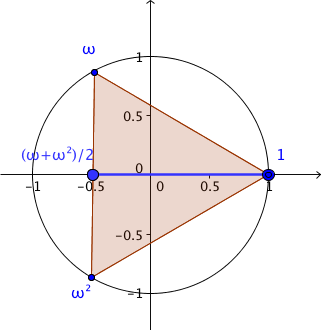
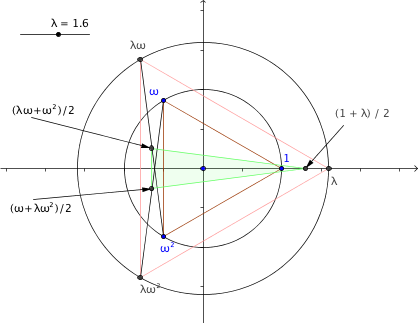
The first example is the simple average of a standard equilateral
triangle and its reverse, namely $\sfrac12(\chi_1+\chi_2)$. The
points are thus $(1,-\sfrac12,-\sfrac12)$; this is a degenerate
triangle of points with the second and third vertices coincident at
$-\sfrac12$. It is a digon with a double point at the left-hand end.
If we
separate the two triangles by making the standard one larger, say lying on a circle of
radius $\lambda>1$ then we get
$$\begin{eqnarray*}
\sfrac12(\lambda\chi_1+\chi_2)=b\sfrac12\left(\lambda+1,-\sfrac12(\lambda+1)+
\sfrac{\sqrt3}2(\lambda-1)\ii,-\sfrac12(\lambda+1)-\sfrac{\sqrt3}2(\lambda-1)\ii\right)
\end{eqnarray*}
$$
$$\begin{eqnarray*}
\sfrac12(\lambda\chi_1+\chi_2)&=&
\sfrac12\left\{\lambda(1,-\sfrac12+\sfrac{\sqrt3}2\ii,-\sfrac12-\sfrac{\sqrt3}2\ii)
+(1,-\sfrac12-\sfrac{\sqrt3}2\ii,-\sfrac12+\sfrac{\sqrt3}2\ii)\right\}\\
&=&\sfrac12\left(\lambda+1,-\sfrac12(\lambda+1)+
\sfrac{\sqrt3}2(\lambda-1)\ii,-\sfrac12(\lambda+1)-\sfrac{\sqrt3}2(\lambda-1)\ii\right)
\end{eqnarray*}
$$
which shows the triangle is an isosceles one with height $\sfrac34(\lambda+1)$
lying along the real axis.
The slider labelled $\lambda$ controls the radius of the outer circle.
The green isosceles triangle of vertices $A$, $B$ and $C$ is the
average of the two triangles with indexed vertices.
If we separate the two basic triangles $\chi_1$ and $\chi_2$ by
turning them in opposite directions by a turn $\ee^{\ii \alpha}$ (in
the attractive terminology of Frank Morley for complex numbers of modulus 1) to make
$$
\begin{eqnarray}
\sfrac12(\ee^{\ii \alpha}\chi_1+\ee^{-\ii \alpha}\chi_2)&=&
\sfrac12\left\{\ee^{\ii \alpha}(1,-\sfrac12+\sfrac{\sqrt3}2\ii,-\sfrac12-\sfrac{\sqrt3}2\ii)
+\ee^{-\ii \alpha}(1,-\sfrac12-\sfrac{\sqrt3}2\ii,-\sfrac12+\sfrac{\sqrt3}2\ii)\right\}\cr
&=& \left(\sfrac12(\ee^{\ii \alpha}+\ee^{-\ii \alpha}),
-\sfrac14(\ee^{\ii \alpha}+\ee^{-\ii \alpha})+
\sfrac{\sqrt3}4\ii(\ee^{\ii \alpha}-\ee^{-\ii \alpha})
,-\sfrac14(\ee^{\ii \alpha}+\ee^{-\ii \alpha})-
\sfrac{\sqrt3}4\ii(\ee^{\ii \alpha}-\ee^{-\ii \alpha})\right)\cr
&=&(\cos \alpha,
-\sfrac12\cos \alpha-\sfrac{\sqrt3}2\sin \alpha,
-\sfrac12\cos \alpha+\sfrac{\sqrt3}2\sin \alpha)
)
\end{eqnarray}
$$
$$
\begin{eqnarray}
\sfrac12(\ee^{\ii \alpha}\chi_1+\ee^{-\ii \alpha}\chi_2)=
(\cos \alpha,
-\sfrac12\cos \alpha-\sfrac{\sqrt3}2\sin \alpha,
-\sfrac12\cos \alpha+\sfrac{\sqrt3}2\sin \alpha)
)
\end{eqnarray}
$$
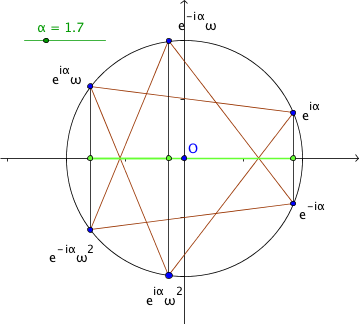
then we have achieved a splitting of the double point at $-\sfrac12$
in $\sfrac12(\chi_1+\chi_2)$ but still have a degenerate triangle on
the real axis, with the second vertex at $z_1=-\sfrac12\cos
\alpha-\sfrac{\sqrt3}2\sin \alpha$ and the third symmetrically
placed about $-\frac12\cos\alpha$ at $z_2=-\sfrac12\cos
\alpha+\sfrac{\sqrt3}2\sin \alpha$.
The green slider $\alpha$ controls the angle away from the axis that the triangles are rotated;
it goes from $0$ to $2 \pi$.
The linear green triangle of vertices $A$, $B$ and $C$ is the average of the triangles with
indexed vertices. Note that the vertices $A_1$, $B_1$ and $C_1$ are positively oriented (counter-clockwise)
and $A_2$, $B_2$ and $C_2$ are negatively oriented.
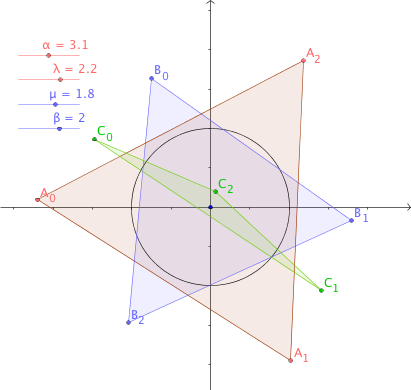
The fully general case is then the addition of two arbitrarily sized and rotated
standard triangles and this is illustrated below.
The sliders are $\lambda$ controlling the size and
$\alpha$ controlling its angle of rotation of the image of the reddish standard triangle labelled
$A_1, B_1, C_1$. Then $\mu$ and $\beta$ are the corresponding controls
for the blue reversed standard triangle labelled
$A_2, B_2, C_2$. We average the two component triangles only to make the
diagram more compact; the result is the green triangle labeled $A_3, B_3, C_3$.
The red sliders are $\lambda$ controlling the size of the red image of the standard triangle and
$\alpha$ controlling its angle of rotation. Then the blue $\mu$ and $\beta$ are the corresponding controls
for the blue image of the reversed standard triangle. We average the
two component triangles to make a green one only to make the
diagram more compact.
The general sum of this form, with six real parameters
$\lambda,\mu,\nu,\alpha,\beta,\gamma\in \reals$, is
$$
\lambda \ee^{\ii \alpha}\chi_1 +\mu \ee^{\ii \beta}\chi_2 +
\nu \ee^{\ii \gamma}\chi_0
$$
and can represent any triangle; the centre of gravity is
$\nu \ee^{\ii \gamma}\chi_0$.
One can spend quite some time playing with figures for these polygon
superpositions but we'll just offer a couple more for enthusiasts here.
Quadrilateral geometry
Pentagon geometry
Proof of Napoleon's Theorem
Let us start by seeing how to express the construction steps in the
simple Napoleon theorem with the help of the characters we
introduced. We need to be able to specify an equilateral triangle
constructed positively on an oriented segment. The standard unit
equilateral triangle is $\chi_{3,1}=:\chi_1$. Its right-hand vertex
is at the point $1\in\cplx$; we see that $\chi_1-\chi_0$ is a
similar triangle shifted so that its right-hand vertex is at the
origin.
To shift it so that its first side is aligned positively along the
horizontal $x$-axis we multiply the whole by
$(\omega-1)^{-1}=3^{-1}(\omega^2-1)$ to get
$3^{-1}(\omega^2-1)(\chi_1-\chi_0)$. This is clear because we want
to move the vertex after the base at $0$, namely at $\omega-1$, to
the point $1$, and
$$
(\omega -1)(\omega^2-1)=\omega^3-\omega^2-\omega+1=3.
$$
Alternatively, we see immediately that
$\overline{\omega-1}=\omega^2-1$ and $|\omega-1|=3$. The
triangular building block we need is thus
$$
3^{-1}(\omega^2-1)(\chi_1-\chi_0).
$$
There is an important thing to note about the constructed triangle:
it is positively oriented with respect to the base interval from $0$
to $1$. It is on the left as we go from $0$ to $1$. To get the
negatively oriented block on the right as we go from $0$ to $1$ we
need
$$
3^{-1}(\omega-1)(\chi_2-\chi_0).
$$
In general, to translate a whole triangular figure by a vector $z$
we have to add to it $z\chi_0$. To rotate by a angle $\alpha$ we
have to multiply by the scalar turn $\ee^{\ii\alpha}$, and to scale
by a homothety $\lambda > 0$ we have to multiply by the scalar
$\lambda$. For instance, if we had not multiplied by
$(\omega-1)^{-1}$ just a moment ago, but only used the rotation
effected by the unit vector
$\{3^{-1/2}(\omega-1)\}^{-1}=3^{-1/2}(\omega^2-1)$ then we would
have had to scale the building-block triangle to unit side-length by
multiplying with $3^{-1/2}$.
If the segment on which we need to erect a triangle is from $z_j$ to
$z_k$, then it is of length $|z_k-z_j|$ and in the direction
$\arg(z_k-z_j)$ from the starting point $z_j$. Thus the triangle
on the left side of the interval which is to be constructed is
$$
3^{-1}(\omega^2-1)(z_k-z_j)(\chi_1-\chi_0) + z_j\chi_0,
$$
and the triangle on the right side is
$$
3^{-1}(\omega-1)(z_k-z_j)(\chi_2-\chi_0) + z_j\chi_0.
$$
Finally in the construction, to find the centroid of a triangle
$z=(z_0,z_1,z_2)$ we just have to take the inner product with
$\chi_0$, namely $\langle\chi_0 | z\rangle$. So the centroid of the
left-side resulting triangle in the last paragraph is, using the
fact that the basis vectors $\chi_j$ are orthonormal,
\begin{eqnarray*}
\langle\chi_0 | 3^{-1}(\omega^2-1)(z_k-z_j)(\chi_1-\chi_0) + z_j\chi_0\rangle
&=& -3^{-1}(\omega^2-1)(z_k-z_j) + z_j\\
&=& -3^{-1}\{(\omega^2-1)z_k-(\omega^2-1)z_j-3z_j\}\\
&=& -3^{-1}\{(\omega^2-1)z_k-(\omega^2+2)z_j\}
.
\end{eqnarray*}
Theorem 1 (Napoleon)
For any nondegenerate triangle in the plane the result of
constructing the centroids of equilateral triangles erected
externally on the sides of the triangle is three points at the
vertices of an equilateral triangle.
Proof. Let the initial triangle be $z=(z_0,z_1,z_2)$, and suppose
the triangle positively oriented. Start with externally
constructed equilateral triangles. That means need right-side
building blocks.
By the above remarks the externally constructed vertices are
$$
( -3^{-1}\{(\omega-1)z_{j+1}-(\omega+2)z_j\} , j\in \bar 3),
$$
so the triangle is
$$3
^{-1}\{(1-\omega)J z+ (\omega+2)z\},
$$
where $J$ is the cyclic permutation
$$
J: (z_0,z_1,z_2) \mapsto (z_1,z_2,z_0) .
$$
To show that this is an equilateral triangle it suffices to take the
inner product with $\chi_2$. We know that the original triangle has
its Fourier decomposition $z=\hat z_0\chi_0+\hat z_1\chi_1+\hat
z_2\chi_2$, and hence that $Jz=\hat z_0\chi_0+\omega \hat
z_1\chi_1+\omega^2 \hat z_2\chi_2$; and the basis
$(\chi_j,j\in\bar3)$ is orthonormal.
Thus
\begin{eqnarray*}
\langle\chi_2|3^{-1}\{(1-\omega)J z+ (\omega+2)z\}\rangle
&=&3^{-1}\{(1-\omega)\omega^2 \hat z_2+ (\omega+2)\hat z_2\}\\
&=&3^{-1}\{\omega^2-1+\omega +2\}\hat z_2 \\
&=&3^{-1}\{\omega^2+\omega +1\}\hat z_2 \\
&=& 0.
\end{eqnarray*}
Therefore we have shown that constructing the centroids of
equilateral triangles externally to the positively oriented initial
triangle yields a sequence of points making up the vertices of a
positively oriented equilateral triangle.
To deal with drawing left-hand side, i.e. , ‘internal’ equilateral
triangles, and taking their centroids we just have to do a similar
calculation. Since we may suspect that the resulting vertices will
have the reverse orientation we will take the inner product with
$\chi_1$. By remarks above the internally constructed vertices are
$$
( -3^{-1}\{(\omega^2-1)z_{j+1}-(\omega^2+2)z_j\} , j\in \bar 3),
$$
so the triangle is
$$
3^{-1}\{(1-\omega^2)J z+ (\omega^2+2)z\}.
$$
Thus
\begin{eqnarray*}
\langle\chi_1|3^{-1}\{(1-\omega^2)J z+ (\omega^2+2)z\}\rangle
&=&3^{-1}\{(1-\omega^2)\omega \hat z_1+ (\omega^2+2)\hat z_1\}\\
&=&3^{-1}\{\omega-1+\omega^2 +2\}\hat z_1 \\
&=& 0,
\end{eqnarray*}
as suspected. We have the vertices of a reverse equilateral triangle. ▓
Corollary
The Napoleon
construction provides a geometrical way to find the discrete Fourier
transform of a triangle.
Proof. We evaluate the other coefficients for the constructed
triangles. First for the external triangles
\begin{eqnarray*}
\langle\chi_1|3^{-1}\{(1-\omega)J z+ (\omega+2)z\}\rangle
&=&3^{-1}\{(1-\omega)\omega \hat z_1+ (\omega+2)\hat z_1\}\\
&=&3^{-1}\{\omega-\omega^2 +\omega +2\}\hat z_1 \\
&=&3^{-1}\{-\omega^2+2\omega +2\}\hat z_1 \\
&=&3^{-1}\{-3\omega^2\}\hat z_1\\
&=& -\omega^2 \hat z_1,
\end{eqnarray*}
and
\begin{eqnarray*}
\langle\chi_0|3^{-1}\{(1-\omega)J z+ (\omega+2)z\}\rangle
&=&3^{-1}\{(1-\omega) \hat z_0+ (\omega+2)\hat z_0\}\\
&=&\hat z_0
\end{eqnarray*}
(which last we really already knew).
Geometrically this means that the external Napoleon triangle has equal sides
of lengths $\sqrt3|\hat z_1|$, and if we want to work out the argument of $\hat z_1$
then all we have to do is to rotate the first side of it back by $2\pi/3$ and flip.
From the internal Napoleon triangle we get similarly
\begin{eqnarray*}
\langle\chi_2|3^{-1}\{(1-\omega^2)J z+ (\omega^2+2)z\}\rangle
&=&3^{-1}\{(1-\omega^2)\omega^2 \hat z_2+ (\omega^2+2)\hat z_2\}\\
&=&3^{-1}\{\omega^2-\omega +\omega^2 +2\}\hat z_2 \\
&=& -\omega \hat z_2,
\end{eqnarray*}
giving us the value for $\hat z_2$. ▓
The generalized form of this just results from noticing that one
could as well use $N$ as 3 above for the number of sides,
$\chi_{N,k}$ for the initial $N$-gon and some other $\chi_{N,l}$-gon
for the constructed figure on each side and still get the same
results with careful manipulation of the indices. It is probably helpful to
remark that the $N=4$ case says that constructing squares on the sides
of a parallelogram gives four centers of gravity of those which are the
vertices of a square, before the general formulation that follows.
Theorem 2 (Generalized Napoleon)
Let $N$ be an integer greater than 2, and $k$ and $l$ be integers
between $1$ and $N-1$. For any nondegenerate affine image of a
regular $(N,k)$-gon in the plane, the result of constructing the
centroids of regular $(N,l)$-gons externally upon the sides of the
initial $(N,k)$-gon is the set of vertices of a regular $(N,k)$-gon
if $k^2=l \pmod N$; if the additional figures are constructed
internally then a regular $(N,N-k)$-gon results.
The matrix point of view
We have been considering a triple of vertices as a function on $\ints_{/3}$.
The cyclic permutation, $(0,1,2)\mapsto (1,2,0)$,
and is the generator, call it $J$, of the group $\ints_{/3}$. Extended to act on functions,
this maps $(z_0,z_1,z_2)\mapsto (z_1,z_2,z_0)$, thus moving the
points by one index around the putative curve. If we write our coordinates out
as column vectors (so as to end up with matrix actions on the left, which
is probably more common) then we can write
\[
\left(\begin{array}{c}
z_1\\
z_2\\
z_0
\end{array}\right)
=
\left(\begin{array}{ccc}
0&1&0\\
0&0&1\\
1&0&0
\end{array}\right)
\left(\begin{array}{c}
z_0\\
z_1\\
z_2
\end{array}\right),
\]
or (using Matlab notation in which ‘,’ is a horizontal spacer and ‘;’ is
a vertical spacer) the result is $Jz$ with $z:=(z_0;z_1;z_2)$ and
$J:= (0,1,0;0,0,1;1,0,0)$.
First note $J^3=1$, so that $J$'s eigenvalue list is $(1,\omega,\omega^2)$. Then
note that we know from above the corresponding eigenvectors to be
$(\chi_0\tr, \chi_1\tr,\chi_2\tr)$ (${}\tr$ is the notation for the transpose); for instance,
$J \chi_1\tr = (\omega;\omega^2; 1) = \omega (1;\omega;\omega^2) = \omega \chi_1$.
Thus we can see an explicit diagonalization of $J$ using $(\chi_0;\chi_1;\chi_2)$
\[
\left(\begin{array}{ccc}
0&1&0\\
0&0&1\\
1&0&0
\end{array}\right)
= \frac{1}{3}\left(\begin{array}{ccc}
1&1&1\\
1&\omega&\omega^2\\
1&\omega^2&\omega
\end{array}\right)
\left(\begin{array}{ccc}
1&0&0\\
0&\omega&0\\
0&0&\omega^2
\end{array}\right)
\left(\begin{array}{ccc}
1&1&1\\
1&\omega^2&\omega\\
1&\omega&\omega^2
\end{array}\right)
,\]
or with $U\st := \frac{1}{\sqrt3}(\chi_0;\chi_1;\chi_2)$ we have $U J U\st =
(1\!:\!\omega\!:\!\omega^2)$;
here we have used ‘:’ as a diagonal separator to supplement our horizontal and
vertical ones, and ${}\st$ denotes Hermitian conjugation. We note $U$ is unitary:
$U\st U = 1$.
We can recognize $U\st$ as the
(normalized) matrix of the discrete Fourier transform above, since it clear that
\[
\tfrac{1}{\sqrt 3} U\st (z_0;z_1;z_2) = (f_0;f_1;f_2).
\]
We could have written the Fourier transform equations in matrix form before as
\[
3
\left(\begin{array}{c}
f_0\\f_1\\f_2\end{array}\right)=
\left(\begin{array}{lll}
1&1&1\\
1&\omega^2&\omega\\
1&\omega&\omega^2
\end{array}\right)
\left(\begin{array}{c}
z_0\\z_1\\z_2\end{array}\right),
\]
and
\[
3\left(\begin{array}{c}
z_0\\z_1\\z_2\end{array}\right) =
\left(\begin{array}{lll}
1&1&1\\
1&\omega&\omega^2\\
1&\omega^2&\omega
\end{array}\right)
\left(\begin{array}{c}
f_0\\f_1\\f_2\end{array}\right).
\]
If we single out the presence of the $3\times3$ Vandermonde matrix
$V=(\chi_0;\chi_1;\chi_2)$ in these formulas, we can write them as
\[
3 z = V\st f \quad {\rm and} \quad 3f=Vz,
\]
and we have $U=\sfrac1{\sqrt3}V$.
A polynomial point of view
The whole matter above could be viewed as part of algebra,
not geometry. Let us explore some of the formalism as a
derivative of what is found in papers of F. Chapoton
for which he, in turn, references Curtis and Reiner.
We are looking at the cyclic group $\ints_{/N}$ and the associated group algebra $\cplx\ints_{/N}$. If we take the generator of the cyclic group to be $t$ then it is well-known that
$\cplx\ints_{/N} = \cplx[J]/\langle J^N - 1\rangle$.
$J$ is the generator of the cyclic group, $\cplx[J]$ is the algebra of complex polynomials
in $J$ and $\langle J^N - 1\rangle$ is the ideal generated by the relation $J^N = 1$.
If $d$ is a divisor of $N$ then the space $\cplx[J]/\langle J^N - 1\rangle$ will be a
module for $\cplx\ints_{/N}$ under the obvious action of multiplication of each term
by $J^k \mapsto J^{kd}$; call this module $M_{N,d}$. Then $M_{N,N}$ is the regular
representation on the group algebra, and $M_{N,1}$ the trivial representation.
The character of $M_{N,d}$ is
\[
\chi_{N,d}(t^k) = \begin{cases}d \text{ if } d | k\cr 0 \text{ otherwise.}\end{cases}
\]
We denote by $K_0(\cplx\ints_{/N})$ the Grothendieck group of the category of
$\cplx\ints_{/N}$-modules of finite rank. The rank of this Abelian group
is the number of divisors of $N$ and the equivalence classes in
$K_0(\cplx\ints_{/N})$ of the standard modules $M_{N,d}$ form a basis of it.
Let us break off generality and consider the simplest cases which we
have already looked at under the guise of plane geometry. For $N=2$ we have
the two-element group $\cplx\ints_{/2}$ and a single non-trivial representation
on $\cplx[J]/\langle J^2-1\rangle =
\{a + b J \colon a,b\in \cplx\}=\cplx^2$. The generator acts by
\[
J: a+bJ \mapsto aJ + b
\]
or
\[
J:
\left(
\begin{array}{c}
a\\
b\\
\end{array}
\right)
\mapsto
\left(
\begin{array}{c}
b\\
a\\
\end{array}
\right)
=
\left(
\begin{array}{cc}
0& 1\\
1& 0\
\end{array}
\right)
\left(
\begin{array}{c}
a\\
b\\
\end{array}
\right)
\]
For the next prime $N=3$ we have the three-element group $\cplx\ints_{/3}$ and a
single non-trivial representation on $\cplx[J]/\langle J^3-1\rangle =
\{a + b t + c t^2\colon a,b,c\in \cplx\}=\cplx^3$. The generator acts by
\[
J: a+b J+c J^2 \mapsto a J^2 + b + c J
\]
or
\[
J:
\left(
\begin{array}{c}
a\\
b\\
c\\
\end{array}
\right)
\mapsto
\left(
\begin{array}{c}
b\\
c\\
a\\
\end{array}
\right)
=
\left(
\begin{array}{c}
0& 1& 0\\
0& 0&1\\
1& 0&0\\
\end{array}
\right)
\left(
\begin{array}{c}
a\\
b\\
c\\
\end{array}
\right)
\]
This was the regular representation $M_{3,3}$. The module $M_{3,2}$ gives an
equivalent representation, and $M_{3,1}$ is, as ever, the trivial representation
$ J \mapsto \text{Id}$.
For the $N=4$ we have the four-element group $\cplx\ints_{/4}$ and a composite $N$.
There is still the regular representation on $\cplx[J]/\langle J^4-1\rangle =
\{a + b J + c J^2+d J^3\colon a,b,c,d\in \cplx\}=\cplx^4$, and
there the generator acts as usual by
\[
J: a+b J+c J^2 + d J^3 \mapsto a J^3 + b + c J + d J^2
\]
with matrix
\[
J:
\left(
\begin{array}{c}
a\\
b\\
c\\
d\\
\end{array}
\right)
\mapsto
\left(
\begin{array}{c}
b\\
c\\
d\\
a\\
\end{array}
\right)
=
\left(
\begin{array}{c}
0& 1& 0& 0\\
0& 0&1&0\\
0& 0&0&1\\
1& 0& 0&0\\
\end{array}
\right)
\left(
\begin{array}{c}
a\\
b\\
c\\
d\\
\end{array}
\right)
\]
But there is also the representation $M_{4,2}$ for which $J$ acts by
\[
t: a+b J+c J^2 + d J^3 \mapsto a J^2 + b J^3 + c + d J
\]
with
\[
J:
\left(
\begin{array}{c}
a\\
b\\
c\\
d\\
\end{array}
\right)
\mapsto
\left(
\begin{array}{c}
c\\
d\\
a\\
b\\
\end{array}
\right)
=
\left(
\begin{array}{c}
0& 0& 1& 0\\
0& 0&0&1\\
1& 0&0&0\\
0&1& 0&0\\
\end{array}
\right)
\left(
\begin{array}{c}
a\\
b\\
c\\
d\\
\end{array}
\right)
\]
Continued by: