RESULTS
Temporal Analysis
We studied one gait cycle for the right leg during motion without
a load on the back and with a load on the back. Although the overall
gait cycle time was similar for gait without a load (1.16 s) and gait
with a load (1.12 s), the duration of the stance phase was relatively
shorter in gait without a load (49%) than in gait with a load (59%).
The duration of the stance phase was 0.56 s for gait without a load
and 0.66 s in gait with a load. The stance and swing phases are the
two components of gait analysis. The stance phase is defined as heel
strike of foot until the toe is pushed off the ground. The swing
phase, which follows, is the region where the foot does not touch the
ground until another heel strike.
Qualitative Analysis
We compared the gait cycle of the right leg in gait without a load
on the back and in gait with a load on the back. The stance phase
started with slight extension of the lumbar spine (at the
thoracolumbar, T12-L1 joint), extension of the hip, and flexion of
the knee. In contrast to gait without a load, gait with a load
underwent greater extension of the hip. The stance phase consisted of
slight flexion of the lumbar joint, extension of the hip, and
extension of the knee. Gait with a load had greater flexion at the
hip compared to gait without a load. In gait with and without a load
on the back the spine segments did not produce significant
differences.
|
|
|
|
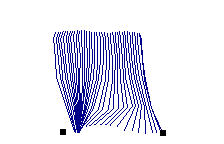
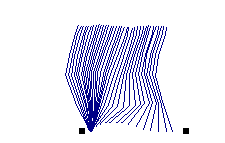
Figure 2. One gait cycle without a load (left) and one
gait cycle with a load (right). The body segments seen are
cervical spine, thoracic spine, lumbar spine, thigh, and
shank. The arrows indicate the direction of movement. The
two black squares indicate reference markers.
|