Reports From Our Fellows Archives
Dispatches From Iraq
'A Snapshot Through a Soda Straw'
By Jay Weiss ’04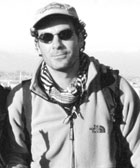
Weiss on the job for ABC
During the summer of 2002, I returned to the States after five years overseas. Based in London, I reported stories across Europe, the Balkans, the Middle East, Central Asia and Africa, which often meant covering violence of one stripe or another. By summer’s end, my “Nightline” colleagues and I had begun planning ways to report on the coming war with Iraq which seemed, even then, inevitable.
At the first sign of Pentagon plans for embedding reporters, my hand shot up like some primitive Pavlovian response. Embedding had obvious advantages but, like most reporters, I had worries about the enterprise. The notion of being “stuck” within the hem of a military unit and largely unable to move freely about the country as the conflict evolved concerned me. Reservations or not, I jumped on board enthusiastically rather than risk missing a crucial chapter in the unfolding post-9/11 history.
The days leading up to my assignment were excruciating. Getting stuck with the wrong unit could be dull as dishwater, while being with the leading edge of the assault could result in new realms in modern reportage. The technology that I and so many others used was new and largely untried. Armed with digital video cameras, laptop editing systems and portable satellite phones capable of transmitting broadcast quality pictures (albeit at a painfully slow rate), provided a chance to bring home the story, and perhaps even some perspective, with bracing speed.
When I got word that I’d be going with the Army’s 101st Airborne Division, I was elated. I had visions of lightning-fast maneuvers, helicopters dropping door-kicking infantrymen and their materiel into hot zones, with me recording the drama, adrenaline thick in my veins.
That’s not exactly how it turned out.
There were exciting moments, for sure. When I jumped out of the Blackhawk helicopter, crammed with fresh-faced young men who’d never seen battle, onto the dusty wasteland just outside of Karbala, I did feel that unmistakable flush as one goes through the looking-glass into complete unpredictability. With Apache and Kiowa helicopters overhead providing cover, I marched with Bravo Company into the thicket of potential conflict.
The Third Infantry Division had swept through this town, like so many others, in their dash to decapitate Saddam’s military machine in Baghdad. Left behind in their wake were Fedayeen and foreign fighters as well as irregulars that had been interdicting supply lines and potentially setting up for a rear guard attack. The 101st was looking for them.
But strangely, Karbala, like Najaf before and the other towns we passed through on our way to Baghdad, barely revealed a sniff of antipathy to the Americans. Quite to the contrary, the open warmth of the people and their obvious relief that Saddam was gone was remarkable.
The Iraqis had done exactly what we had asked of them, more or less. They laid down for the American military juggernaut. Not that they had much of a choice, of course. But seeing the enormous stockpiles of weapons and ammunition stored in every school, in every military base�and even in some mosques�led me to believe that things could have been a lot worse for the American interlopers, had the Iraqis really wanted to fight.
When I was in Najaf with the 101st, soldiers called in a pinpoint hit on a suspected sniper. We then crossed over a mine-laden bridge and into the center of town. I could immediately sense that the traumatized Iraqis were no threat. As I approached and began filming the crowds gathering on the streets, they started to cheer and chant, “Bush! Good! Good!” Later that evening, I was dressed down by a top non-commissioned officer in my battalion for getting between his men and the Iraqi crowd. I had jeopardized his men, he said, coming between them and any potential enemies in the crowd, eclipsing their line of fire, as it were. Militarily speaking, he was right.
The instincts that drove me to get closer to the Iraqi people ran contrary to the military authority I was essentially under. With hostilities coming to an end, the 101st’s role in Najaf, Karbala and elsewhere had quickly become eminently un-newsworthy. It wouldn’t have taken much work to discover the reservoir of doubt and suspicion that lay just beneath the patina of the initial warm Iraqi welcome.
General Richard Myers, Chairman of the Joint Chiefs of Staff, dismissed front-line U.S. commanders’ complaints of the battle plan at one point during the war, saying they were looking at a “snapshot through a soda straw.” My view was equally limited by the constraints of the embed. If I had decided to get off the 101st’s train and pursue other stories, I wouldn’t have been allowed to get back on.
The primary story available to embedded reporters was the superb job and character of the men and women of the U.S. military as they rolled across (in my case at least, an uncontested) Iraq. The Pentagon’s embedding plan was brilliant.
Of course, I’d do it again in a heartbeat and therein lies part of the problem. The chance to cover war, especially an American one, is perhaps the most dramatic story imaginable. The stampede of reporters and news organizations eager for access to the spectacle creates an unequal and uncomfortable relationship with the Pentagon.
Unless news organizations stand together to address the lessons learned, the next time around could be much the same: terrific pictures and dramatic copy, seen through a largely military lens, occluding the obvious and perhaps the essence of the story. Once inside the military envelope, there’s virtually no way to get out and see the bigger picture which was a heartbreakingly short step away when the bang-bang ended.
Jay Weiss is a Washington, D.C.-based producer for “Nightline.”


