Reports From Our Fellows Archives
Remember the Recount?
The Race to Find Out Who Really Won the 2000 Election
Two MJF Alums Duke It Out Over the Recount:
Ford Fessenden ('90) and Dennis Cauchon ('97)
So the Supreme Court’s decision in Bush v. Gore, for better or worse, finally ended the Florida nightmare. The identity of the next president was settled, the country could return to its routines, journalists could take a few days off, and 175,000 questionable ballots were instantly rendered moot and silent.
The only problem, then, was the Florida legislature, which had seen fit many years before, to pass a dubiously unambiguous Freedom of Information Act. Under the language of the act, it was clear, those 175,000 ballots might always remain moot, but need not forever remain silent.
This epiphany, of course, occurred to more than one journalist after the Supreme Court’s ruling. Joe Lelyveld, the Times’ executive editor at the time, instructed the Washington bureau chief to call other major news outlets that might be contemplating an effort to go look at those ballots, and suggest we do it together. Why not? There would be little competitive glory in such a public-service effort, and considerable headache. Seven other media outlets thought this was a good idea. Two—The Miami Herald and USA Today—didn’t, and set out to collaborate on their own effort.
The character of these competing projects was set from the very beginning. The other guys were built for speed, looking, at least initially, only at the 60,000 undervotes, and using an accounting firm to tally them. We were built on a social-science model, using multiple coders, objective criteria, and validation studies to make the project transparent and the results reliable and verifiable. Borrowing from scientific methods is the key to the “authoritative journalism” I profess—a disciplined and systematic assessment of facts, sometimes called “computer-assisted reporting,“ that is meant to lend authority to reportage.
Those methods served Lelyveld’s idea—that we should do this for the history books. The mantra of what became known as “the consortium” was: do it right, make it definitive, allow the country to close this chapter. If it came down, for instance, to accepting Sarasota County’s sloppy hand-separation of uncounted ballots, or demanding a costly and time-consuming retabulation by machine, we opted for the latter. We spent more money than the other guys and, alas, more time.
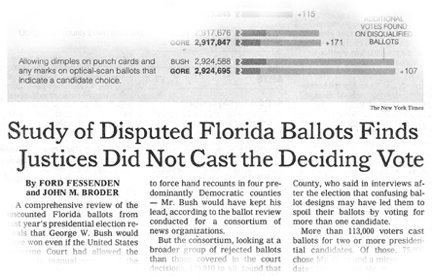
So, of course, we lost the race to publication by several months and knew that was our fate from the start. As coordinator of the project for the consortium, along with The Washington Post’s Dan Keating, I felt I was being subjected to the worst fate imaginable: getting beat on one of the biggest stories of the year. And it was no balm when Sept. 11 suddenly relegated the story to a much lower level of importance. We still weren’t in the paper, and suffered further delays when all the newspapers reassigned their ballot project reporters to terrorism duties.
The competition could certainly be annoying. In Duval County, their lawyers somehow managed to have a meeting with a judge that our lawyers weren’t informed about, resulting in an unfortunate event in the annals of freedom of information: a newspaper obtaining an order barring another newspaper from viewing a public document. But our competitive squabbles paled before the concerns of our primary task, especially with the Republicans watching every move. We were shadowed throughout the state by Republican operatives and volunteers, who were laying the groundwork for discrediting our effort should its result seem to question the new president’s legitimacy. The Republicans showed up at every county seat—count them, all 67—and sat at every table to view every ballot we viewed. We were tipped to the potential of their efforts in the first week, when we were suddenly getting press calls that one of our coders in Pinellas was drunk and rowdy. There was, in fact, no truth to it, and the Republicans produced no evidence that there was.
But my energies were focused almost entirely on ensuring that our ballot review was beyond reproach. I actually ran across Dennis Cauchon (’97), USA Today’s ballot project manager, only once in the months we were crisscrossing Florida. And ultimately, we produced what we set out to produce: a database that characterizes the uncounted ballots in ways that will be useful to political scientists and journalists unraveling what went wrong in Florida.
Ford Fessenden is an investigative reporter at The New York Times.

“My idea is simple: Let’s recount it ourselves.” So began a Nov. 27, 2000, memo to my editors at USA Today. I proposed examining the disputed undervotes and overvotes in Florida’s deadlocked presidential election. The goal was to provide the first independent look at the 175,000 disputed ballots and report who really won Florida. The memo concluded, in a line best read with exaggerated pomposity: “If we don’t do it, who will?”
The answer turned out to be nearly everyone: The New York Times, The Wall Street Journal, the Miami Herald, CNN, and a dozen other media outlets wanted to do it. Even a few conservative groups gave it a shot before running out of gas.
In the best of all possible worlds, the journalists would have done it together, pooling resources, dividing costs, and delivering a single definitive result. Alas, we live in an imperfect world. The oligarchs could not dine together in peace. The disagreements involved (as expected) ego, control and credit, although revisionist history (as expected) has adopted high moral principles as the reason for the schism. Regardless of the cause, the result was a battle between two groups of news outlets spending about $1 million each to do the same thing. The competition was expensive, often bitter, sometimes petty. It was so much fun!
In each camp, a University of Michigan Journalism Fellow helped run the show.
The Miami Herald-USA Today group was headed by Herald managing editor Mark Seibel and myself. The other group included The New York Times, the Associated Press, The Los Angeles Times, The Chicago Tribune, The Washington Post, CNN, and other heavyweights. Ford Fessenden (’90) of The New York Times helped organize and run it.
Ford’s group was called The Consortium. We also called it the Evil Empire. We were obsessed with The Consortium. We were paranoid. We were the little guy. We were David trying to slay Goliath. We were the small-town entrepreneur trying to survive an onslaught from a pollution-spewing multinational corporation.
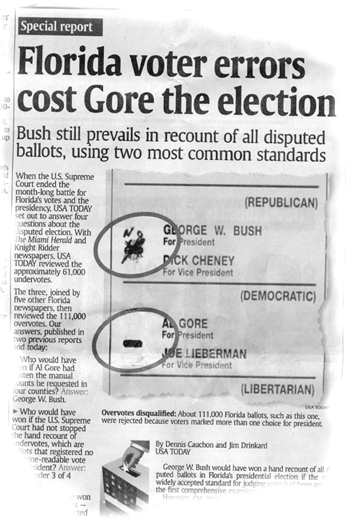
We were, in essence, deluding ourselves. And, let me tell you, it was darn effective motivation. In reality, we were both well-financed corporate research efforts trying to answer a question primarily of interest to the political elite. But the truth would have bred sloth and self-loathing. So, for us, it became Ali vs. Frazier.
Every day I asked myself: If I were running The Consortium, what would I do to screw me? Every day I checked in what counties The Consortium was examining ballots and how fast they were going. Every day, we worked harder—faster, better, cheaper was my slogan. We used $110-an-hour accountants from BDO Seidman to examine the undervotes. When we found their results didn’t differ from those of reporters, we switched to just reporters. When we found that data entry from paper forms was slow, expensive, and less accurate, we switched to entering information directly into a database on laptops. Faster. Better. Cheaper. When Duval County offered to let us examine ballots on a Saturday, we said “yes” and The Consortium said “no”. Our slogan: We work Saturdays.
From talking to Ford and others in The Consortium, I know that they were far less obsessed with us. They were committed to doing the best job possible, regardless of how long it took. And it did take a long time. We published complete results May 11. The Consortium published November 11.
In retrospect, both approaches had strengths and weaknesses. The Consortium approached it as an academic project. We approached it as a journalistic one. The Consortium hired the National Opinion Research Center at the University of Chicago to collect the data, using temps hired in Florida. The Consortium did not see any data until NORC delivered a complete database about a week before publication. This protected The Consortium from leaks and charges of political bias. NORC also provided extensive statistical analysis on technical issues, such as the consistency of the data reported by the temps. By contrast, we had reporters on site during every ballot examination, and we managed our own data on a daily basis. We did statistical checks of our data, but when we found it was fine, we moved on. We wanted to publish quickly because we thought interest would wane. I have a journalistic saying: You can be best, but if you’re second, you’re still second best. As it turns out, I think we were both first and best. The findings of the two groups were virtually identical: Bush wins under some standards, Gore under others.
I have never worked harder in my life than on this project. Naturally, I think we won, they lost. I am amused at myself for how much I loved to hate The Consortium. It tastes sweet even today.
Dennis Cauchon is a national reporter at USA Today.


