Events Archives
Covering Permanent War
Conference Draws Stars, Large Audience
By Ron French '03Editor's Note: Fighting began as the Journal went to press. It made the timing of our conference look brilliant, while dating all else. Such is our business...
The worries began months before the bombs. NBC's Ashleigh Banfield fretted about decontamination. CNN's Christiane Amanpour feared the loss of good will. National Public Radio President Kevin Klose stressed over how to squeeze high-tech satellite phones and low-tech goats for bartering into a strained budget. And The New York Times' Judith Miller wondered how her job would become tougher.
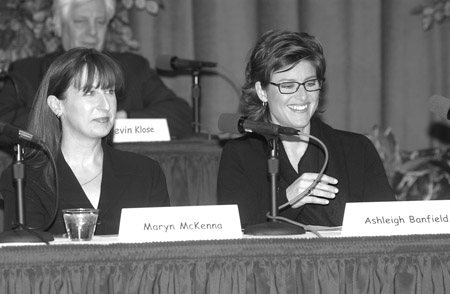
Kevin Klose, President & CEO, NPR, Maryn McKenna '99, science and medical writer, Atlanta Journal-Constitution, Ashleigh Banfield, anchor and correspondent, NBC, weigh in on war and the new national stance. The Conference has been widely aired on U of M's cable channel.
The war on terror is changing the lives of journalists. New beats, strained budgets and security concerns are as uncomfortable as the chemical suits many now carry in their baggage. Those changes have been magnified by the war in Iraq, as journalists struggle to redefine their role in a new, scary world.
"We don't know what will happen," said Klose. "Nothing is safe anymore." Public fears, the media and the institutions they cover were the topic of "Covering Permanent War and Bio-terrorism: The Press and Public Policy," sponsored by the W.K. Kellogg Foundation. It was a timely topic in January. Now, it seems almost prescient.
The dangers and constraints facing foreign correspondents in Iraq are dramatically different from those faced by Charles Eisendrath, a correspondent for Time magazine in London, Paris and Buenos Aires in the 1960s and 1970s. "Then, to a level that now seems quaint, the media were protected," said Eisendrath, the director of the Knight-Wallace Fellows at Michigan. "There was an understanding that we were not carrying guns, we were trying to tell the truth." That protection doesn't exist today. Many journalists working overseas now go through a week-long boot camp to learn how to survive in hostile environments. They're trained how to respond when kidnapped and to provide emergency first aid.
"I never thought when I entered this career that I would have to assess whether I was a victim of a chemical attack or a biological attack," said Banfield, who carries a suitcase containing three chemical suits, gloves, boots and a decontamination kit while covering the Iraq war.
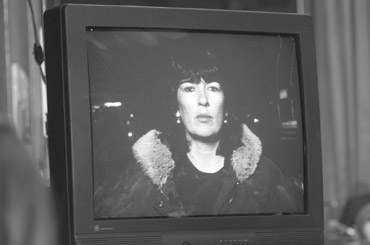
Christiane Amanpour, chief international correspondent live from Tel Aviv via a satellite hookup provided by CNN.
"My biggest concern is safety," said Eason Jordan, chief news executive for CNN, which had about 100 people covering the conflict in the Middle East. "Journalists are probably in greater danger than they've been in since at least Somalia."
Miller, a Pulitzer Prize-winning reporter and co-author of the book Germs: Biological Weapons and America's Secret War, called Sept. 11 a "defining moment for American journalism." Sensitive information is now much harder to get from the government (Miller doubts she could write Germs today). And reporters are much more likely to self-censor. "How much publicity do you want to give to potential threats, and give people ideas they might not otherwise have had?" Miller asked. "Anyone who tells you that the trade-off between security and democracy is an easy one has never had my job."
Finding that balance is something reporters are now learning on the fly. "This kind of war poses questions for journalists that they've never faced before," Jordan said.
Sometimes ethics and patriotism become intertwined, said Tom Rosenstiel, director of the Project for Excellence in Journalism. The American press is less willing to print negative stories about the government during times of war, because "there is a patriotic upsurge and the public doesn't want to hear certain things."
And during a war, the government and military are less willing to provide information to the press. Amanpour, CNN's chief international correspondent, said she believes "the American people are better served by having a broader knowledge of what is going on." But that is increasingly difficult for correspondents like her, because the military provides little meaningful access. "There should be a balance (between security and the public's right to know), and now it is completely out of whack," she said.
After the attacks of Sept. 11, "The world came together in a sense of communal outrage," Amanpour said. "That good will has dissipated at an alarming rate." Today, much of the world views America as pursuing a unilateral foreign policy "willing to conduct one war after another in the Muslim world. "The rest of the world and the U.S. are talking past each other to a degree that hasn't been seen in years," Amanpour said.
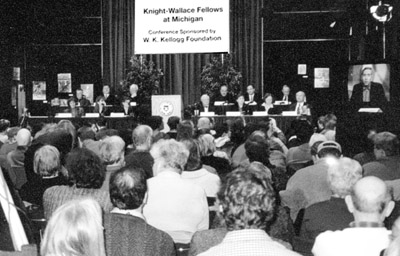
Panelists address half the crowd; overflow attendees watched a big screen monitor.
Meanwhile, those who remain in the main offices are shifting beats and budgets to meet the new reality. National Public Radio created a national security desk of reporters and editors, as well as beefing up its science and health coverage. Reporters have had to become instant experts on things like anthrax and smallpox—a job made more difficult by a tight-jawed administration and scientists unaccustomed to communicating to the media.
Maryn McKenna '99, science and medicine writer for the Atlanta Journal-Constitution, talked about the difficulties of finding experts on anthrax in the fall of 2001. Those who were willing to talk to the press knew little; those who understood anthrax were instructed by the FBI not to talk.
The result was sometimes inaccurate, often sensationalized reports on the danger to the public. "When people are frightened, they don't process information as quickly," said McKenna. "We should be extraordinarily careful not to scaremonger."
In the aftermath, the Centers for Disease Control and Prevention added more press officers. "Until (the anthrax attacks), people in public health considered journalists as an interruption to our real work," said F.E. Thompson Jr., deputy director for public health programs at the CDC. "Now, many of us realize that it is only through the media that we can effectively communicate to the public."
The war in Iraq and the constant drumbeat of potential terrorist attacks in the U.S. are straining the budgets of media outlets. With additional reporters in the field in the Middle East, "satellite phone costs are through the roof," said NPR's Klose.
No one was willing to predict when the changes would end, and what journalism would look like by then. "When the battle front is your home," said Miller, "your jobs as journalists are going to be very different."
Ron French is a reporter for The Detroit News.


