Reports From Our Fellows Archives
A Pakistani Journalist’s Story
Javed Nazir Discovers That Freedom of Expression Has Limits
By Javed Nazir, ’02Knight Senior Research Fellow
Life changed for me in a dramatic manner early this year just when it seemed I had reached a plateau. For the past five years, I had been editing The Frontier Post, an English-language daily published from Peshawar, a garrison and border town in Pakistan just 17 miles from Afghanistan. The paper, once at the cutting edge of Pakistan’s aggressive journalism, had run into serious financial problems, and some of its best people had deserted it for greener pastures.
The Frontier Post publisher, Rehmat Shah Afridi, was in prison under what most of us reckoned were spurious charges. Third-world regimes are known to be intolerant of gutsy journalists and publishers. My publisher had allowed a fantastic threshold of freedom of expression that we do not normally associate with publications in Pakistan or in comparable societies. The paper consistently ired the previous Nazaz government by exposing corruption. For instance, we published a story detailing how members of the ruling party — including Prime Minister Sharif himself — had through illegal and bizarre use of power and influence obtained massive loans from some public-sector banks, leading to the banks’ failure.
With our publisher in prison, and funds becoming scarcer, we hit a particularly bad patch. I was committed to keeping the paper alive, even though a lack of funds seriously undermined both the quality and direction of the paper. Unfortunately, this difficult phase proved to be longer than we anticipated. To be part of a collapsing paper is bad for everyone’s morale. Were it not for the staff’s loyalty (a phenomenon that has been surprisingly more evident in my newspaper than elsewhere), I would have called it a day.
And then the unthinkable happened. On January 28 we published a letter from an American Jew which came to us through the Internet. The letter, "Why Muslims Hate Jews," contained some offensive references to the prophet of Islam. The man responsible for choosing and editing the letters for the editorial pages deemed the letter to be okay. At the least, he thought, it would trigger debate. Apparently, he did not grasp the repercussions of publishing a blasphemous letter in a social milieu dominated by religious extremism. He should have taken out the offensive contents. Because of the financial squeeze, The Frontier Post at that point was making do with as few hands as possible. The editor in charge of the editorial page was also a victim of extreme fatigue because of near-impossible working hours. His critical faculties were obviously under intense strain. But in my country, there is no such thing as extenuating circumstances.
The next day saw a big and a frenzied mob on the streets of Peshawar, a city that is a hotbed of conservatism. Religious extremism would be a more fitting term. This is a city that has seen some of the most vociferous anti-U.S. demonstrations against the bombing in Afghanistan. Lest we forget, this is the city where American and Saudi efforts (and money) were pooled and coordinated to set up a massive chain of seminaries to train highly indoctrinated young men to fight the Soviets in the ’80s. The mob torched the offices and press of The Frontier Post as police stood by. Criminal proceedings were initiated against six journalists working for the paper, including myself. We were faced with Pakistan’s infamous blasphemy laws that hand out either death or life imprisonment for the accused.
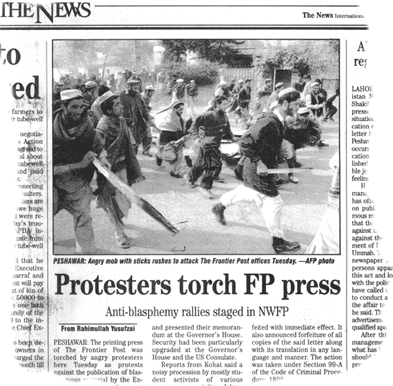
The International News reports on the attack
on
The Frontier Post’s offices.
I was some 300 miles from Peshawar, in Lahore, where my family lives, at the time this was happening. The police were looking for me, and I went into a hiding of sorts. I moved my family to some friends in the interior of the country. Fortunately, Pakistan’s bureaucracy is a crusty and slow outfit. This meant that I still had time to respond to the looming threat and escape from a crowded airport. I contacted U.S. officials in Lahore and was told not to expect any tangible help. Indeed, one American official, though courteous and concerned, reacted in a chillingly matter-of-fact way: "You have endangered the lives of your Pakistani friends by coming out to the U.S. Consul General building. I have the diplomatic immunity. Not they." He was right, and he helped me understand my predicament better. I grasped the fact that the extremists could be keeping tabs on my movements and on anyone I associated with. My friends advised me to meet with a lawyer, so I arranged a meeting with one in Lahore, who said I would be better off leaving the country immediately. This was a tough decision. I realized I had no recourse but to leave Pakistan.
While I was making these arrangements, my journalist wife got in touch with a wonderful New York-based organization, The Committee to Protect Journalists. The C.P.J. sent a letter to the head of the government in Pakistan, expressing its dismay over the fate of the six Frontier Post journalists. Amnesty International also intervened on our behalf, which helped soften up the Pakistani government at least. Pakistan’s military ruler, General Pervez Musharraf, had been desperately seeking recognition — and legitimacy — from the international community. Apparently, he thought it wise to slow down criminal proceedings against us. There was no way, however, to mollify the religious zealots, who thought killing six offending journalists would assure them a berth in heaven.
I left Karachi for New York on January 30, leaving my family in danger. This was depressing. Besides, I could hardly figure out how I might be received in the United States. The C.P.J. took care of me but did not know precisely what to do. Here was an advocacy organization, clearly not expected to give refuge to someone like me. I asked them to help me find a research assignment, preferably with a university, a task that was bound to be both difficult and time-consuming. I stayed in New York for some three weeks. Under a strong impulse I decided to go back to Parkistan without telling the C.P.J. I had received a threatening call in New York, which made me think that someone had revealed my whereabouts to the extremists back home. Not that I had started doubting my circle of acquaintances in America. But if I wasn’t safe here in America, then I might as well return home and be with my family. The thought of my family getting hurt because of my profession overwhelmed all concerns for my own safety.
I went into hiding upon returning to Pakistan. I stayed with friends in other cities. Of course my family was upset to see me return in so short a time. The fact that no newspaper wanted my writing depressed me further. No newspaper in Pakistan wants to raise hackles among militant religious elements, notwithstanding their commitment to truth and democracy.
All during this period, however, the C.P.J. kept in touch with me. They established a special emergency fellowship for me funded by the Knight Foundation. Charles Eisendrath was gracious and kind to offer me a fellowship with the Michigan Journalism Fellows program. As he apparently does with all fellows, he asked me what I would do here in Ann Arbor. When I told him that I wanted to write a book about Pakistan’s perma-nently beleaguered minorities, such as Christians and Hindus, he gave me a spirited go-ahead. Being a victim of intolerance myself, I thought it made huge sense to highlight the miseries of those compatriots who are confronted with indignities that result from being considered less than equal.
Given the events of September 11, the task of an international scholar like me assumes a far greater significance. We should seek more understanding of the present climate of intolerance before defining solutions.


