Reports From Our Fellows Archives
Dispatches From Iraq
'I’d Never Seen Real War Before'
By Richard Leiby ’01The wounded Iraqi child named Yusef lay on the hospital cot, his fingers busy with a PlayStation game controller, his eyes locked on a video screen nearby. A small, battery-powered fan cooled his face. A stuffed panda sat within his reach. He shifted occasionally when the pain overcame him. He moaned and called out for his father (baba, in Arabic) before dozing off.
The boy’s father, Rasheed, was a man of some means—a well-dressed Ministry of Health official who told me he could afford whatever it would take to save his son’s life. Yusef was shot on April 9—“the day my beloved Baghdad fell,” the father said—caught in a crossfire between U.S. and Iraqi forces. A bullet—and most certainly it was an American bullet, Rasheed believed—had entered near the boy’s hip, torn through his intestines and exited through his back.
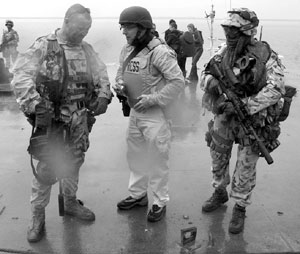
Leiby, flanked by Royal British Marines, at the port of Umm Qsar
Yusef, who just turned nine, had already undergone one colostomy operation and needed another. But this hospital had run out of antiseptics, and had no fuel to even boil water, so its surgeons could not safely operate. An infection was spreading, but they couldn’t even sterilize instruments.
“The sepsis has reached his blood,” Yusef’s doctor explained. His face was grim: Unless medical supplies arrived soon—or an airlift could be arranged—the boy would surely die. In other Baghdad hospitals, the story was the same: shortages of critically needed medicines, sporadic electricity, no clean water, and many children dying from easily treatable conditions, such as diarrhea.
I met this father and son on Saturday, May 10, a month after the Iraqi army walked away from the fight and the Saddam statue was toppled. Everywhere I went that day, Iraqis railed against the conquering Americans for failing to provide humanitarian supplies, basic services and security in the war’s aftermath. They were losing patience. Rasheed, 52, a Baathist functionary now out of work, was the angriest of all: “All I hear are hollow promises.”
As we spoke, he handed a cigarette to an elderly nurse’s aide, clad in a black abaya and standing in the hallway. There was no smoking in the ward. “Go smoke this one for me,” he told the old woman. “I’m boiling like a volcano inside.”
Then Rasheed turned to me and made a promise I’ll never forget. “If I have to watch my son die tonight, I swear to you that in the morning I will go out and kill one American. I will kill a soldier or a civilian. I hope it would be a general.
“You’ve heard of the Hammurabi code? An eye for an eye, a life for a life. Don’t you know that we Iraqis invented it?”
I thought of how I’d feel if it were my own nine-year-old son lying there, dying. I told Rasheed I could not endorse his plan for revenge, but, as a father, I understood his rage.
Now I see that day was a turning point for me, journalistically. I’d gone to cover war without thinking much about its horrible consequences. How naive—but then, I’d never seen real war before.
In late February I set out for Kuwait as gung-ho as any freshly minted Marine. I had my gas mask with custom-made lens inserts. I had my chem-bio suit and supply of decontamination powder. I had a military-spec helmet. I’d been trained at a Pentagon-sponsored “media boot camp” at Fort Dix, a crash course in group-think, Army-speak and first aid.
I’d never been a soldier, but now I was ready to accept an embed with deploying troops. For months I’d been spun up with promises from Pentagon hawks and conservative think-tankers about how Iraqis would welcome their liberation. They said it would be over in a couple of weeks, a cakewalk. They said Hussein was planning to nuke us, so we had to act. I thought we were doing the Right Thing with a pre-emptive invasion.
At the last minute my bosses decided not to embed me; The Post already had several reporters locked into field positions. My editors wanted a roving free agent. I’m glad they made that decision. Operating as a unilateral—a credentialed reporter unattached to any unit—I think I gained a broader view of the war than my embedded colleagues, who saw the action as if “through a soda straw.”
I believe the embed program was good for journalism overall—it helped bring two utterly disparate cultures closer together. Hundreds of journalists now understand the military better. And it allowed reporters to bear direct witness to war.
Still, I regard it as largely a propaganda coup for the Department of Defense. The TV reporters, especially, focused on the push to Baghdad—ever onward, CNN, MSNBC and Fox News soldiers!—leaving few cameras behind to cover the instability and power vacuum left in the invasion’s wake. Unilaterals like me had to venture into Iraq at our own peril to chronicle the chaos left behind. (I wasn’t brave at all: I took two trips into the southern port of Umm Qsar under protection of the British Royal Marines.)
Truth be told, I didn’t cover much of George W. Bush’s splendid little war. I didn’t see anybody killed. I decided to leave the Middle East on April 6. I returned for my second tour on April 27. This time I caught a taxi cab from Basra to Baghdad. To me this was a much better way to see Iraq than from inside a U.S. military transport.
On May 1 my Department of Defense credential expired. Coincidentally, that was the same day that Bush declared an end to major combat—and I realized that I was covering the better story. The aftermath.
While gunfire blazed in the streets and blackouts descended, I bore witness to what the administration has yet to admit: We had no plan for the post-war occupation. Sadly, I never found out what happened to young Yusef. It was just one day of many, one tragedy of many.
When I made it home in mid-May, some friends and neighbors wondered why I’d stayed so long. Wasn’t the war over?
No, I assured them, it was only beginning.
Richard Leiby is a staff writer for The Washington Post.


