Reports From Our Fellows Archives
The Joys of Immaturity: Why Writing For Kids is My Best Job Yet
By Elizabeth Kastor ’96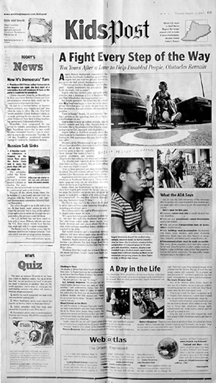
I live in a world of silly jokes and Britney Spears, animal vomit and the Federal Reserve.
To learn more about what these subjects have to do with the University of Michigan, read on.
Once upon a time, I was a Michigan fellow. Now I'm deputy editor of KidsPost, a five-day-a-week page for kids in The Washington Post. The path from one to the next was not always obvious, but in retrospect was not without its own, slightly skewed logic.
KidsPost is — or so the small band behind it feels — unique. Monday through Friday, we publish news, features, art, and anything else which we think kids ages 8-13 might be interested in or should know. One day, that might be an explanation of the Middle East peace talks and the Arab-Israeli conflict. The next day, we might advise how to pick a pet or a band instrument, detail the long and sticky history of chewing gum, or tell the story of a 14-year-old girl who uses a wheel chair and how the Americans with Disabilities Act has — and has not — made her life easier and better. We also publish kids' art, and get them to answer other kids' questions, such as what to do when your parents buy a couch you hate.
Every day, we also summarize one or two news stories (you haven't lived until you've tried to explain the Yugoslav election in 120 very simple words).
We launched KidsPost in April 2000, and as far as we know it's the only daily (or nearly daily) feature like it in any American paper. The brain child of Steve Coll, The Post's charismatic managing editor and a former Livingston Award winner, KidsPost was intended to do several things at once. In the longest term, Coll wanted to see if we could nurture a love of newspaper reading in future adults. We won't know if we've succeeded at this goal for, oh, 20 years.
Coll, and the rest of us, also had heard from kids and parents that children want to read The Post, but can't. The stories are too long, the writing too far over their heads. Schools often turn to USA Today, rather than The Post, because it offers shorter stories, simpler language, and lots and lots of the graphs children need to learn how to read to fulfill the various learning standardsnow so common in schools (ask a fifth-grade teacher what she or he loves, and you come to realize graphs and charts have a seductive quality you never noticed.)
The Post higher-ups also hope that the page can increase circulation, both through school subscriptions and among parents who can't see why, with all they have to do, they should subscribe to The Post.
My colleagues and I just hope kids read it, and judging from the impassioned email, comments at schools we visit and thousands of entries we get in our various contests, they do.
We're a small staff: an editor (John Kelly, Nieman '98, but I don't hold it against him), me, a copy editor, an art director (the page is very heavily designed, far more playful and colorful and varied than the rest of the paper), and two part-time writers.
We also have a resident Britney Spears doll, who — when her belly button is pressed — emits that familiarly small, shallow voice so revered in the pre-teen world. We resort to Britney, and our assorted other toys sent to us by manufacturers hoping we will write about them, at times of great stress, such as the recent day when I had to try to understand the Federal Reserve well enough to convey its purpose to the average 10-year-old reader. (I bet you didn't know that the Fed publishes a very intelligent if somewhat campy comic book explaining monetary policy. An invaluable resource — I got mine from an editor on the financial desk who refers to it frequently. You can get yours by going to www.ny.frb.org).
Tell adult journalists you write for kids, and they have one of two reactions. Either their faces go blank and they quickly move on to talk to someone else who does something more important, more serious, more adult. Or, their eyes light up and you know they get it. The reaction probably depends on whether they actually like children or not, whether they think kids are interesting and worthy of being taken both seriously and lightly.
I like kids. When I arrived in Ann Arbor in 1995, I came with two of them, a four-year-old named Ben and a six-month-old named Chris. But I don't like only my own kids. I think they're all pretty interesting, and so I spent a good deal of my time in Ann Arbor sitting in at a family and child treatment clinic run by the psychology department.
In theory, those hours spent hearing the stories of kids and parents who were struggling with ordinary and horrifically unordinary hardships were meant to feed my work as a general assignment feature writer in The Post's Style section. But in truth I went there because I love stories, and I am fascinated by the games, fantasies, jokes and vulnerabilities and strengths of children.
I also spent time sitting in the dark. I studied photography, and closed myself off in a darkroom for hours and hours of chemical-infused contemplation. The pictures were okay. The dark was great.
I always appreciated Charles Eisendrath's comment that the fellowship should act like a bomb in your life: It should explode the routine and assumptions you've relied upon, send some things flying. A darkroom is a good place to experience the explosion.
But not all explosions are completed in nine months. After I returned to Washington, I went back to my job writing for Style — a great job, but one that after 13 years I'd been in too long. I edited in Style for a while, then took a 15-month tour of editing in the Metro section. And now, KidsPost.
The explosion still reverberates. In Michigan, I thought about kids, I sat in the dark, I learned to knit (don't laugh) and to make silver jewelry (I said don't laugh!). Over nine months, I tried things out. I learned to see in black-and-white through a camera. I learned to think in color and three-dimensions through yarn and silver and beads.

Elizabeth Kastor ’96
After spending my entire professional life crafting those essentially intangible things — words — I played with solid things and images in Michigan. I realized later I was thinking about many paths creativity can take. Now I spend my days working closely with a creative and talented artdirector, thinking in pictures, creating a page that is as much about images as about words. My colleagues and I have made something, created something that is all our own. I may be writing simpler sentences than I did in Style, but this is the most creative job I've ever had.
And the explosion continues. That I don't know how the explosion will end is part of the delight of living within it.
Oh yes, animal vomit. Did you know there are animals that can't throw up? Readers of KidsPost do. (Horses that eat too much grass can actually die because they are physiologically unable to vomit up the stuff: Their stomachs swell and eventually explode without a vet's intervention. Go home and tell your kids this. They'll think it's cool, believe me.)
And the joke, sent to us by a reader:
Q. Why did the cannibal student get suspended from school?
A. He was buttering up the teacher.


