Events Archives
The Beijing Olympics and ‘The New China’
Excerpts from the 2003 Graham Hovey Lecture
By James Miles ’95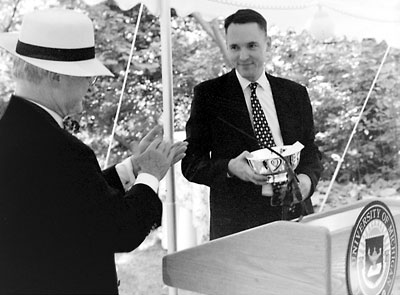
A thunderous round for The Economist’s James Miles
In 2008, the world’s attention will be focused on China probably more than at any other time since the crushing of the Tiananmen Square protests in 1989. In that nearly two-decade interval between Tiananmen and the Olympic Games, the country will have undergone an extraordinary transformation. Rightly in many ways, China’s slogan for the Olympic Games is ”a new Beijing, a new Olympics.” In English this is translated as ”new Beijing, great Olympics” for fear of giving the impression that China is casting aside the Olympic tradition.
But the word ‘new’ is crucial in China’s thinking. The communist nation founded in 1949 was called a New China, one that was supposed to be very different from the weak, corrupt country of the past. After more than 50 years of communist rule, the ruling party still wants to wipe the slate clean and start again. At the Olympics, China wants to present itself as a modern, changed country—changed, not least from the China that the world saw when the tanks moved into Tiananmen Square.
For a while at least, Beijing’s Olympic organizers considered making Tiananmen Square the venue for the beach volleyball competition. Tanks, troops, tattered tents—the images that are still fixed in the minds of many outside China when they think of Tiananmen —would be transformed into a display of harmless fun (though still overlooked by a huge portrait of what would no doubt be a rather skeptical Mao). At least that was the idea. Then it was impressed on the organizers that this was going a little too far. The plan has been quietly dropped.
In 2008, Beijing itself will indeed be new. Very little of the ancient city will be left after years of frantic development. This has involved the leveling of vast swaths of old courtyard homes, the relocation of hundreds of thousands of people, the construction of a forest of high-rise office buildings and shopping malls where once there were decaying apartment buildings and idle state-owned factories. A Chinese friend of mine who worked abroad for a year told me that on his return he couldn’t find the way home to his own apartment. His neighborhood had changed beyond all recognition.
Except as a result of a war or earthquake or other such cataclysmic event, perhaps no other city in the world has changed so much in such a short space of time. When I drive around the city, or into the suburbs on family outings, I often have to stop to ask the way—the maps need changing so often. Where once there were residential areas, now there are expressways, wide boulevards and parks planted with flowers and trees. The former residents, meanwhile, have been moved away to new soulless developments in the suburbs.
The city I knew when I first arrived as a correspondent for United Press International 17 years ago—a quiet backwater, with hardly a restaurant open at night, no bars, little traffic, tightly controlled—has become one of the most cosmopolitan cities in Asia. A capital city as vibrant, congested and dynamic as any capital city in the region. And with a sense that this is only the beginning, unlike Tokyo or Hong Kong, for example, where many wonder whether the best is behind them.
There are many who grumble about the heavy-handed and often corrupt methods that have been used to bring about the capital’s transformation. I know of one elderly woman who was finally driven from the home where she had lived for decades after her water and electricity were switched off with no warning. She’d known for a while that she had to move out to make way for a new development, but no one had so much as thought to do her the courtesy of giving her a date when she had to leave. And she had no legal rights, or certainly none that could compete with the power and wealth of the developer and his official backers. But there are many others who accept that for all these injustices their lives are improving, or if not, there is at least some promise of a better future.
To set the scene a little more, bear in mind that 2008 will mark the end of the first term in office of China’s new president Hu Jintao and Prime Minister Wen Jiabao, who were appointed in March this year. It is likely that between now and then, Hu and Wen will continue to operate under the shadow of the former president and party chief Jiang Zemin. But Jiang will be 82 in 2008. If he hasn’t retired by then he certainly will in that year. If all goes smoothly Hu and Wen will oversee the Olympics at the start of their second terms in office, only this time they will be truly in charge. It will be their coming-out party.
But will it be a confident China, at ease with the outside world and rightly proud of its achievements that greets the Olympics in 2008? And will it be one that its neighbors feel at ease with? In the book I wrote while I was in Ann Arbor as a fellow in 1994-95 (called The Legacy of Tiananmen: China in Disarray), I described a country being torn apart by the economic changes unleashed in 1992 as a result of Deng Xiaoping’s call for renewed reform. Deng’s reform drive was motivated by a belief that only economic wealth could save China from the fate suffered by communist countries elsewhere. I argued that the economic changes themselves were storing up long-term problems: corruption, a growing gap between rich and poor, the breakdown of subsidized healthcare and education, soaring unemployment as state-owned enterprises collapsed, the weakening of the party’s grip as private enterprise boomed—all of these could be contained if the party itself evolved, but a sclerotic party inept at handling crises and prone to factional strife might fail to keep up with the pace of change and eventually be overwhelmed by it. This process in turn could be chaotic and traumatic, not just for China but for its neighbors and even the world beyond.
So was the book wrong to dwell on potential political instability in China when the real story of the years since Tiananmen has been one of relatively stable growth and change? After all, the leadership succession that took place earlier this year was reported as the smoothest in Communist China’s history. The answer to that question is that I think China’s political system is as fragile as the people running it are factious. In other words, as long as the people leading China are generally in agreement with one another about the way the country should be going and what it should be doing, the chances of a political meltdown such as almost occurred in 1989 are not that great. And China’s leaders are well aware of that. Tiananmen may be history to many ordinary Chinese, but the political elite is still acutely aware of its lessons.
China’s handling of the SARS crisis is often cited as symptomatic of leadership disputes. At least at the time, many also saw it as an event that would force China to change the way it’s governed. I disagree with both analyses. SARS came to Beijing. A new disease that had already hit Guangdong and Hong Kong, leaving dozens dead, spread around the capital, infecting hundreds and eventually thousands of people. The leadership’s first response was to keep quiet. One common interpretation is that Hu and Wen wanted a more open approach, while Jiang wanted to keep on covering up the extent of the epidemic, fearing that more openness would cause panic and economic damage. But I think the leadership was generally of one mind about how to handle this. I think the decision in late April to come clean about SARS was caused not by any conversion to the merits of open government, but by events—the knowledge that the World Health Organization already had overwhelming evidence that the situation was much worse than the authorities had declared, and indeed that it was on the verge of issuing a caution against travel to Beijing. The instinct of all China’s leaders, whether Hu, Wen or Jiang, was to cover up unless circumstances forced them to do otherwise.
Luckily for China’s leaders, SARS did not produce the kind of debilitating schisms seen during Tiananmen. But if it had gone on longer and had a bigger economic impact, it might have. China’s political stability in the next few years is by no means assured.
The Olympics will be an orgy of celebration in a country that is not just fanatical about sport but is craving assurance that the world admires and respects it. My newspaper published an editorial in 2001 arguing that China should not be awarded the Olympics because its motives for hosting them were largely political. It said that China’s leaders aimed to “show China’s authoritarian philosophy, as well as its sporting prowess, at its finest, and help the country on its way towards their dream of Great Powerdom.” Luckily at The Economist we don’t subscribe to what China euphemistically calls democratic centralism, so I’m free to disagree. Personally, I was in favor of giving China the games, not because China best represented the Olympic spirit, whatever that may be, but mainly for pragmatic reasons. The country had been rejected before, in 1993, and that had soured the views of many Chinese towards the western world. The Olympics, I would cynically suggest, are political enough anyway. Why not give China—or rather the Chinese people—the recognition they crave and see if it helps the country emerge as a more confident, more responsible power instead of one nursing grievances against imaginary enemies? And if China’s fears of disrupting the Olympics lead to a more accommodating stance toward Taiwan and the handling of other regional problems, then that would be a welcome dividend.
I agree that China will use the Olympics to demonstrate the country’s emergence as an important power. But I would go further and suggest that China’s dream of great powerdom will probably remain just a dream well beyond the Games. China in five years time will still be only at the starting block in the journey to great powerdom. It will be acting more confidently on the world stage. We have seen it in recent weeks trying with unusual vigor to resolve the nuclear crisis on the Korean peninsula. In June we saw Hu Jintao meeting G8 leaders in France, the G8 having in the past been scorned as a rich man’s club. I wonder how different the mood might be if China had not got the Games? Recently Colin Powell described relations between China and America as being at their best since Nixon’s visit to Beijing in 1972. That’s a remarkable change in tone from 2001, after the collision of an American surveillance plane with a Chinese fighter jet.
There are still many who argue that this situation is only temporary—that China’s growing military capability and its resentment of American power will inevitably bring about conflict. I think that’s quite wrong. China is a country preoccupied with managing traumatic internal changes that, if mishandled, could topple the party. The party uses the rhetoric of nationalism to try to maintain cohesion and shore up its legitimacy, but in carefully rationed doses. The party needs to dream of taking over Taiwan, of keeping Japan in its place, of keeping American power at bay because it feels these dreams brought it to power in the first place. Just as Chinese leaders pay lip service to Marxism, so do they to these nationalist aspirations. Lip service it will remain, and particularly so as long as China remains engaged with its potential enemies and appreciates the benefits of this engagement. The Olympics will reinforce China’s position as a normal status quo power. They will not be a reenactment of the Berlin games in 1936.
James Miles is the Beijing correspondent for The Economist. This essay is excerpted from the 2003 Graham Hovey Lecture.


