Events Archives
Beyond the Front Page: Why newspapers are going Multimedia
By Ellen Soeteber ’87Excerpted from the Graham Hovey Lecture, 2000
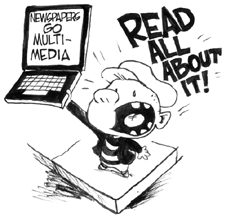
The multimedia newspaper might sound like a contradiction in terms. How can a single medium — the newspaper — be plural?
A small but fast-growing number of papers are experimenting to find out. They are extending their traditional missions into broadcast TV, cable news, radio, the Internet, new-media platforms just now in development such as broadband, and ones that human beings have yet to imagine.
A true multimedia newspaper is one where the editors, reporters, photographers, and other news staff are involved in envisioning and developing cross-media opportunities. And I do mean — without lapsing into corporate-speak — that these are opportunities.
For the primary goal of the multimedia newspaper is to reach out and gain the greatest-possible audience for the results of its newsgathering efforts.
And why not?
After all, among all the news media, newspapers generally still enjoy the greatest trove of resources to develop information of significance to our communities.
We are proud of our longstanding role as civic contributors. And we feel rewarded when our work has impact.
If we feel so strongly about what we do, why wouldn't we want to find wider means of communicating it?
To explore where we are and where we're going, let's start by looking back briefly at the evolution of mass information media.
First, of course, there was the newspaper. It emerged as an influential public forum — one that reached beyond the elite for its audience — in the early years of our nation, and it grew up alongside American democracy as an integral participant.
Then came radio, with broadcast emerging as a news and entertainment force in the 1920s.
At mid-century, broadcast television exploded into our culture. Cable and satellite TV eventually followed, creating a dramatic proliferation of channels and splintering the mass TV audience.
And, of course, in the past decade, we've seen the rapid emergence of the Internet as a communications medium.
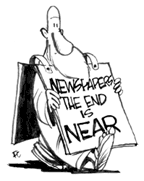
With the emergence of each of the new media, there have been gloom-and-doomers who said the new format would be the death of newspapers. They said it when radio came on board; they said it when TV came along.
TV did indeed spell the death of most downtown afternoon newspapers, but a new generation of suburban a.m.'s sprung up in their place.
Many of these — such as the Sun-Sentinel, where I work now* — are larger and more metropolitan and more sophisticated than the old downtowners they replaced. (Believe me, I know; I worked for two of them, too.)
So TV didn't bring the demise of print. It did force newspapers to change, which has been mainly a healthy thing. As we've evolved, many newspapers have become far better. Many have also become more prosperous than ever.
Today, a new generation of naysayers offers the same dire forecasts about the Internet's effect on print.
But newspapers aren't going to be extinguished by the Internet, any more than they were by broadcast or cable. Unless newspapers commit suicide — which they could if the emphasis on short-term profits overwhelms long-term strategies — newspapers will continue long past your or my lifetime. They will change. They will continue to evolve.
One of the most interesting and exciting elements of newspapers' current evolution is the opportunity to go multimedia: to "publish," if you will, in all manner of media, in a growing range of formats, and to seize the opportunity to reach new audiences and remain the nation's most vital source of news and information.
As each of the news mediums emerged and grew, each developed its distinctive style, its own culture, its particular focus, its own standards and idiosyncrasies — even its own lingo.
Literally, news folks in the various media don't speak the same language. Here's one elemental example:
In a newspaper, a news story is called, well, a 'story.' On radio, it's a 'wrap.' In TV, it's a 'package.'
Or here's another: If I use your precise words in a newspaper story, that's a 'quote.' On radio, it's a 'cut.' Television calls it a 'bite.'
These cultural differences grew to such a great extent over the years that those of us who work in the various media came to view ourselves as very separate entities — competing beings who were alien to each other and, generally, alienated by each other.
Glaring at each other across our cultural divides, we lost sight of the fact that - distilled to our essentials - each of us does the same thing: We develop news and information, and we offer it to the general public.
What does it really matter that the offerings go out in different formats, or via different technologies? Whether we use still or moving pictures, written words or spoken ones, we report and present news.
Let me back up for a moment and return to when I was a Michigan Journalism Fellow.
My year in Ann Arbor was a wonderful one, and it ended on a wonderful note:
A few weeks before the spring term came to an end, I was named the Chicago Tribune's Metropolitan Editor, responsible for all local and state news coverage. That was where I had spent most of my career as a reporter and editor, so it was familiar turf.
At that time, during my decade and a half in the business to date, I had already shifted through many changes in the production of newspapers.
The first newspapers where I worked in Chicago in the 1970s still used typewriters - manual typewriters. And we typed our deadline stories on half-sheets of green and carbon paper pasted together at the top.
My first Chicago daily newspaper job was as a copy boy — and 'copy boy' was indeed the official job title then — at the Chicago Daily News. At that time, what passed for new technology was the electric pencil sharpener the gossip columnist had purchased and let me use to sharpen the dozens of newsroom pencils.
We had banks of rewritemen — and they were all men — taking news items from reporters who called in from pay phones.
We printed these papers with linotype machines spewing out hot metal letters, and we had rooms full of ancient proof readers - some of them so blind, you had to take them by the hand through the composing room to keep them from bumping into the hulking machinery and hurting themselves.
By 1987, when I went back home from Ann Arbor, that was all gone: The paper was produced with computers and pasted-up cold type. Not long afterward, even the cold type and the last of the human printers were replaced by fully computerized systems.
As massive as those changes were, though, they were simply changes in how we produced newspapers.
Across the country and around the world, newspapers were being redesigned, colorized, and generally much improved.
But what we did remained, at its core, unchanged: We reported, wrote, and edited stories. We set them in type and rolled giant printing presses. We delivered these stories in a sheaf of newsprint that was ferried to your front door or your corner news box - as we still do.
But something new was in the wind. The Chicago Tribune was quietly getting ready to launch a novel effort: a local cable-TV news station. It was called Chicagoland TV - CLTV for short - and it was modeled after the CNN national news channel.
But what was most different - and to many people it was radical, even heretical - was that this TV news effort was not being launched by the Tribune Company's large broadcast arm, but by the Chicago Tribune itself.
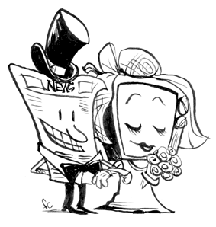
This was a TV news operation started up and run by a newspaper. Inside Tribune Tower, though, taking a bold step into a new medium wasn't radical at all.
The long-time Tribune publisher, Col. Robert McCormick, is most remembered today for the breathtakingly reactionary bullheadedness that marked his last years. But Col. McCormick and Tribune Company were astonishingly open-minded when it came to embracing new technology.
As radio was coming into its own, Col. McCormick started up WGN Radio. The call letters were an acronym for the Tribune's immodest motto, proclaimed daily on its front page, as the World's Greatest Newspaper.
And WGN-AM was an enterprising pioneer. It became the first radio station in America to offer live out-of-town news reports, with feeds from the Scopes "monkey trial'' in 1925 in Tennessee. In perhaps the earliest example of cross-media news coverage, those feeds were provided by Chicago Tribune reporter Philip Kinsley.
As reported in Lloyd Wendt's history of the newspaper, McCormick advanced the novel theory that the daily radio highlights would feed Chicagoans' appetites for details of the sensational trial in the next morning's paper. And McCormick proved to be right about that.
Later, when television emerged, McCormick jumped in again and launched WGN-TV.
And despite the doomsayers, none of the Tribune's new mediums drove out the original one. The Chicago Tribune made gobs of money then, and it makes even more now.
But we were totally separate entities. We co-existed for decades but literally didn't know each other. We certainly never dreamt of working together. A wall existed between print and broadcast that no one wanted to scale.
By the time CLTV was up and running, it was the early 1990s, and I had moved out of the newsroom to be deputy editor of the Tribune's editorial board. But the rumblings emanating from the newsroom staff were loud and clear: Omigod. . . this television news outfit, CLTV, was going to put print reporters on TV to headline the stories they were covering — sometimes in advance of the next day's newspaper.
Now, the folks on the TV side tend to be as disdainful of newspaper types as the other way around. So, the shock and dismay coming from the other side of the wall — from WGN as well as from the city's other TV newsrooms — was just as clear.
Heresy, heresy, heresy. The Walls of Jericho were tumbling down.
Let's cut to the present. I have moved to Fort Lauderdale as managing editor of the Sun-Sentinel of South Florida, also a Tribune Company newspaper.
Transplanted from a life lived in the Midwest, I was embarking on a new round of learning. But it wasn't just learning a new area, a new core of readers, and a new competitive battle with the Miami Herald and the Palm Beach Post.
It was learning a whole new way of doing business and of producing journalism. It's a new way of thinking as well as operating, and it goes by many names:
Media integration. Synergy. Sharing. Media convergence. Cross-over coverage.
At the Sun-Sentinel, we've created a smorgasbord of media partnerships over the past three years. We share key news content with our broadcast partners, although always under our own terms and being careful to protect our standards and our competitive strengths.
By doing so, we gain new audiences for our work, and we reinforce our relationship with our current readers. At a more basic level, we also gain promotion for our name and for our reputation. To use a marketing term, we extend our brand.
Our newspaper's territory stretches across two broadcast markets: Miami-Broward and Palm Beach County. So, we have partnerships — providing news stories and features daily — to TV stations in each market. We also provide news and features to the only news-radio station in Miami-Broward.
And this spring, we became the first newspaper in the nation to produce news programs for a public radio station when we began airing five daily newscasts from the Sun-Sentinel newsroom for NPR's Palm Beach County affiliate.
And our staff provides breaking-news updates throughout the day to our on-line operation, Sun-Sentinel.com.
Newspapers can better maintain our long-standing role as a mass medium — we will be more likely to preserve our influence as a public forum — if we reach out to as many potential audiences as we can.
Newspapers are still the singly most expansive mass news medium. Although newspaper readership has declined over the past few decades, you still have more than three-quarters of all Americans reading a newspaper at least once a week.
That's far more than the number who watch the evening network news shows, whose viewership has dropped sharply in competition to cable and on-line.
And cable news has an even more limited audience, by far. In fact, any one of the top 50 or so U.S. newspapers has more Americans reading it on a typical newsday than CNN has watching.
But having said that, we know well that not everyone wants to get their information the same way: You may want the traditional newspaper, and want to get it delivered to you in the traditional way. That is certainly the way I want it, and the way a majority of North Americans and a growing number of people in Latin America and other countries still want their substantive news.
But your next-door neighbor may think she's too busy to find time for the newspaper, and may only grab the news headlines on the radio on her way to work. The students here in Ann Arbor probably prefer to use the Internet.
So why shouldn't we use all the means at our disposal to get our work to the most people possible? Why should we restrict ourselves to one outlet — as wonderful and as large as that one is?
Going multimedia doesn't have to mean — it must not mean — that we abandon standards. Credibility is our most precious asset, and in any medium we use, we have to protect that.

Ellen Soeteber delivers
Graham Hovey Lecture
September 2000 at Wallace House.
To be effective, multimedia journalism must maintain our strengths while building new ones. It means we not only learn how to bridge our long-standing differences, but that we learn the best of each other's practice.
This is seldom easy. There's a lot of contentiousness and disdain on both sides. But, frankly, broadcast TV news has even more to lose these days than do newspapers.
Are there risks involved? Sure. Are there discombobulations and distractions? Absolutely. Will there be some embarrassing bumps along the way? Of course.
We've already seen some, and we'll see some more.
Are there bigger risks if newspapers don't reach out? I believe there are.
All of us who care about newspaper journalism at its best; all of us who want to preserve the resources and the reasons for enterprising and effective journalism; all of us who want to make a difference - we all have a strong interest in pursuing the multimedia newspaper.
And you know what? It's kind of fun, too.
* At press time, Ellen Soeteber was named editor of the St.Louis Post-Dispatch.


