Reports From Our Fellows Archives
What Are Fellowships For?
The Case of the Knighted Englishman and the Knight-Wallace Fellow from NPR
By Scott Huler '03My research project as a Knight-Wallace Fellow has focused on the Beaufort Scale of wind force, a remarkable 110-word gem of lucid descriptive prose that I stumbled across one day in the Merriam-Webster dictionary decades ago when I was a copy editor.
The scale categorizes the wind based on its force, breaking it into 13 categories from 0, calm, to 12, hurricane. Beaufort, a 19th-century British admiral, developed the scale to improve the information in ships' logs. Instead of a sailor writing that the wind blew "a light breeze," for example, which was open to interpretation, Beaufort devised a scale that gave that sailor something according to which he could measure-and quantify-his observation.
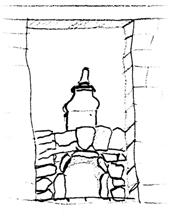
The apex of the old gate to the Ciudad Vieja, which was there in Beaufort's time, caught Huler's eye.
As it has come down to us (you can find it in many dictionaries), the Beaufort Scale definition of "light breeze," which is number 2 on the scale, is "wind felt on face; leaves rustle; ordinary vane moved by wind." Each of the 13 designations of the scale has an equally lovely—and simple description.
To copy editors, of course, such simple, direct language is the Holy Grail, and when I found this beautiful description I fell in love with it. At the time, I was editing unbelievably dull prose about computers, and this little scale served as a constant reminder that prose, though simple, need not be dry. I returned to it regularly for inspiration, like a favorite poem. A rather genteel, slow-motion pursuit of the scale's history over the last 15 years or so suddenly turned into full-fledged research when I received my Knight-Wallace Fellowship.
To understand the scale and its history, of course, I've researched, among other things, Sir Francis Beaufort, the general man of science for whom the scale is named. Because I was making my project into a book (for Crown, an imprint of Random House), I feared that the fellowship trip to Buenos Aires in December might conflict with the time I needed to spend in libraries and at the keyboard.
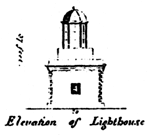
Beaufort focused on something more useful to sailors.
Then I learned that Beaufort was most famous in his own day as a hydrographer, and that he took surveys, and drew the maps that made his reputation off Montevideo, Uruguay—a quick two-and-a-half hour ferry ride from Buenos Aires, where, of course, the Fellowship planned to take me. As ever, I'd rather be lucky than good.
So while Birgit Rieck, Lori Scott, and Wendy Palms planned our trip to Buenos Aires, I contacted the Admiralty in England and got copies of Beaufort's charts and notes from Montevideo. Beaufort, I learned, did a lot more than read his sextant and take harbor soundings. To supplement that purely quantitative work he made incessant sketches—lovely sketches of coastlines the world over dot his journals and the charts he produced. The drawings, I thought, were analogous to the crisp prose of the scale itself: the simplest and purest way to get information across.
I thought they were exquisite, and I wanted to do the same.
To learn to see the world in something like the way Beaufort saw it, I took a drawing course at the UM School of Art. I learned to make quick pencil and charcoal sketches. I used Wallace House's copier and made sketchbook-size copies of Beaufort's drawings and charts of Montevideo. I packed a few pencils and erasers, enjoyed Buenos Aires with the Fellowship group, and then grabbed a bag, my sketchbook, my partner, and two patient other Fellows and jumped the ferry Juan Patricio to see what Sir Francis saw.
Fellow Einat Fishbein and I were inexplicably able to use our week-long familiarity with Spanish to stammer our way onto the bridge with the captain, and from that vantage point I sketched away. Here are the results.

Sir Francis anchored off Montevideo for a month in 1807 and sketched the shoreline.

Mr. Huler had a few minutes to sketch the same scene from the deck of a ferry in 2003.
Scott Huler is a reporter and producer for Nashville Public Radio.


