News from Wallace House Archives
From the Head Fellow: Last Tango in Buenos Aires
By Charles R. Eisendrath ’75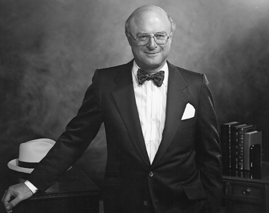
For members of the class of ’02, the last tango of their field trip to Buenos Aires was an eerie ride to Ezeiza airport during a state of siege. They had been ferried around the city in two minivans piloted by the redoubtable Leo Iannello of “Transleo,” who put his entire fleet (two vehicles) at the disposition of Clarin and its guests from Ann Arbor, USA. Leo knows the city and its sometimes erratic ways. He has also come to appreciate shenanigans of American journalists that are equally erratic and terrifying to him as unofficial chaperone. In addition to rushing into riot zones (see Joe Coleman’s story), these have included gallops across the pampas resulting in broken bones and descents into tango dives frequented only by natives who know how to take care of themselves when steamy dancing turns violent.
So everyone took note when Leo ordered a new procedure for the vans going to the airport. The group would not divide up haphazardly, as had been standard practice. Mobs around Buenos Aires had been stopping vehicles for freelance looting. Leo would have to choose the route carefully and load his charges and their gear in a way to minimize personal injury. This was no time to worry about mere belongings. The theory was for all 22 Fellows, staff, and significant others to cram into the lead Leo-Mobile. Gear was to follow in LM-2, under orders that it be surrendered immediately rather than slow the exit of LM-1 (as usual, however, a few of our group turned up in the wrong place). The streets were a mixture of spooky desertion and clots of stalled traffic; there were anxious moments of entrapment between columns of marchers/looters before Leo found an opening and sped his charges off towards home.
The idea of all this wasn’t risk-courting, but it most definitely was exposure to the way things are done in other parts of the world. For political-succession watching, there really isn’t anything better than a “soft coup,” Argentine style. To understand this one, outsiders needed to know only a few things. First, that President Fernando de la Rua and his Allianza party were on the ropes. Second, that the military could not enforce order because it had been thoroughly discredited by the brutality of its “Dirty War” against terrorism, which it won, and the futility of an ill-conceived war against Britain, which it had lost. Third, that two leaders of the opposition Peronist party wanted de la Rua’s job. Both were from Buenos Aires province, which completely surrounds the capital. Eduardo Duhalde was a senator; Carlos Ruckauf, the provincial governor, controlled the security forces responsible for all approaches to the city. Word went out to police to stand by if anyone just happened to want something from the local supermarket and would prefer not paying for it. Many did. Press photos showed officers standing idly by, as ordered.
Presto! Duhalde becomes president-for-now, Ruckauf, foreign minister-for-now and strong presidential successor.
Because Argentina’s government imploded before our eyes and its economy entered terminal meltdown as we were leaving, this particular visit went beyond the usual lesson plan. With the force of a hammer, the trip shattered comfortable assumptions about how U.S. news organizations cover the world for the home audiences of the world’s only superpower. I would argue that in foreign reporting, Americans live in a banana republic.
Were even the basics of the events we witnessed adequately reported? Mostly not, in my opinion. About the change of government, even the best reports related little more than how many were killed and who took over from whom. Precious little about why an elected government fell and even less about how. Nothing whatever about the implied threat posed by the lack of police protection in a metropolitan area of 12 million, many of them members of Latin America’s largest middle class, with plenty to lose.
Astonishingly, no American report I could find called it a coup, which would have put it in perspective as involving something messier (and a good deal harder to fix) than “protests” against “economic conditions.” Accounts of the financial backdrop of Argentina’s default on $141 million in public debt, the biggest ever, were even thinner than the political reporting. Sure, there were learned analyses about pegging the peso to the dollar and arcana involving the effect of Brazil’s devaluation on Argentina’s balance of payments. Fair enough, but HELLO OUT THERE! EARTH TO AMERICAN JOURNALISM!
How about telling us American taxpayers crucial things that have been common knowledge around Buenos Aires for years? Like that in contrast to people in parts of the world asked to bail them out, Argentines traditionally manage to avoid paying 55 percent—repeat, 55 percent—of taxes not automatically deducted from payrolls, and that the figure for the last six months has probably been closer to 70 percent? Or that if Argentines could bring themselves to scale back their cheating to a mere one-third (reality check: Britain’s evasion rate is four percent) their government would have had no trouble, whatever, meeting interest payments on its debt. On these critical subjects I could find very little, even as the International Monetary Fund considered an aid package for an economy “in distress.”
Like many friends of Argentina, I love the place and its people, but Argentine public life drives everyone crazy, including the Argentines.
What has this diatribe of mine to do with running the Fellowships? Quite a bit, actually. The timing of our trip provided ringside seats at Argentina’s twin debacles, and their aftermath, as viewed both on-scene and then at home. Soon after the centrifugal force of the news cycle spun Argentina back into media oblivion, we gathered for a director’s lunch. Scheduled topic: whither Argentina and foreign news in general. But as usual in this program, the unannounced prevailed: a more general and constructive discussion of what Michigan Fellows can take back to their newsrooms. For the Fellows, a director’s lunch is a free lunch, but the guy who pays for it could not have asked for more.