News from Wallace House Archives
Food for Thought
By Charles R. Eisendrath '75I confess to a lifelong love affair with food markets—but it was only this fall that I recognized it as a passion that saved my life. The Fellowships were staging a national conference, “The Food Page: The Press and Public Policy.” The venue was Ann Arbor’s Kerrytown Market, a vibrant outdoor/indoor affair just off Main Street. The date was September 15, just four days after the day in 2001 that changed all of our lives.
But for me and only one other American journalist that I know of, plus a handful of others from elsewhere, 9/11 was our second Tuesday, September 11. The first was removed by 30 years and a continent.
In 1973 I was Time’s bureau chief for Hispanic South America and had landed in Santiago for an interview with President Salvador Allende Gossens. It was scheduled for 8:30 a.m., September 11, but instead of reporting early to the Moneda Palace, as many would have, I did my usual—a dawn detour to the Central Market for ceviche seasoned to awaken your entire being, and the chance to admire the wrought-iron structure designed by Gustave Eiffel, after his tower for the Paris exhibition of 1889 brought him literally all the work of that kind in the world.
Soup, sunrise over the Andes and local press digested, I returned to the hotel for notebook and tape recorder, then set out on foot across Constitution Square for the President’s office. For me, the coup began with a burst of fire from a recoilless rifle literally at my left shoulder. A moment before, the soldier looked like just another security troop. Then, suddenly, he was at war, and I was partially deaf. It is a permanent and unpleasant reminder of that day, but nothing compared to what would have happened had I been waiting in Allende’s suite.
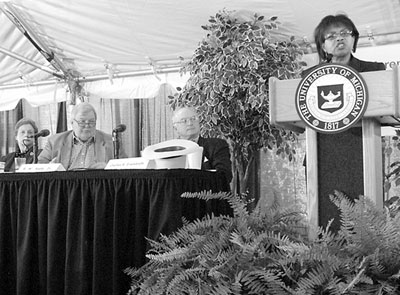
Dean Paula Allen-Meares links food and Social Work
Although shooed back into the hotel by swarming troops and ordered to the basement because of a coming “bombardment,” I climbed to the rooftop deck instead. Ari Rath of The Jerusalem Post and I watched two Chilean Air Force Hawker-Siddley fighter-bombers rocket the office in which Allende died.
Absent a weakness for markets, the 62-year-old at the conference podium in all probability would have been a footnote fatality at 32.
Such experiences make public policy a part of one’s intellectual architecture. It was a pleasure to expand the program’s W.K. Kellogg Foundation conferences from previous subjects such as assisted suicide, welfare reform, “permanent war,” to the food chain.
Then, too, I loved the idea of the Fellowships’ staging the first University of Michigan event, ever, in Ann Arbor’s Kerrytown Market. The nexus of policy issues began with nutrition but spread out into society like ingredients from a spilled mixing bowl: health, obesity, minority economics, women’s roles.
R. W. “Johnny” Apple, who as chief correspondent for The New York Times routinely sums up nations, political doctrines and religions in a sentence or two, set a tone of serious irreverence, before local television and a live audience of about 300 in tents rigged in the market stalls. The United States, he said, has changed from a place where a “Puritan” silence squelched experimentation to a situation in which the sheer bulk of cookbooks—“many of which are fortunately not much cooked from”—presents “an environmental hazard.” Other speakers presented major themes with similar playful seriousness:
•America is all alone in its food obsessions. Where Americans see cholesterol, fat and death, the French and other cultures see pleasure. Lacking a common agricultural background based on available fresh foods going back thousands of years, Americans applied the techniques of mass production to the previous tradition of handicraft—“industrial gastronomy,” in the memorable phrase of Lynn Rosetta Kasper of Minnesota Public Radio.
•Media discussion of food misses important points. It rarely probes what drives unhealthy school lunches (food producers’ philanthropy to schools based on school purchases of their products). It ignores the importance of terminology, such as a current campaign that equates being fat with being sick, the first step in obtaining insurance coverage for a weight-loss industry already worth $32 billion annually. It fails to point out the delusional nature of the Atkins diet, which has as many adherents as Canada has residents and which has Americans thinking they can eat tons of fat without being fat, as Kim Severson of The San Francisco Chronicle put it. What’s more, when it comes to coverage of food issues, American media obey the American taboo on discussions of race, said Harvey Levenstein, a Canadian sociologist. The upper classes do most of the fretting (thanks to upscale journalism), while the lower classes have most of the problems.
•Not much changes. Marion Nestle of New York University and author of Food Politics: How the Food Industry Influences Nutrition pointed out that despite the intense interest in every new discovery, nutrition standards haven’t changed much since the 1950s. “Eat less, move more and eat your fruits and vegetables.” That was trumped by UM classicist Susan Alcock, who pointed out that current political correctness is child’s play. The ancient world was obsessed by food, she said, because what you ate in (500 BC) Athens could make or break you, because it was thought to determine your politics and your morals.
Food for thought, all of it.