News from Wallace House Archives
From the Head Fellow: Sacred Fire and the "Holy Spit, Hot Damn!" Experience
By Charles R. Eisendrath '75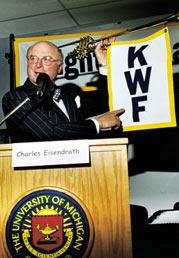
To the letter—Eisendrath makes it official
The 30th anniversary of journalism fellowships at the University of Michigan is a good time to talk about stress, if only because it is so misunderstood in journalism in general, and this journalism fellowship in particular. Everyone knows that a year of sabbatical study is the opposite of stress, right?
Depends on what kind. Many journalists apply for a year off because they are “stressed out” by their jobs. This absolutely never means they love their work so much that they literally cannot do enough of it. Usually, there's just too much ugh-work. People under enormous stress doing what they love don't call it that. They call their work “excitement” and say it's too addictive to leave.
In the words of that great psalmist, Irving Berlin, the Knight-Wallace Fellowships at Michigan endeavor to “accentuate the positive, eliminate the negative, and (not) mess with Mr. In-Between.” A year away from familiar settings—read editors, deadlines, competitors—eliminates a lot of negative. For some, however, there remains a bubbling, troubling goo labeled “Whither me?” and an ocean of time for wallowing. Useful counseling involves turning up the steam in order to convert angst into action. It IS nervous-making. Who wouldn't develop a little FOF (fear of failure) after telling everyone about taking a year for self-improvement? The challenges begin before anyone sets foot in Wallace House as a Fellow, and they eliminate the Mr. In-Between called Wallow.
My first question to applicants at their interviews is “Tell us about your professional dreams because at the level of this program, dreams come true. Wrong dream, wrong candidate.” The question hasn't varied in a decade and it is utterly astonishing how few journalists know it's coming-which is part of what Knight-Wallace Fellowships address. Most journalists neither research nor plan their own careers with anything like the care they lavish on stories. That this is insane becomes clear with that first question, and the creative anxiety it produces seems utterly appropriate. What we are up to, after all, is selecting people who will captain their professional lives from among others content with a life of taking orders.
Even for people who know where they want to go and have come to Michigan to help get there, a little FOF is a wondrous instrument. I learned this from a former boss. At the time (1968), Richard M. Clurman ran the Time-Life News Service, which aside from the wires and anomalies like the BBC, fielded the largest corps of correspondents in the world. “Congratulations,” he would say in his hiring spiel. “As long as you work for me, you will have anything you need to get the most complete story available. If you want a plane or a boat, charter it. If you should go somewhere, go. If training would help, get it.” Then he would pause. “So if you come up short, the problem will be you.”
Minus chartered planes, that's how I greet new Fellows. I can make good on an extraordinary brag because the program is backed by a receptive community and remarkable commitments. Alone among 38,000 students, for example, Fellows are permitted by the University to take any course, in any academic unit, without prerequisites. A political cartoonist needed a cadaver to study human anatomy and a lithography studio to apply what he learned. A features man was convinced that in addition to writing courses, an ice rink would help improve the flow of his narrative prose. A science editor wanted a professor to help build a mechanical fish. Several found horses essential to getting their thinking going. None of this was problematic. Wallace House is available at any hour, for purposes that include just staring into the fireplace on a winter evening, or pondering a muse. The aim: creating at the University of Michigan what a first-rate outfit imparts with the assignment of a “Holy spit, hot damn!” story along with the support to bring it off.
Unlike any other long-term fellowships, ours are part of a public institution located between the coasts. More than any other, ours represent financial commitment by most of the leading news organizations of the country. The change of the program's name announced at the reunion celebrates new gifts from donors already our largest, but the opportunity to bestow a new logo on an enterprise already strong would not have been possible without grants from the others. I feel responsible to an entire profession every time I approve an applicant. It is an important responsibility for the Fellows, too. Each is accepting an invitation to lead.
Sometimes that means climbing an organizational ladder, but not always. What we look for are big people without regard for the size or fame of their organizations. Some from the journalistic outback move on to Gotham. Others stay right—often gloriously—where they came from.
That's why we expect a great deal of serious work. Since Fellows neither pay tuition (the program pays it for them) nor teach, the per-capita costs are disproportionately large, as is the endowment necessary to cover them. The program's most important assets by far, however, are the people who support it. Four of them joined the reunion panel on “The Future of the News.” Introducing them, I made a point of presenting the personal achievements behind the well-known names. I wanted to emphasize to an audience of 200 Fellows, alumni, friends, family, editors, faculty, as well as Graduate Dean Earl Lewis and University President Mary Sue Coleman, that the panelists are among the program's primary role models. They represent big dreams and the risks without which such careers do not happen.
Hodding Carter, president and CEO of the John S. and James L. Knight Foundation, was on hand to personally deliver a $5 million challenge grant, the largest gift in our history. True, his family owned a newspaper, one that established a distinguished record in the civil-rights era. But The Delta Democrat in Greenville, Mississippi, was not exactly The New York Times, and it in no way pointed toward Hodding's subsequent record in public broadcasting and government service, not to mention philanthropy. Under Hodding's guidance, the Knight Foundation has more tightly focused its mission and established itself as the most important underwriter of efforts to maintain what is best described as the “sacred fire” of journalism in difficult times. The term includes “values,” to be sure, but involves much, much more, beginning with the courage to put reporting the news above all else.
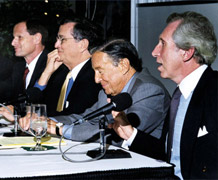
“Whither the News?” panelists (from left) Tash, Carter, Wallace, and Osnos field audience questions
The other panelists, all members of our board, made a difference the same way Hodding has—with a willingness to challenge themselves.
Behind the icon named Mike Wallace is the inventor of brand-name television interviewing, a co-founder of the most successful news program in broadcast history, and the winner of most major prizes the business offers, several of them multiple awards. Yes, he has made lots of money in a 63-year career in broadcasting . But so have dozens of others, and I know of no record of giving back to the profession from any journalist (I'm excepting publishers here) on his scale of generosity. All this from having come to the University of Michigan in 1935 as a kid from Brookline, Mass., and leaving with a dream.
Peter Osnos arrived with the first fellowship class in 1973, which says something about his eye for opportunity. He was already at The Washington Post, but so were hundreds of other people who have not contributed what he has. After taking charge of the paper's coverage of some of the most demanding stories of his time-including Indochina and the Soviet Union-he became foreign editor. When that wasn't enough, he joined Random House, publishing a Who's Who of celebrity authors, with his share of best sellers. And when that still didn't quite give him enough latitude, Osnos founded Public Affairs, which specializes in books by journalists, concerning journalistic topics.
Unlike the others, Paul Tash contributed mightily while staying right where he landed after college-The St. Petersburg Times-as reporter, metro editor, managing editor, executive editor, and president. Tash is now president-designate of Times Publishing Company, the umbrella organization for The Times, Congressional Quarterly, several regional publications, and the Poynter Institute. It is a remarkable outfit by any measure. The Times ranks in the top echelon of the nation's regional newspapers and has surpassed the circulation of The Miami Herald, which has a far larger metropolitan area. Poynter, meanwhile, has emerged as the profession's leading think-tank, with a high-quality journalism school of its own.
With help from them, their colleagues on the board, our alumni, and the University, we plan several initiatives.
The $5 million Knight challenge designates $1 million for administration, $2 million for environmental journalism, and $2 million to sponsor Fellows each year from opposite sides of a world problem-this year's pilot program includes an Israeli and an Indonesian.
Mike directed his gift, accounting for 20 percent of the required matching money, to endow Wallace House, so that its expenses will no longer draw resources from the Fellowships themselves. Finding the remaining 80 percent ($4 million) will be our first priority. Raising endowment is never easy, and the coming period is likely to make the pre-9/11, pre-Enron era seem like winning praise from your mother. That said, experience tells me there's always support if the project is good enough, which means coming up with ideas well enough matched to the interests of a donor to become part of those interests. It isn't a complicated business—just entirely unpredictable.
We have a strong selling point. There simply isn't a field as important as journalism to the functioning of a democratic society, and there have been few times when journalism needed more help. I'm not talking about the business of journalism, which is doing just fine, although you wouldn't know it from the complaints and cutbacks. The undisputed fact is that even newspapers, traditionally the profit plodders of the field, are making more than double their historical profits in the middle of the most dismal advertising dry-up in decades. Returns average more than 20 percent; 30 to 40 percent is not unusual. In local television, making 50 cents on the dollar has been utterly routine.
What's wrong with that as a business proposition? Nothing, so long as you serve the customers and/or fool them. This is a moment full of irony. Journalists themselves have never been as well prepared. The best in journalism has never been better. Yet the norm has rarely been lower. Readers and viewers, who are neither well served nor fooled, are deserting. Metro newspaper readership hasn't moved much above the numbers of the 1960s although the nation's population has doubled. The audience for broadcast television news has fallen drastically in the years since network policy shifted it from public service to profit center. Competition (suburban weeklies, specialty magazines, cable television, public radio, the Internet) underlies some of this, but not all.
The last time the business of journalism was this fat and its practice this thin, a repentant yellow journalist named Joseph Pulitzer drafted a will providing for a prize to encourage better coverage than his papers had supplied (it improved dramatically in his old age), and journalism schools at Missouri and Columbia universities to instruct the young in what not to learn from their elders.
All nourished the idea that journalism could be a high calling. It is. The worst contemporary problem is that the Joseph Pulitzers of our era are sending a dispiriting message. Incoming Fellows paint newsroom morale in tones of dark blah. They feel orphaned by companies that no longer urge them to scale the journalistic heights. Instead, with every diminished beat and the replacement of fresh news with canned goods, they signal “It's the bottom line, stupid.”
But it isn't the bottom line. It's the tomatoes and the soccer moms.
You have to take a lot of tomatoes out of the soup to produce profit several times higher than the Standard & Poor industrial average. In banner years, for example, automobile companies make a five-percent return. That's about one fifth and one tenth of what newspapers and television make, respectively. If car manufacturers removed enough substance from their products to match media profits, chances are soccer moms could not depend on their reliability to bring the kids safely home from the game. Lack of trust is precisely what shows up in poll after poll about journalism.
One of these days, more media companies will return to concentrating on their products as much as their profits. Meantime, a critical function is being supplied at places where those who will lead a rebound come to sharpen their skills. That their re-tooling requires a full academic year is no mystery. It takes time for someone to enter the cave, get used to the quiet, realize that the holy flame is kept burning just for them-and then prepare to take it home, ready to ignite a few fires when the time comes. As it definitely will.