News from Wallace House Archives
From the Head Fellow: Rushing Forward, Looking Back
By Charles R. Eisendrath ’75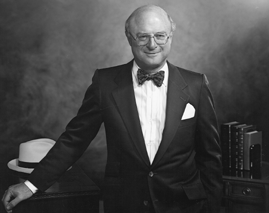
Remember "Afghanistanism?" Until September 11 it meant "safe to discuss because too remote to care about." Suddenly, Afghanistan is local news while the journalistic terrain of America looks increasingly unfamiliar:
A top-rated network anchor goes on camera, close to tears, to report a terrorist casualty. Not in the field. In his Rockefeller Center office.
The New York Times closes down its newsroom while people in moon suits sweep it for anthrax.
Presidents of all five networks (ABC, CBS, NBC, CNN, FOX) say "Yes, Ma’am" to Condoleeza Rice’s request that they tone down stories unrelated to the safety of military personnel but not to the administration’s liking.
Newsroom stalwarts of an erstwhile liberal persuasion have discussed a new openness toward "manly" (i.e., macho) men, racial profiling (for Middle Easterners) and even torture to "encourage" confessions in terrorism cases.
What happened is that for the first time in the experience of any American journalist active today, credible threats have been made to their persons and the profession at home. Journalists are no longer reporting horrendous events from a safe haven.
There IS no safe haven.
A couple of generations of working journalists and their academic cousins have had nothing but skepticism for World War II predecessors who submitted to censorship with what seemed incomprehensible complicity. Now it’s comprehensible, if not yet condoned beyond network television.
It is important to chart media responses against the immediate dangers known to be facing the country now and in the months following Pearl Harbor. As of this writing, we know of neither a terrorist army beyond the Taliban, nor even established connections between the Twin Trade Towers attacks and the bio-terrorism that followed. The situation in December of 1941 was far more dire, and obvious as a sunken fleet. Nothing prevented the Imperial forces of Japan, several million strong, from further attacks on the American mainland. Self-censorship now, when threats seem far more ambiguous, is premature.
The seemingly unthinkable silence of the press about "atrocities" like the rounding up of Japanese Americans in the 1940’s seems less mysterious as Muslim Americans face profiling-based arrest and detention in 2001 without much fuss in the media. This is a time for careful reflection. Not the academic kind. I mean the application of high-minded standards — standards that were easy yesterday — to the far more difficult situation now. Now is where they — and we — will be tested meaningfully. These include:
A healthy skepticism of official pronouncements including those on the need for summary tribunals;
More reliance on independent sources to counter those of government;
Far less reliance on paid "sources," such as the experts trotted out by network television in place of reports from more expensive beat correspondents.
What all this has to do with a journalism fellowship program in the Midwest is illustrated by the pieces in this issue of the Journal by Javed Nazir and his wife, Ameera Javeria, also a journalist. They came to Ann Arbor on a program I helped the Knight Foundation design two years ago for Michigan, Harvard and Stanford. Then, of course, threats to journalists seemed like a sort of professional "Afghanistanism." The idea was to provide exile fellowships to colleagues under credible death threats for telling the truth.
Javed and Ameera are both furiously at work on books concerning unpopular topics at home — Javed’s on the status of Pakistan’s minority Christians and Hindus, Ameera’s about restrictions on her country’s women. International colleagues like them have known all their lives what maintaining professional standards means in times of test. As we — and the broader University of Michigan community — learn about their experiences, it is we, the hosts, who are in their debt.