Travel Reports Archives
Coup in Argentina:
A Trip Into Foreign News
By Joe Coleman ('02)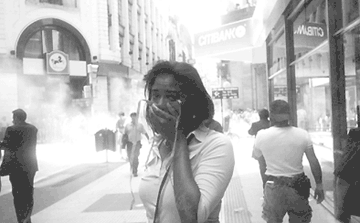
Michelle Genece recovers form a tear-gassing.
When Associated Press reporter Todd Richmond started his Michigan Journalism Fellowship last September, his dream was to transfer from Milwaukee, WI, to a bureau where he could write more feature stories and someday a Pulitzer-prize-winning series on the struggles of small-town America. Now, as his fellowship comes to a close, things are different: he wants to master Spanish and maybe try his hand at being a foreign correspondent.
What would encourage someone who was issued the first passport of his life just last October to consider throwing himself into foreign news? A trip to Buenos Aires, which the Fellows took in December. “The whole fellowship has been an international eye-opener for me,” says Richmond. “Argentina was just the icing on the cake.”
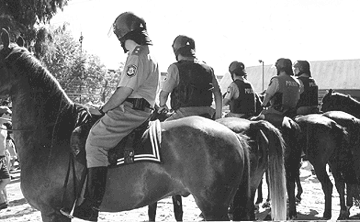
Mounted police at the ready.
Reactions like Richmond’s fit perfectly with MJF Director Charles Eisendrath’s motives for making the trip a primary aspect of the program: to “radicalize” American reporters on the importance of foreign news and reporting.
The theory is intriguing: take reporters to a city that enjoys the luxuries of major European or U.S. cities—world-class architecture, a rich cultural life, distinctive cuisine—but also suffers from deeply rooted economic and political troubles a world away from those encountered in Paris or New York. Then watch the journalists grapple with the enigma that is Argentina, making discoveries about themselves and their own country in the process.
Buenos Aires was a fabulous classroom. For newcomers to international affairs like Richmond, it offered a compelling introduction to the political, social, and economic difficulties most of the world faces. For the several Fellows with overseas experience, the trip was a chance to broaden their take on Latin America and to gauge the depth and reach of the region’s promise and its problems, long neglected in our own backyard. Even for someone who had reported from Latin America (I covered Colombia in 1989 and 1990 for UPI), a week in Argentina was a valuable refresher course in the region’s vexing complexities.
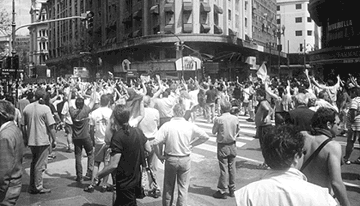
Fellows mix with crowds demanding change.
The trip was a “news tour” designed to have us learn as much about Argentina as possible. That translated into a rapid-fire series of meetings over the week with experts in economics and politics, dissident politics, and journalism. On the morning of December 19, we met with the Argentine Army Chief of Staff, General Ricardo Brinzoni, a starched, ramrod-like figure who turned up 45 minutes late and shaking nervously enough to be noticed in a press-conference setting. He had been delayed by a call from President Fernando de la Rua, he said, but “it was nothing unusual.”
The declaration of a state of siege came two hours following our meeting. Within 24 hours rioting had toppled the de la Rua government, setting the stage for the biggest default in the history of international finance. During a lunch MJF gave for the Argentine press, our guests’ cell phones kept us all informed of the rioting taking place around us. On the same day, we met with the Mothers of the Plaza de Mayo, whose children had “disappeared” in abductions by the Argentine military during the “Dirty War” of the 1970’s and 80’s. That night a group of us went to the Plaza to see history in action: some 10,000 protesters calling for the resignation of the president and an end to economic-austerity measures. In all, 27 people died in rioting around the country.
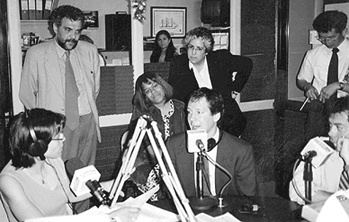
Joe Coleman goes live on Argentine radio, watched by fellow Fellows Carlos Prieto, Robin Farmer, and Margo Hernandez.
Sharon Emery, who works for Booth Newspapers in Lansing, MI, was in the middle of the rioting. At one point during the tear-gassing she was nearly run down by mounted police at full gallop. She was shaken but now sees it as an important lesson in how raw power is wielded.
Balancing the rough stuff and the briefings was the Argentine ambience. There was so much steak to be had that avowed carnivores yearned for veggies. We saw a ballet performance as well as a backstage tour of the Teatro Colon, one of the world’s great centers for opera and dance. There was tango and a day riding horseback gaucho-style across the pampas at an estancia. After learning something about Argentine history, we found it easy to appreciate the frayed grandeur of what was once among the richest nations of the world.
Michelle Genece, an ABC News producer from New York, says the experience provided a chance for the group to digest events in a different way than reporters normally do. “If you’ve got the resources, it’s imperative to take a trip like this—it does different things to different people in your group,” Genece says. “The point is to let our brains breathe, and not to be limited by the constraints we usually face.”
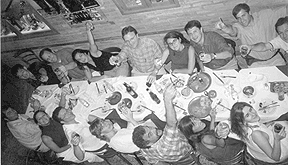
Standard study-recovery procedure.
Marzio Mian, who covered the Bosnian wars for Corriere della Sera, Italy’s leading daily, says the challenge for news organizations is to recognize and satisfy the unappreciated appetite for foreign news among readers. Thanks to the trip, a small group of reporters will take the excitement back to their newsrooms. “For some Fellows,” Mian says, “there will be a ‘before Argentina’ and an ‘after Argentina’.”
That’s certainly the case for Richmond. Back in Ann Arbor, he saw his new interest in Spanish become an obsession. He peppers Spanish-speaking Fellows with grammar questions and pulls them aside for a little conversation practice. “It’s real now,” he says.
Joe Coleman is Tokyo correspondent for the Associated Press.


