Reports From Our Fellows Archives
Bribes, Chocolate Bars, and What a Bomb Does to a Body
NYT's Barry Bearak ('81) on the Afghan WarJust in at press time—Bearak takes Pulitzer Prize for Afghan reporting
For Barry Bearak, a foreign correspondent for The New York Times, covering the war in Afghanistan is just one part of an eight-country, 1.5 billion-person beat. In February, he won a 2001 George Polk Award in foreign reporting for his "dramatic, eyewitness early reporting on the Taliban and his subsequent coverage of the war on terror." While in Ann Arbor, Bearak spent much of his time preparing himself to be a foreign correspondent—in Central and South America, though, not South Asia. He recently shared his experiences with Charles Eisendrath.
Q: How does the abduction and murder of Daniel Pearl affect the approach reporters now take in covering the war zones of terrorism?
A: Danny’s death is a terrible tragedy, and I, like many others, can’t help but believe: there but for the grace of God go I. But, basically, I think the journalist’s approach must remain the same. Most of us have gone to great lengths to get interviews with some of the planet’s least savory characters—and we have accepted their terms for where, when, and how. It’s our job to try to meet terrorists, go to their training camps, get into their heads. I don’t know that Danny did anything particularly careless or wrong in Karachi. And I’m afraid the best of reporters will inevitably remain easy pickings for the most terrible of people.
Q: Tell us about your assignment. How long were you on the story, from which places, among how many Times reporters? What were you asked to do that was different from the others?
A: My wife, Celia Dugger, and I are co-chiefs of the South Asia Bureau, based in New Delhi. Afghanistan falls within our eight-country, 1.5 billion-people domain. We’ve been at this since August 1998, and the way things have worked out, I’ve been the one to make the trips to Afghanistan. Indeed, on Sept. 11, I was in Kabul, covering the trial of eight Christians charged with proselytizing.
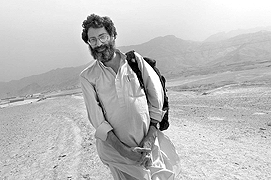
Barry Bearak in Afghanistan
Back then, TV was forbidden in Afghanistan. But some friends from CNN were living down the hall from me at the Intercontinental Hotel and they were able to summon still images of the WTC attack from the network’s Web site. Then within days, the Taliban ordered all foreigners out of the country. We lingered a week, however, sort of “hiding out” until our visas expired.
As it happened, I was on the road for all but six days between the first week of August and New Year’s Eve. In Afghanistan, I reported from Kabal, Jalalabad, Bamian, and several smaller places in between. In Pakistan, I wrote from Islamabad, Peshawar, various refugee camps, and the Tirah Valley in the tribal areas. At one point, The New York Times had 12 reporters and six photographers either inside Afghanistan or poised on the border. All of us were asked to follow the news wherever we were, though I was also permitted to break free from the daily grind and write some longer pieces.
Q: I have the impression that our military shrink-wrapped this war even more tightly than Desert Storm—correct?
A: Yes, but Afghanistan is a big place and the U.S. military was in very few locations. The bigger shrink-wrappers were the Taliban, who for the most part barred all foreign journalists from entry. They did conduct a few brief guided tours, and I, like hundreds of other reporters, spent a good deal of time trying to cajole my way onto the small list of invitees. Once, in the cajolery, I brought a chocolate mousse cake to the home of the Taliban’s ambassador to Pakistan. I can’t say whether he enjoyed it. I never saw him again. Within a week, Kabul had fallen and he was a fugitive. He’s in U.S. custody now, where, presumably, chocolate mousse cake is in shorter supply.
Q: I also gather that there were daunting physical constraints to coverage, independent of minders from the U.S. military. Which were more of a factor?
A: The physical constraints were bigger. And the most daunting among them were the many, many people in a besieged nation who would have considered it their privilege—indeed, their duty—to murder you.
Q: How about the routine daily humdrum of staying alive and filing. What kinds of places did you stay in, for example? Anything worthy of your memoirs?
A: In Pakistan, most journalists stayed in nice hotels with room service, mini bars, and air conditioning—places more appropriate for a travel piece than a memoir about war. In Afghanistan, the cities have a few decent hotels, but they were quickly overwhelmed, and hot water and sit-down toilets soon became as cherished as great stories. Eventually, most bigger news organizations rented houses in Kabul, which often caused reporters to begin splitting their time between reporting the news and re-wiring the electrical outlets.
In more remote locations, the sleeping bag proved a great invention as did the wood-burning stove. Always, the filing of stories and photos was done through satellite telephones. This is just like filing stories any other way, except you get to spend wearisome hours talking to the technology people at the home office as you alternately re-configure the equipment and curse their invention.
Q: Along with awfulness, every war produces hilarious stories à la Scoop. What’s best from the ’Stans?
A: Actually, hilarity was in short supply, though I suppose I may feel differently as the years go by. Already, I can smile about border guards and anti-Taliban commanders who were insatiable in demanding bribes. No one has ever said “gimme, gimme, gimme” with less shame.
I might also mention one night in Tirah, in the Pakistani tribal areas just opposite Tora Bora, where clan warfare is common. I was accompanied by 14 machine gun-toting bodyguards on a dangerous, seven-hour moonlit trek through the mountains. Three of us were riding mules. When we finally reached a point of safety, some of the guards decided to stage an ambush just so I could experience what one actually felt like. The furious gunfire spooked the mules, and all the riders were thrown to the ground, including one (fortunately, not me) who was dragged across the rocky ground for a few minutes. Some of the tribesmen were greatly amused by all this. Possibly, someday, I will also see the hilarity.
Q: Exactly what does “cave” mean in the Afghan sense? I grew up in the Ozark cave country, and lots of Americans can picture tourist caverns, but I sense that the journalistic shorthand may be misleading. Are Afghan “caves” actually underground fortress-communities, like ours in the Rockies?
A: No, for the most part, Afghan caves are more like small holes in the walls of the mountains. I didn’t see anything that would make me want the phone number of Osama bin Laden’s real estate agent.
Q: What’s your best guess about our ability to rely on Pakistan as a long-term bastion of political secularism?
A: If “long-term” means 10 years or so, I don’t think we can definitely rely on anything in Pakistan except for the mountain ranges, riverbeds, and slums of Karachi. Everything else is up for grabs.
Q: Some reporters have said that covering this war was the most exhilarating, terrifying assignment of their lives. When you think back on the experience, what’s likely to stand out?
A: Exhilarating? This question gave me pause. I began to think of things in my life I have considered exhilarating, and the war in Afghanistan only ranks 978,452nd. I really, really like the Afghan people, and so for me the sadness of the situation was enough to trump most cheerier emotions.
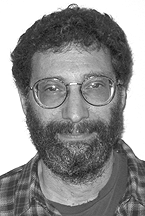
Barry Bearak ('81) is a
foreign correspondent for
The New York Times
As for terrifying, there were indeed many moments. Four journalists were murdered while traveling the road between Jalalabad and Kabul. Two days later, when no one else was risking it, I made the same trip, trusting my gut instincts that the murders were an isolated incident. While I survived the journey without a problem, once in Kabul I learned of several other attacks that I had known nothing about. My gut, while lucky, had been badly uninformed—and I now hope to have the good sense to tell it to shut up.
Q: What’s the hardest thing to convey to American audiences about the Afghan situation?
A: Few people know—or are willing to know—what a bomb does to a human body.
Q: What’s the answer to the question I haven’t been smart enough to ask?
A: You asked about the places we stayed in but not about the food, a subject of great importance, especially so for people who are overweight. During the past years, I have found that Afghanistan offers two sure-fire diet plans. With one, you eat all you want and whatever you want, which results in getting giardia or a similar parasite. With the other, you eat only chocolate bars and saltine crackers. Either way, you come home 10 pounds lighter.


