Alumni News Archives: Winter 2001
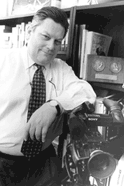
Christopher Cook
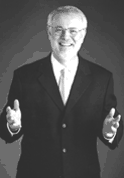
Donovan Reynolds
In May, public television stations in Michigan aired The Sprawling of America, the first documentary series produced by Great Lakes Television Consortium, the public-television production arm of Michigan Radio. Christopher Cook, '82, wrote, produced, and directed both documentaries, which examine the devastating social, economic, and environmental impacts of sprawl. The series marks a return to public and educational programming at the University of Michigan, where another MJF alum, Donovan Reynolds, '95, is director of broadcasting and station manager of Michigan Radio.
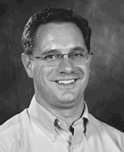
Karl Leif Bates
Karl Leif Bates, '98, has been named director of communications for the University of Michigan's new Life Sciences Institute. He is responsible for internal and external communications, including the web site, media relations, and public outreach for the new $230 million research institute on the Ann Arbor campus (see www.lifesciences.umich.edu). As a medical Fellow, Bates studied genetics and dreamed of a job like this. Still no word on the genetics and society text book for non-majors he started writing during the fellowship year; a fifth publisher is looking at it now.
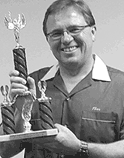
Tom Grant
With the words "TV sucks," Tom Grant, '98, left his job as an investigative reporter with KXLY-TV in Spokane and began a career in print as news editor of The Local Planet Weekly. Grant's reporting at KXLY won two national awards this year — a duPont-Columbia silver baton and a Sigma Delta Chi award for investigative reporting. He announced his departure from television in an article for The Local Planet Weekly in which he bashed local television for buckling in the face of threats of lawsuits and refusing to cover stories about major advertisers. In the six months since joining Spokane's alternative press, Grant has seen the circulation of the paper rise by 30 percent and advertising sales rise by 50 percent. And he doesn't have to wear a tie any more.

Hayes Ferguson
Hayes Ferguson, '99, is chief operating officer of legacy.com, an online obituary site developed in conjunction with several newspaper partners. "It's been a great experience that's taught me a lot about the business side of newspapers," she says. For September 11, the site has created a guest book for everyone who died in the attacks. "The response to our 9/11 site — created at the request of several newspapers, including The New York Times and Chicago Tribune — has been extraordinary. Tens of thousands of people from around the world, including the family members of victims, have left messages (written notes and/or posted photos) in the National Book of Remembrance and in individual guest books. This is just one of many, many guest books that have had a profound effect on the folks who work here. We have a team of people that reads every single entry that comes in."
An article in the spring issue of The Journal of Michigan Fellows by Dan Froomkin, '96, was featured this past summer on the Poynter Institute's web site (www.poynter.org). Froomkin, editor of washingtonpost.com, described why traditional journalism can flourish on the Web.
Phil Langdon, '80, received a Knight Community Building Fellowship from the School of Architecture at the University of Miami, a new program funded by the John S. and James L. Knight Foundation. Fellow- ships were awarded to 12 people from a variety of fields involved in community, planning, design, and related issues. "We meet six times at various locations throughout the year, and each of us will carry out a research project," he says. "Mine will be a look at urban housing that currently doesn't have much of a market, most likely focusing on abandonment in some of the row-house neighborhoods in Philadelphia or Baltimore. This will fit into a book I'm writing with San Francisco architect Herb McLaughlin about how to revitalize cities."
Harris Meyer
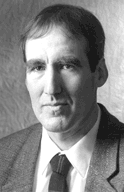
Harris Meyer, '91, won the 2000 Gerald Loeb Award for Distinguished Business and Financial Journalism for an investigative article he wrote for the New Times Broward Palm Beach. The article exposed layers of deception in Rexall Sundown's multi-level marketing scheme involving doctors selling dietary supplements to patients. This year, Meyer took finalist honors in the John Bartlow Martin Award for Public Interest Magazine Journalism and second place in the 11-state Green Eyeshade Award in the investigative reporting category. He was honored for a New Times article he wrote last year on occupational safety hazards at a Publix Supermarkets warehouse where five workers have died in recent years. Meyer currently is law editor of the Daily Business Review and executive editor of the monthly Florida Lawyer magazine, both published by American Lawyer Media.
Henry Goldman, '90, opened Bloomberg News' City Hall bureau in August, just weeks before the attack on the World Trade Center. "On Sept. 11, I expected to start work late because it was election day in the Democratic primary for Mayor," he says. "At 9 a.m., just as I was about to go outside for a run, I got a call from my editors that a jet had just crashed into the World Trade Center. I rushed to the office, and from there we decided I had to find Mayor Giuliani.
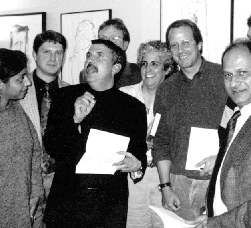
Tom Friedman of The New York Times
signs his book
The Lexus and the Olive Tree
for 2002 Fellows at Wallace House.
"I ran into the subway, and got stuck inside a packed car for almost two hours, as the towers collapsed and all subway transit stopped. After the authorities evacuated us about a half mile through the subway tunnel, we emerged upon a world in which dust hung in the air like fog, and ash covered the streets and sidewalks like powdered snow. There were thousands of pieces of paper that had been blown from the towers, and hundreds of dead birds. A wave of thousands of people, covered with dust and ash and dazed, walked slowly north, as I made my way south toward the fire. As I talked with them, I heard all the stories of people jumping from the highest floors, and of bodies falling into the street along with the shards of glass and chunks of concrete and steel.
"I spoke with dozens of firefighters that day, heard their stories about climbing up through the towers and evacuating people floor by floor. I saw hundreds volunteering to hammer together crude stretchers made of wood taken from a construction site near Lafayette Square — which were never used. By the end of the day, after I'd walked about four miles and finally caught a bus from midtown and got home, people were still walking dazed from south to north, past my apartment building, slowly heading north."


