Your cousin is a little bit taller than you, not to mention somewhat bow-legged. His evening clothes don't fit you as well as they might. You're standing in the private dining hall of the Excelsior House Hotel, about to receive a free meal, and about to hear a speech from the President of the United States!
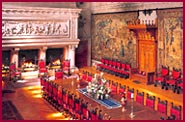
You look about you at the assembled company. This being a fairly formal affair, you realize that this is a gathering of the most prominent Democrats in Indianapolis. "Not," you reflect to yourself, "that that's saying much." You've never heard of a Democrat who was truly prominent, or rich, or well-respected, socially. Not in the Midwest, anyway. From the few men your uncle introduced you to upon arrival, you discerned the usual intellectuals, college professors (your Uncle Ezra is a professor of Mathematics), minor civil servants, pacifists, and general radicals. You also spotted a few first-generation immigrants and Catholic priests. Are people normally outcast from traditional white, Protestant society naturally drawn to the Democratic party? Or are those people outcasts simply because they're Democrats? You don't have the experience to judge, but the question gives you pause.
In between railings against Benjamin Harrison, your uncle filled you in on what the Democratic party stands for during your ride here. Basically, they are staunch adherents to Adam Smith's idea of free trade. While Republicans may favor doing business with lots of price controls and high tariffs, Democrats think trade should be as free as possible. Since they favor the capitalistic idea of supply and demand, the Democrats rail against the magnates who set pittance wages for the workers, something that has not made the party popular with businessmen. Those workers who are not socialists also tend to favor the Democrats, as a result of this. Finally, the Democrats are the American equivalent of the British Liberal party, which is concerned with improving living conditions and making life better for the common man, as a whole. Quite ironic, since the common man in Indiana does not vote the Democratic ticket.
An old man with a ribbon saying "Vote for Grover and be in the Clover" motions for you to take a seat. No sooner do you do so then you need to stand up again, as the President enters the hall!
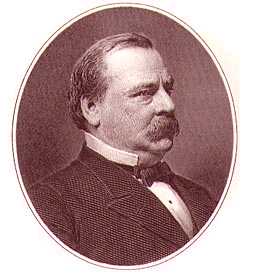
As you clap, you size the President up. He's a big man, and rather stern looking, but he walks with a kind of jaunty spring in his step. You get the impression that he's not as foreboding as he seems. As he reaches the head of the table, he raises his hands in the air and addresses the company.
"Welcome friends, and thank you! Please, begin your meals, and I shall begin talking shortly!"
All right. The food really is excellent, and you quickly make your way through a salad and a huge steak with all the trimmings. You are just starting into a pineapple glace when the President rises again and adopts an oratory pose. It looks as if his talk is about to begin.