 "We took
the ship of state when there was treachery at the helm, when there was mutiny
on the deck, when the ship was among the rocks, and we put loyalty at the helm;
we brought the deck into order and subjection. We have brought the ship into
the wide and open sea of prosperity, and it is to be suggested that the party
that has accomplished these magnificent achievements cannot sail and manage
the good ship in the frequented roadways of ordinary commerce?"
"We took
the ship of state when there was treachery at the helm, when there was mutiny
on the deck, when the ship was among the rocks, and we put loyalty at the helm;
we brought the deck into order and subjection. We have brought the ship into
the wide and open sea of prosperity, and it is to be suggested that the party
that has accomplished these magnificent achievements cannot sail and manage
the good ship in the frequented roadways of ordinary commerce?"
Interesting. A mixed metaphor, when he speaks of sailing the
ship into the roadway. Still, very interesting. You understand that the Senator
is talking about the Republican Party's rise to the presidency during the Civil
War. By "brought the ship into the wide and open sea of prosperity,"
he is referring to the series of Republican presidents since then. You ponder
these words, and as you look about, you see a look of agreement and admiration
in every face. "It's amazing," you muse, "how many people around
here see the Republican party as a sort of wise father, or even as a savior!"
You file the thought away and return your attention to the speech.
"President Cleveland has radically changed the sailing
course of the ship, only because, in his rash actions, he has made the mistake
of mistaking the flashlight of some British lighthouse for the light of day."
Britain? You remember Uncle Sam leading John Bull in the parade,
and wonder if there is any connection. The writing on the bull's sash said that
John Bull controlled the Democratic party: could this be what the Senator means?
You listen attentively as he continues to speak. Apparently, President Cleveland
has given his support to a new piece of Democratic legislation called the Mills
Bill, which calls for lower tariffs on European goods. The Republican party
and Senator Harrison believe that this only opens America up to goods made by
"slaves," the destitute European labor force. Harrison promises to
maintain the protective high tariff already established.
"Two propositions...now stare our working people--and
the whole country--in the face...: competition with foreign countries, without
adequate discriminating and favoring duties, means lower wages to our working
people; a revenue-only tariff, or progressive free trade, means larger importations
of foreign goods, and that means less work in America."
In his own words, he calls for, "...protection to American
labor against the pauper labor of Europe..." by boycotting or levying
high duties on foreign luxury items. Reflecting on this, you realize that it
is an excellent strategy. Just as Hoosiers are disdainful of anyone they consider
"too showy," they are also critical of anyone who would purhcase an
imported French coffeepot or an English rifle. American goods, they maintain,
are quite good enough for an American!
Next, the Senator lapses into a long diatribe on currency, which,
quite frankly, leaves you a bit muddled. You are not able to follow his discussion
of exchange rates, the gold standard, and other financial matters. However,
it is perfectly clear to you that the Republicans support using both gold and
silver in coinage. They demand restrictions and provisions such that, whether
a dollar is minted out of gold or silver, its value never changes, and it always
remains a dollar, backed up by the government. Evidentally, some independent
congressman has proposed demonetizing silver. Although you are not at all sure
that anyone in the crowd understands this financial matter better than you,
you notice several other men nodding their heads and muttering words of support
as the Senator speaks of it.
Harrison also speaks at length about providing veterans' benefits
to discharged GAR soldiers. THIS strikes a very definite chord. As Harrison
states that "the gratitude of the Nation to the defenders of the Union
cannot be measured by laws," you look about and notice several men in their
Union blues. While the Grand Army of the Republic is technically non-political,
you've never known a single member of the Civil War veterans' association, or,
indeed, any Civil War veteran, who was not a Republican. To your astonishment,
just as Harrison finishes his sentence, the entire crowd breaks out in song.
It is a song lampooning President Cleveland, and how he hired a substitute to
fight for him in the Civil War. It is sung to the tune of "Marching Through
Georgia:"
Grover Cleveland sent a substitute where he did not dare
to go,
Into the Union Army to face a rebel foe;
There he left this poor old German to die a death of woe
While he was boasting of our Union victory!
While the Senator seems a bit flustered at this, he resumes
talking and finishes his speech. The remainder is fairly straightforward and
unspectacular: you learn that Harrison intends to repeal all taxes on tobacco
and that he intends to abolish polygamy in the Territories. After another fifteen
minutes, the speech is over, and Harrison resumes shaking hands. You do not
stay. You estimate that it must be nine o'clock or later, so you make your way
to your Uncle Ezra's. Your intention is to leave your parcel at the door and
look for lodgings somewhere in town, but you learn from your aunt that your
uncle is at a dinner, and should be out for at least a few more hours. Gladdened
by the prospect of a bed and a meal without having to endure your uncle's terrible
company, you spend the night and strike out early the next morning. As the horses
make their way down the Cashtown Pike, you consider the party platform that
you heard about the night before. It should be very useful. You realize that
you heard biased data, but at least you learned what the important issues of
this upcoming election are. Confident in your new wisdom, you concentrate on
the drive ahead.
Go home and wait for the election!
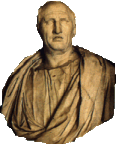
(The bust at the top of the page is of Marcus Tullius Cicero,
a great orator, and a contemporary of Gaius Julius Caesar)