Chapter 6: Isothermal Reactor Design: Molar Flow Rates
Selectivity and Yield:
| Instantaneous | Overall | |
| Selectivity | \( S_{DU} = \frac{r_D}{r_U} \) |
\( \tilde{S}_{DU} = \frac{F_D}{F_U} \) |
| Yield | \( Y_D = \frac{r_D}{-r_A} \) |
\( \tilde{Y}_D = \frac{F_D}{F_{A0} - F_A} \) |
| Example: | \( A + B \xrightarrow{k_1} D \) |
Desired product, \( r_D = k_1 C_A^2 C_B \) |
\( A + B \xrightarrow{k_2} U \) |
Undesired product, \( r_U = k_2 C_A C_B^2 \) |
|
|
\( S_{DU} = \frac{r_D}{r_U} = \frac{k_1 C_A^2 C_B}{k_2 C_A C_B^2} = \frac{k_1 C_A}{k_2 C_B} \) |
||
|
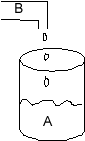
To keep the selectivity of the desired products high
with respect to the undesired products carry out the reaction at high concentrations of A
and low concentrations of B. If the reactor is liquid phase, a high selectivity can easily
be achieved using a semibatch reactor in which B is few slowly to A. |
||