Chapter 6: Isothermal Reactor Design: Molar Flow Rates
Stoichiometric Table – Measures other than Conversion
Let’s again consider the production of ethyl benzene (click back)
\( 2 \text{Ethylene} + \text{Toluene} \rightarrow \text{ethyl benzene} + \text{propylene} \)
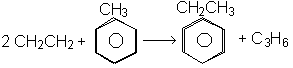
The gas feed consists of 25% toluene and 75% ethylene. Write the rate of disappearance of toluene as a function of the molar flow rate. What are the coupled mole balances and rate laws?
Hint 1: What are the relative rates of reaction?
Hint 2: Write the volumetric flow rate in terms of the molar flow rates
Hint 3: Write the concentration of toluene and ethylene in terms of the molar flow rates
Hint 4: Write the rate of disappearance of A, –rA solely as a function of the molar flow rates
Hint 1.
\( A + 2B \rightarrow C + D \)
For relative rates for measures other than conversion, the stoichiometry comes in relating the relative rates.
For this elementary reaction
\( -r_A = k C_A C_B^2 \)
\( \frac{-r_A}{1} = \frac{-r_B}{2} = r_C = r_D \)
\( r_C = r_D = -r_A \)
\( r_B = 2r_A = -2k C_A C_B^2 \)
Hint 2.
Write the volumetric flow rate in terms of molar flow rates
\( v = v_0 \frac{F_T}{F_{T0}} \frac{P_0}{P} \frac{T}{T_0} \)
Isothermal operation and (T = T0 and P = P0)
\( v = \frac{F_T}{F_{T0}} \)
\( F_{T0} = 4F_{A0} \)
\( F_T = F_A + F_B + F_C + F_D \)
\( v = v_0 \left( \frac{F_A + F_B + F_C + F_D}{4F_{A0}} \right) \)
Hint 3.
In terms of molar flow rates
\( C_A = \frac{F_A}{v} \)
For a flow system at constant T and P
\( v = v_0 \frac{F_T}{F_{T0}} \)
\( C_A = \frac{F_{T0} F_A}{v_0 F_T} = C_{T0} \frac{F_A}{F_T} = 0.2 \frac{F_A}{F_T} \)
\( C_B = \frac{F_B}{v} = \frac{F_{T0} F_B}{v_0 F_T} = C_{T0} \frac{F_B}{F_T} = 0.2 \frac{F_B}{F_T} \)
\( F_T = F_A + F_B + F_C + F_D \)
Hint 4.
In terms of molar flow rates
\( -r_A = k C_A C_B^2 = k C_{T0} \left( \frac{F_A}{F_T} \right) \left( \frac{F_B}{F_T} \right)^2 \)
\( -r_A = k C^3 T_0 \frac{F_A F_B^2}{(F_A + F_B + F_C + F_D)^2} \)
\( k C^3 T_0 = \frac{250 \, \text{dm}^6}{\text{s} \cdot \text{mol}^2} \left( \frac{0.2 \, \text{mol}}{\text{dm}^3} \right)^3 = 2 \times 10^{-1} \left( \frac{\text{mol}}{\text{dm}^3} \right) \, \text{s}^{-1} \)
\( -r_A = 2 \times 10^{-1} \, \frac{\text{mol}}{\text{dm}^3} \frac{F_A F_B^2}{(F_A + F_B + F_C + F_D)^3} \)
\( -r_B = 2 \times 10^{-1} \, \frac{\text{mol}}{\text{dm}^3} \frac{F_A F_B^2}{F_T^3} \)
Hint 5.
\( -r_A = 2 \times 10^{-1} \, \frac{\text{mol}}{\text{dm}^3 \cdot \text{s}} \frac{F_A F_B^2}{(F_A + F_B + F_C + F_D)^3} \)
\( \frac{dF_A}{dV} = r_A \)
\( r_B = 2 r_A \)
\( \frac{dF_B}{dV} = 2 r_A = -2 \left( 2 \times 10^{-1} \right) \frac{F_A F_B^2}{(F_A + F_B + F_C + F_D)^3} \)
\( r_C = -r_A \)
\( \frac{dF_C}{dV} = -r_A \)
\( r_D = -r_A \)
\( \frac{dF_D}{dV} = -r_A \)
\( F_T = F_A + F_B + F_C + F_D \)
\( V = 0 \, F_A = F_{A0}, F_B = 3 F_{A0}, F_C = F_D = 0 \)
Use Polymath to solve these coupled ODEs