Chapter 2: Conversion and Reactor Sizing
Topics
- Conversion
- Design Equations
- Reactor Sizing
- Numerical Evaluation of Integrals
- Reactors in Series
- Space Time
- Useful Links
Conversion
Top
Consider the general equation
\( aA + bB \rightarrow cC + dD \)
This equation represents a generic chemical reaction where reactants A and B combine to form products C and D.
The basis of calculation is always the limiting reactant. We will choose A as our basis of
calculation and divide through by the stoichiometric coefficient to put everything on the basis of "per
mole of A".
\( A + \frac{b}{a} B \rightarrow \frac{c}{a} C + \frac{d}{a} D \)
This equation represents a reaction where reactant A reacts with a fraction of B to form products C and D, each scaled by the factor of 1/a.
The conversion X of species A in a reaction is equal to the number of moles of A reacted per mole of A
fed.
\( X = \frac{\text{moles reacted}}{\text{moles of } A \text{ fed}} \)
This equation represents the calculation of conversion, where X is the ratio of moles reacted to the moles of substance A that were initially fed into the system.
| Batch | Flow |
|---|---|
| \( X = \frac{(N_{A0} - N_{A})}{N_{A0}} \) | \( X = \frac{(F_{A0} - F_{A})}{F_{A0}} \) |
What is the maximum value of conversion?
For irreversible reactions, the maximum value of conversion, X, is that for
complete conversion, i.e. X=1.0.
For reversible reactions, the maximum value of conversion, X, is the equilibrium
conversion, i.e. X=Xe.
Batch: Moles A remaining, denoted as \( N_{A} \), is calculated by subtracting the moles of A reacted from the initial moles of A. The formula for this is:
\( N_{A} = N_{A0} - N_{A0} X \)
Alternatively, this can be expressed as: \( N_{A} = N_{A0} \) - (moles A initially) * (moles A reacted) / (moles A fed).
Flow: The rate of moles of A leaving, denoted as \( F_{A} \), is determined by subtracting the rate of moles of A reacted from the rate of moles of A fed. The formula is:
\( F_{A} = F_{A0} - F_{A0} X \)
This can also be represented as: \( F_{A} = F_{A0} \) - (rate of moles A fed) * (moles A reacted) / (moles A fed).
Design Equations
TopThe design equations presented in Chapter 1 can also be written in terms of conversion. The following design equations are for single reactions only. Design equations for multiple reactions will be discussed later.
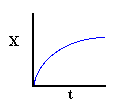
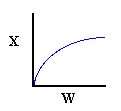
Reactor Mole Balances in Terms of Conversion (Click on Reactor to see picture)
| Reactor | Differential | Algebraic | Integral | ||
|---|---|---|---|---|---|
| Batch |
\( N_{A0} \frac{dX}{dt} = -r_{A} V \) |
\( t = N_{A0} \int_{0}^{X} \frac{dX}{-r_{A} V} \) |
|
Derive | |
| CSTR |
\( V = \frac{F_{A0} X}{-r_{A}} \) |
Derive | |||
| PFR |
\( F_{A0} \frac{dX}{dV} = -r_{A} \) |
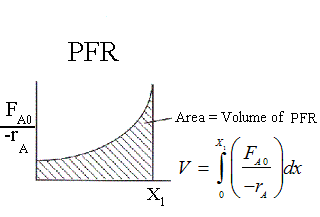
\( V = F_{A0} \int_{0}^{X} \frac{dX}{-r_{A}} \) |
Derive | ||
| PBR |
\( F_{A0} \frac{dX}{dW} = -r'_{A} \) |
\( W = F_{A0} \int_{0}^{X} \frac{dX}{-r'_{A}} \) |
|
Derive |
Reactor Sizing
TopBy sizing a chemical reactor we mean we're either detering the reactor volume to achieve a given conversion or determine the conversion that can be achieved in a given reactor type and size. Here we will assume that we will be given -rA= f(X) and FA0. In chapter 3 we show how to find -rA= f(X).
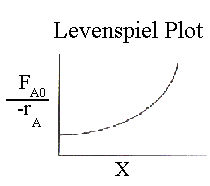
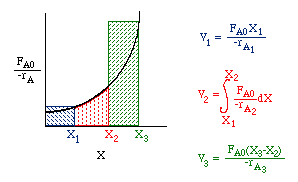
Given -rA as a function of conversion,-rA=f(X), one can size any type of reactor. We do this by constructing a Levenspiel plot. Here we plot either \(\frac{F_{A0}}{-r_{A}}\) or \(\frac{1}{-r_{A}}\) as a function of X. For \(\frac{F_{A0}}{-r_{A}}\) vs. X, the volume of a CSTR and the volume of a PFR can be represented as the shaded areas in the Levenspiel Plots shown below:

Example Using the Ideal Gas Law to Calculate CA0 and FA0
Example Levenspiel plots in terms of concentrations
Numerical Evaluation of Integrals
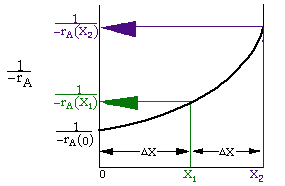
TopThe integral to calculate the PFR volume can be evaluated using a method such as Simpson's One-Third Rule:
|
NOTE: The intervals \( \left( \Delta X \right) \) shown in the sketch are not drawn to scale. They should be equal. |
\( \text{PFR: } V = \int_{0}^{X} F_{A0} \frac{dX}{-r_{A}} = \frac{\Delta X}{3} \left[ \frac{F_{A0}}{-r_{A}(X = 0)} + \frac{4 F_{A0}}{-r_{A}(X_{1})} + \frac{F_{A0}}{-r_{A}(X_{2})} \right] \)
Simpson's One-Third Rule (above) is one of the more common numerical methods. It uses three data points. Other numerical methods (see Appendix A) for evaluating integrals are:
- Trapezoidal Rule (uses two data points)
- Simpson's Three-Eighth's Rule (uses four data points)
- Five-Point Quadrature Formula
Reactors in Series
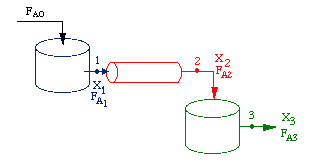
TopGiven -rA as a function of conversion, one can also design any sequence of reactors by defining the total conversion up to a point "i":
|
\( X_{i} = \frac{\text{moles of A reacted up to a point } i}{\text{moles of A fed to first reactor}} \) |
Only valid if there are no side streams |
Consider a PFR between two CSTRs
Example
Use Levenspiel plots to calculate conversion from known reactor volumes
Critical
One of the goals of the course is to have the readers further develop their critical thinking skills.
One way to achieve this goal is through Socratic questioning. Throughout the course students will be asked to write
questions on critical thinking drawing from information in the Preface section B2. Below are some examples of critical
thinking questions (CTQ) that are either superficial or don't use
R. W. Paul's Six Types of Socratic Questioning
Example
Reactors in Series CSTR-PFR-CSTR
Critical
What if ...?
Space Time
Top\( \tau = \frac{V}{V_{0}} \)
Space time is the time necessary to process one volume of reactor fluid at the entrance conditions. This is the time it takes for the amount of fluid that takes up the entire volume of the reactor to either completely enter or completely exit the reactor.
| Reaction |
Reactor | Temperature | Pressure atm | Space Time | |
| (1) | C2H6 → C2H4 + H2 |
PFR | 860°C | 2 | 1 s |
| (2) | CH3CH2OH + HCH3COOH →
CH3CH2COOCH3 + H2O |
CSTR | 100°C | 1 | 2 h |
| (3) | Catalytic cracking | PBR | 490°C | 20 | 1 s < τ < 400 s |
| (4) | C6H5CH2CH3 → C6H5CH = CH2 + H2 | PBR | 600°C | 1 | 0.2 s |
| (5) | CO + H2O → CO2 + H2 | PBR | 300°C | 26 | 4.5 s |
| (6) | C6H6 + HNO3 → C6H5NO2 + H2O | CSTR | 50°C | 1 | 20 min |
Useful Links
Top* All chapter references are for the 1st Edition of the text Essentials of Chemical Reaction Engineering.