Chapter 1: Mole Balances
Topics
- Chemical Identity
- Reaction Rate
- General Mole Balance Equation
- Mole Balance on Different Reactor Types
- Self Test Exercises
Chemical Identity
TopA chemical species is said to have reacted when it has lost its chemical identity. The identity of a chemical species is determined by the kind, number, and configuration of that species' atoms.
Reaction YouTube Video: Carbon Dioxide and MagnesiumThree ways a chemical species can lose its chemical identity:
-
Decomposition
\(\text{CH}_3\text{CH}_3 \rightarrow \text{H}_2 + \text{H}_2\text{C} = \text{CH}_2\)
Ethane decomposes to form hydrogen gas and ethene.
-
Combination
\(\mathrm{N_2 + O_2 \rightarrow 2NO}\)
Nitrogen gas reacts with oxygen gas to form nitrogen monoxide
-
Isomerization
\(\mathrm{C_2H_5CH=CH_2 \rightarrow CH_2=C(CH_3)_2}\)
Ethylene reacts to form isobutene
Reaction Rate
TopThe reaction rate is the rate at which a species looses its chemical identity per unit volume. The rate of a reaction can be expressed as the rate of disappearance of a reactant or as the rate of appearance of a product. Consider species A:
A → B
rA = the rate of formation of species A per unit volume
-rA = the rate of a disappearance of species A per unit volume
rB = the rate of formation of species B per unit volume
Example: A → B
If B is being created at a rate of 0.2 moles per decimeter cubed per second (i.e. the rate of
formation of B is
rB = 0.2 mole/dm3/s),
then A is disappearing at the same rate (-rA = 0.2 mole/dm3/s).
This also means that the rate of formation of A is rA = -0.2 mole/dm3/s.
For a catalytic reaction, we refer to -rA', which is the rate of disappearance of species A on a per mass of catalyst basis.
Example Is sodium hydroxide reacting?
Consider species j:
- rj is the rate of formation of species j per unit volume [e.g. mol/dm3*s]
- rj is a function of concentration, temperature, pressure, and the type of catalyst (if any)
- rj is independent of the type of reaction system (batch, plug flow, etc.)
- rj is an algebraic equation, not a differential equation.
We use an algebraic equation to relate the rate of reaction, -rA, to the concentration of reacting species (e.g., CA) and to the temperature (T) at which the reaction occurs [e.g. -rA = k(T)CA2].
General Mole Balance Equation
Top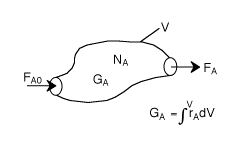
FA0= Entering molar flow rate of A (mol/time)
FA= Exiting molar flow rate of A (mol/time)
GA= Rate of generation(formation) of A (mol/time)
V = Volume (vol e.g. m3)
rA= rate of generation(formation) of A (mole/time•vol)
NA= number of moles of A inside the system Volume V (mol)
t = time (e.g. s)
IN - OUT + GENERATION = ACCUMULATION
\(\mathrm{F_{A0} - F_{A} + \int_{0}^{V} r_{A} dV = \frac{dN_{A}}{dt}}\)
Ethane decomposes to form hydrogen gas and ethene.
Mole Balance on Different Reactor Types
TopThe General Mole Balance Equation (GMBE) applied to the four major reactor types (and the general reaction, A → B):
| Reactor | Differential | Algebraic | Integral | ||
|---|---|---|---|---|---|
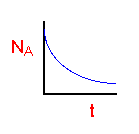
| Batch |
\[\frac{dN_A}{dt} = r_A V\] |
\[ t = \int_{N_{A0}}^{N_A} \frac{dN_A}{r_A V} \] |
|
Derive | |
| CSTR |
\[ V = \frac{F_{A0} - F_A}{-r_A} \] |
Derive | |||
| PFR |
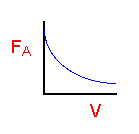
\[ \frac{dF_A}{dV} = r_A \] |
\[ V = \int_{F_{A0}}^{F_A} \frac{dF_A}{r_A} \] |
|
Derive | |
| PBR |
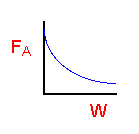
\[ \frac{dF_A}{dV} = r'_A \] |
\[ W = \int_{F_{A0}}^{F_A} \frac{dF_A}{r'_A} \] |
|
Derive |
Self Test Exercises
TopThe following humorous video is set to Randy Newman's song "You've got a friend in me" was made by Professor Lane's 2008 Chemical Reaction Engineering class at the University of Alabama, Tuscaloosa.
The following animation is an excerpt taken from the lecture slides that Professor Fogler uses in his Reactions course, illustrating the importance of "Keeping Up"